Introduction: 3D printing quality traceability is becoming the dividing line for delivery capability
In many companies, 3D printing is still seen as a tool for “making a sample quickly.” But once orders move from single prototypes into real business scenarios involving multiple batches, multiple materials, and cross-functional collaboration, what determines delivery quality is no longer just machine performance. It becomes process design, data recording, engineering judgment, and continuous improvement capability. lantu3D Printing focuses more on full lifecycle management from design blueprint to physical delivery: the front end must understand the model’s intended use and acceptance criteria, the middle stage must select the right process, material, and post-processing route, and the back end must complete inspection, packaging, transportation, after-sales support, and review. The value of a 3D printing quality traceability system is to build a stable connection between all of these links.
Common problems in the industry include incomplete requirement descriptions that lead to repeated model revisions, opaque production queues that cause delivery delays, samples that pass but small-batch consistency that fails, and scattered inspection records that make it difficult to review issues. Solving these problems cannot rely only on “buying more equipment” or “working overtime to catch up.” Instead, companies need a management mechanism that the team can execute, the data can verify, and the customer can understand.
1. Define the object first: turn a technical task into a manageable work order
The first step in a 3D printing quality traceability system is to convert vague requirements into an engineering work order. A work order should at minimum include the application scenario, material, quantity, dimensional tolerance, surface requirements, assembly relationships, post-processing, delivery time, and acceptance method. For functional parts, it is also necessary to specify load direction, operating temperature, contact media, and expected service life. For display parts, the focus should be on color, texture, seam lines, painting, and visible surfaces.
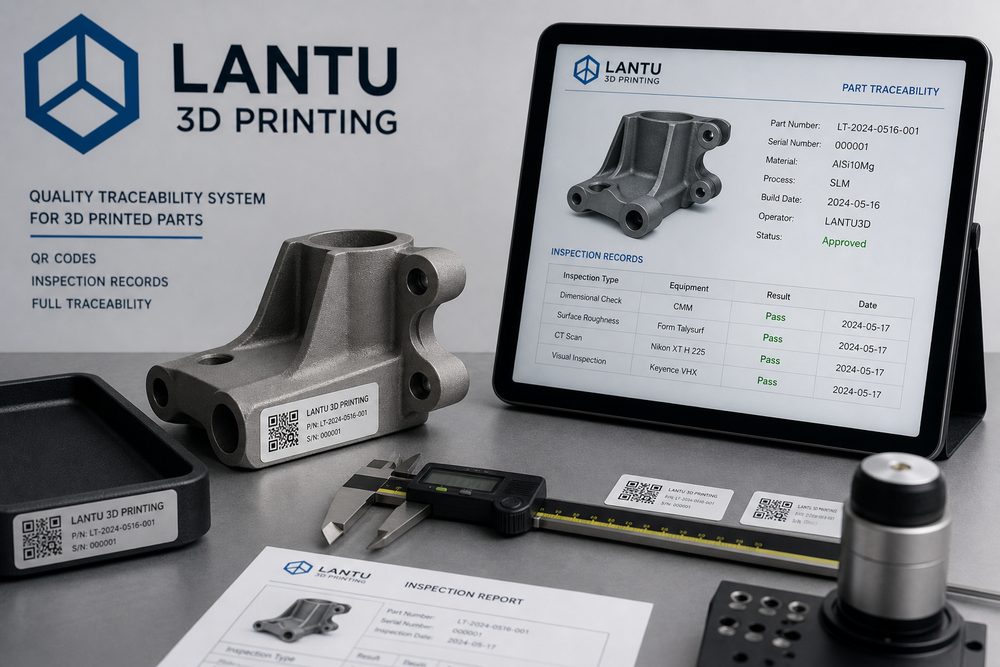
At the execution level, it is recommended to use end-to-end records covering model versions, material batches, machine parameters, and inspection reports as the basic control points. The benefit is that every communication can be tied to clear fields instead of being left in chat logs. For example, when a customer says “the strength needs to be good,” that is not enough to guide production. The engineer must further confirm whether the requirement is bending strength, tensile strength, impact resistance, or thread locking strength. When a customer says “the surface should be smooth,” that also needs to be translated into a specific post-processing plan such as sandblasting, polishing, painting, or electroplating.
In project management, lantu3D Printing typically divides a work order into three layers: the requirement layer records the customer’s goals, the engineering layer records process decisions, and the production layer records equipment, batch, and operating results. Only when these three layers are linked can quality traceability, delivery analysis, and cost review form a closed loop later on.
2. Manage uncertainty with data: key parameters must be recordable and comparable
The advantage of 3D printing is flexibility, but flexibility also brings uncertainty. Different materials, machines, build orientations, layer heights, support strategies, and post-processing methods all affect the final result. Without parameter records, the team can only rely on personal experience. Once personnel change or order volume grows, quality variation expands significantly. Therefore, a 3D printing quality traceability system must be paired with data-based records.
Using actual projects as an example, critical parts should at least retain STL/STEP versions, slicing files, material batch numbers, machine IDs, layer height settings, and post-processing records. These parameters are not collected to create complicated spreadsheets, but to help the team understand under what conditions results remain stable and under what conditions risks increase. For SLS nylon parts, records should include powder batch, refresh ratio, packing density, cooling time, and dye batch. For SLA resin parts, records should include layer height, support contact points, cleaning time, secondary curing time, and surface repair methods. For metal printed parts, attention should also be paid to heat treatment, stress relief, machining allowance, and non-destructive testing requirements.
Data also plays an important role in making customer communication more professional. When a customer wants a shorter lead time or lower cost, the team can explain, based on data, which steps can be optimized and which steps will increase risk. For example, reducing post-processing waiting time may affect coating stability, and overly compressing cooling time may cause deformation in powder-based parts. Explaining trade-offs with data is much easier to win trust than simply saying “it cannot be done.”
3. Move quality control upstream: do not wait until delivery to find problems
Many rework cases in 3D printing projects do not happen at the end of production; they stem from unclear front-end definitions and missing mid-stage checks. An effective management mechanism should move quality control upstream into model review, process review, and first article confirmation. Model review focuses on wall thickness, hole diameter, overhang angle, assembly clearance, and fragile structures. Process review focuses on material selection, build orientation, support placement, batch consistency, and post-processing feasibility. First article confirmation verifies whether the actual part matches expectations.
Using a unique code to trace problems can shorten troubleshooting from “checking the whole batch” to “tracking a single part”. This means the team needs inspection checklists rather than relying entirely on an engineer’s on-the-spot judgment. The checklist can be simple, but it must cover key items: whether the model version is the latest, whether the quoted quantity matches, whether the material can meet the use environment, whether the tolerance matches the process capability, whether post-processing will change dimensions, and whether packaging can protect vulnerable structures.
Moving quality control upstream also reduces communication costs. If an assembly issue is found at the first article stage, adjusting the model and parameters is usually manageable. If the problem is only discovered after the entire batch is completed, the loss expands to materials, machine time, post-processing effort, and delivery reputation. For a platform like lantu3D Printing, which emphasizes the journey from blueprint to delivery, quality is not the final inspection step; it is a design principle that runs through the entire project.
4. Build a closed loop: review, knowledge retention, and continuous optimization
Completing one project does not mean management ends. A mature 3D printing service system will turn every abnormality, complaint, delay, and successful experience into reusable knowledge. A review should not only ask “who is responsible,” but should also ask whether there are gaps in the process: was the requirement recorded accurately, were the process parameters justified, was production scheduling aware of post-processing bottlenecks, were inspection standards communicated in advance, and were customer expectations managed correctly?
It is recommended that each project retain at least four categories of materials: first, requirement and quotation documents, including customer objectives, quantities, materials, and lead time; second, engineering documents, including model versions, DFM suggestions, process routes, and parameters; third, production and quality documents, including machine data, batch information, inspection results, and photos; fourth, delivery and feedback documents, including packaging records, logistics information, customer confirmation, and after-sales issues. The more complete the materials are, the faster similar projects can be decided in the future.
Continuous optimization can start with three indicators: on-time delivery rate, first-pass yield, and the distribution of rework causes. On-time delivery rate reflects scheduling and supply chain capability, first-pass yield reflects engineering and production stability, and the distribution of rework causes reveals process weaknesses. After three to five batches of data accumulation, the team can usually identify recurring issues such as dyeing variation in a certain material, easy breakage in a certain thin-wall structure, or excessive queue time in a certain post-processing step.
Conclusion: turn 3D printing capability into a reproducible service system
A 3D printing quality traceability system is not extra administrative work; it is a necessary foundation for moving 3D printing from “able to make” to “able to deliver reliably.” Equipment determines the upper limit of manufacturing capability, process determines delivery stability, and data determines the speed of continuous improvement. For industry practitioners, future competition will not only be about who has more equipment or lower prices, but about who can understand needs faster, choose processes more accurately, control quality more steadily, and turn every delivery into organizational capability.
lantu3D Printing is positioned not as a simple processing shop, but as an implementation platform connecting design, engineering, manufacturing, post-processing, inspection, and delivery. Building a systematic method around a 3D printing quality traceability system can help customers reduce trial-and-error costs, while also helping service teams improve efficiency, reduce rework, and strengthen traceability. Only by turning experience into process, process into data, and data into improvement can 3D printing truly become a reliable force within enterprise R&D and manufacturing systems.
Submit a model, drawing, image or written notes. Engineers will review material, process, finishing and delivery based on actual use.