Introduction: Equipment investment is not as simple as "buying a printer"
As 3D printing continues to expand in prototyping, low-volume production, and tooling and fixtures, more companies are considering building in-house equipment capacity. Equipment vendors often emphasize speed, precision, and material options, but what truly determines the success of an investment is whether the machine matches the order structure and can generate stable cash flow. Being able to afford equipment does not mean you can use it well. Idle machines, expired materials, insufficient post-processing, and gaps in operator experience can all significantly extend the payback period.
When serving clients, Blueprint3D often encounters two types of needs: one group of companies is suited to building basic prototyping capability internally, absorbing high-frequency, low-complexity parts in-house; another group has highly volatile orders and broad process requirements, making it more suitable to obtain flexible capacity through a platform-based service. The core of equipment investment decisions is to use data to determine the boundary between "in-house production, outsourcing, or a hybrid model."
1. Start with order structure, not equipment specifications
Investment evaluation should begin with parts data from the past 6 to 12 months, including part quantity, material requirements, size range, accuracy requirements, surface finish level, delivery urgency, and reasons for rework. If 80% of demand is concentrated in small resin appearance prototypes, an SLA system may deliver a significant efficiency improvement. If demand is spread across nylon, metal, transparent parts, high-temperature materials, and multiple post-processing workflows, a single machine will struggle to cover the real business needs.
Order frequency is also critical. If there are only a small number of prototypes each month, in-house equipment may be too costly due to low utilization. If there are regular prototyping and fixture needs every week, internal capacity can shorten communication cycles. It is recommended to calculate annual printing-hour demand and compare it with the machine's available hours. A machine can theoretically operate 8,760 hours per year, but after accounting for maintenance, material changes, failures, nesting efficiency, and staffing shifts, actual availability should usually be estimated at 50% to 70%.
2. Total cost of ownership must include hidden expenses
The equipment quotation is only part of the total cost of ownership. A complete cost model should include site space, electricity, air conditioning or ventilation, consumables, support materials, cleaning fluids, powder loss, waste disposal, software licensing, maintenance, spare parts, training, and labor costs. For SLA systems, post-curing boxes, cleaning equipment, resin storage, and waste liquid treatment must all be budgeted. For SLS systems, powder recycling rates, sieving equipment, cooling time, and dust safety management can significantly affect operating costs.
Quality costs must also be considered. During the early stages of new equipment introduction, parameter instability, immature support strategies, and surface finishing rework often occur. If the yield is only 80% in the first three months, then one out of every five parts requires reprinting or repair, increasing both material and labor costs. The investment model should include a ramp-up period rather than assuming the machine will operate at full load and stable output immediately after delivery.
3. The capacity model determines the payback period
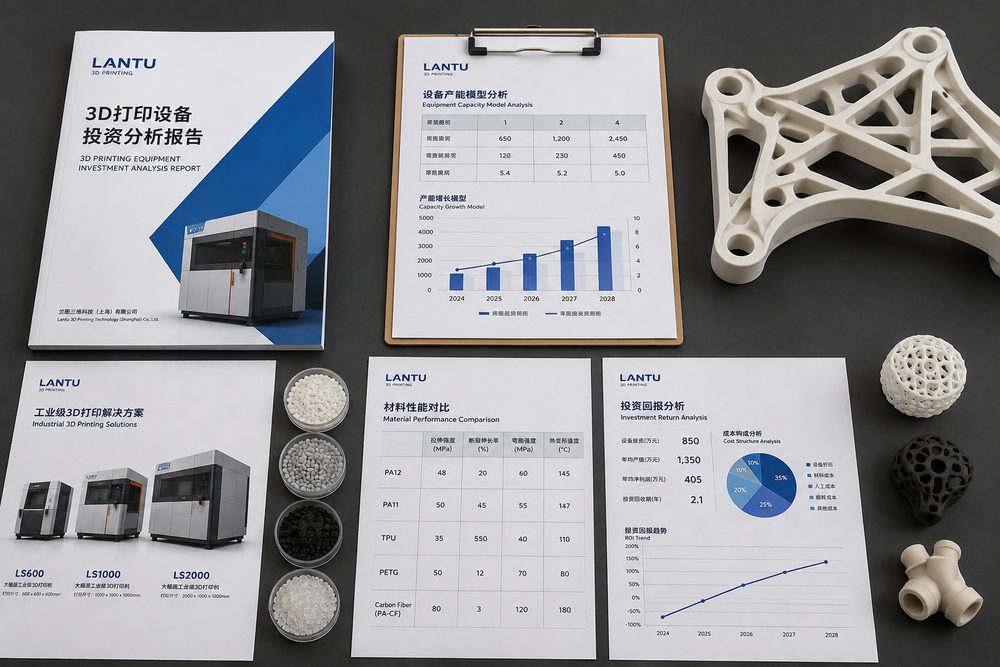
Cash flow payback can be estimated with a simple model: annual outsourced cost that can be replaced minus annual operating cost, divided by initial investment. Suppose a company spends 300,000 RMB per year on outsourced resin prototypes and can replace 70% of that after building in-house capability, saving 210,000 RMB. If annual material, labor, maintenance, and facility costs are 120,000 RMB, the net annual benefit is 90,000 RMB. If the equipment and supporting investment total 450,000 RMB, the static payback period is about five years. If the equipment replacement cycle is short or the business changes quickly, this result may not be ideal.
By contrast, if a company has a stable annual fixture demand of 800,000 RMB and an in-house SLS or FDM farm can replace 50% of that work, with operating costs of 200,000 RMB and a net annual benefit of 200,000 RMB, then an investment of 600,000 RMB would have a payback period of about three years, making it worth deeper evaluation. The key is not to compare only single-part printing costs, but to incorporate utilization, yield, and management costs into the model.
4. In-house capacity and platform collaboration are not mutually exclusive
Many companies mistakenly believe equipment investment has only two options: "buy" or "do not buy." A more mature approach is a hybrid capacity model: internal equipment handles high-frequency, low-risk, confidential, or fast-response parts; external platforms handle projects with special materials, expensive equipment, complex post-processing, or large fluctuations in volume. This improves internal responsiveness while avoiding excessive fixed asset investment for low-frequency needs.
The value of Blueprint3D lies in integrating design, process planning, manufacturing, post-processing, and delivery management. Even if a company builds its own equipment base, it can still rely on a platform for process review, complex material validation, supplemental production capacity, and quality traceability. Equipment investment should not weaken external collaboration; rather, it should help a company understand more clearly which capabilities must be retained internally and which should be obtained through professional partners.
5. A validation checklist before investing
Before formal procurement, it is recommended to complete five validations. First, select 20 to 50 typical historical parts for pilot production and record success rates, labor time, and post-processing difficulty. Second, confirm material supply and safety compliance requirements, especially for resins, powders, and metal powders. Third, arrange for at least two staff members to receive process training to avoid concentrating expertise in a single person. Fourth, establish acceptance criteria including dimensions, surface quality, strength, and delivery records. Fifth, set a three-month pilot target, such as machine utilization, yield, average lead time, and unit cost.
If pilot results show that many parts still require external post-processing, dimensional stability is insufficient, or the equipment is difficult to maintain, procurement should be delayed or the investment scope reduced. The best time to invest in equipment is not when the budget is sufficient, but when demand is stable, process boundaries are clear, and operational capability is ready.
Conclusion
3D printing equipment investment decisions require a comprehensive assessment from four dimensions: capacity modeling, total cost of ownership, cash flow payback, and organizational capability. For companies with stable demand, concentrated processes, and high responsiveness requirements, in-house capacity can improve efficiency. For projects with changing demand, complex materials, or demanding post-processing requirements, platform collaboration offers greater flexibility. Blueprint3D recommends treating equipment investment as part of manufacturing system development rather than as a single-point purchase, and using data and pilot results to determine the most appropriate implementation path.
Submit a model, drawing, image or written notes. Engineers will review material, process, finishing and delivery based on actual use.