Introduction: Packaging Is Part of 3D Printing Delivery Quality
Many 3D printing projects go smoothly during the design, printing, and post-processing stages, only to encounter breakage, scratches, deformation, or missing parts during shipping. Thin-wall structures, clear resin parts, painted exterior parts, long and slender models, and multi-part assembled products place even higher demands on packaging and transportation. Packaging is not simply about boxing items up; it is the final process of delivery quality control.
lantu3D includes packaging and shipping in project lifecycle management for a simple reason: customers judge the final physical item they receive, not the condition it was in when it left the factory. Only by considering part characteristics, transportation routes, and acceptance methods together can last-mile risk be reduced.
1. Classify by Risk, Not by Packing Orders at Random
Before packaging, parts should be graded by risk. Low-risk parts are typically thick-wall nylon parts with no fine sharp edges and only general surface requirements; medium-risk parts include assembled housings, sandblasted parts, dyed parts, and fitted parts with holes; high-risk parts include clear resin parts, long slender rods, thin-wall decorative parts, sharp-cornered models, painted parts, and fully assembled sets.
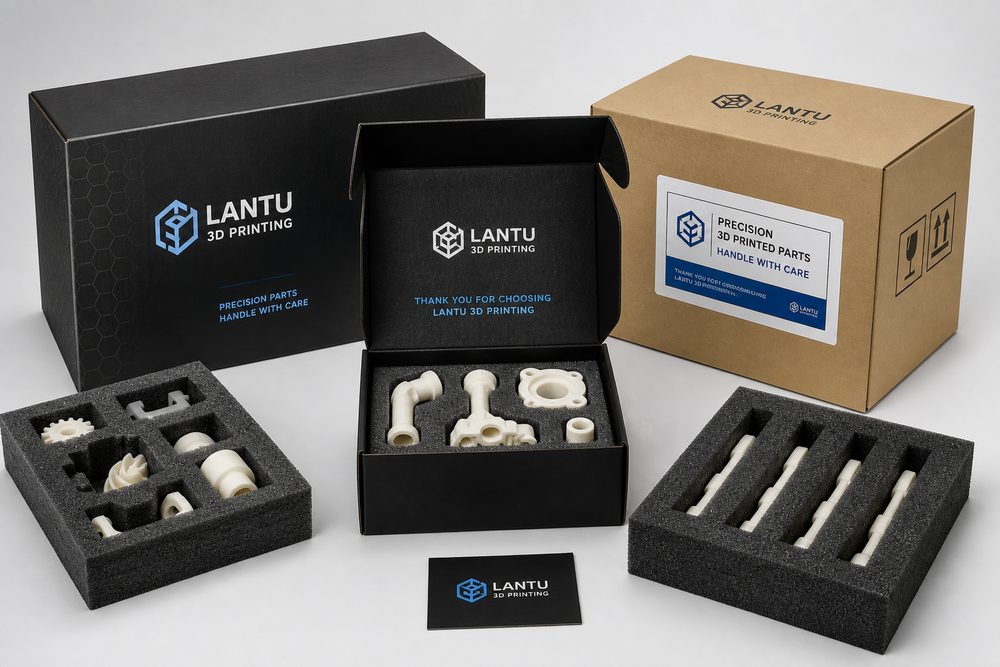
Different risk levels require different packaging strategies. Low-risk parts can be bagged individually with cushioning material; medium-risk parts need sectional fixing to avoid mutual friction; high-risk parts should use foam slots, custom supports, hard outer boxes, or localized protective covers. For long slender parts, prevent bending; for clear parts, prevent scratches; for painted parts, prevent surface sticking and pressure marks.
2. Protective Structures Should Be Designed Around the Load Path
Damage in transit usually comes from compression, impact, vibration, and friction. Packaging design should let the outer box bear the external force, let the cushioning material absorb the impact, and prevent key areas of the parts from taking direct load. For example, models with small column-like structures should avoid having the columns touch the carton walls; housings with snaps should avoid lateral compression on the snaps.
For bulk parts, it is recommended to use compartment trays or numbered bags. Keep at least a cushioning gap between each part to avoid hard contact. For painted parts, first use a non-shedding, non-sticking protective film or soft bag, then place them into the foam structure. If the shipping distance is long, perform a simple drop simulation or shake test to confirm that the packaging will not shift inside the box.
3. Labels and Checklists Make Delivery Traceable
Orders with multiple categories and large quantities are most likely to encounter missing parts, incorrect parts, and customer difficulty identifying components. It is recommended that each packaging unit include the part number, quantity, material, color, or post-processing instructions. For assembled parts, use codes such as A01, A02, and B01, matching the BOM list and drawings.
The packing list should include the order number, batch number, total quantity, quantity per box, and special notes. If the same project is shipped in multiple batches, clearly state the scope of the current shipment and the remaining delivery plan. This not only helps customers with acceptance but also makes it easier to quickly locate which batch, which box, and which type of part is involved if a problem occurs.
4. Special Materials Require Attention to Environmental Factors
Some 3D printing materials are sensitive to temperature, humidity, or light. Photopolymer resin parts may change color after prolonged exposure to strong light; nylon parts may change in dimensions and feel after absorbing moisture; painted parts may show surface imprints in high-temperature environments. Before shipping, choose moisture-proof bags, desiccants, light-blocking packaging, or temperature-controlled shipping based on the material properties.
For functional parts that require assembly or testing, it is recommended to remind customers in the delivery instructions about the resting time after unpacking, cleaning methods, and pre-use inspection items. For example, if nylon parts require precision assembly upon arrival, they may need to be left in a room-temperature environment for a period of time before critical dimensions are checked.
Conclusion: Good Packaging Reduces Loss and Builds Professional Trust
Although 3D printing packaging and shipping management may seem like a back-end step, it directly affects the customer's judgment of project quality. By applying risk classification, load-path protection, label traceability, and environmental control, companies can significantly reduce transit damage and after-sales communication costs. lantu3D emphasizes a complete closed loop from design to physical delivery, and packaging is an indispensable part of that loop.
Submit a model, drawing, image or written notes. Engineers will review material, process, finishing and delivery based on actual use.