Introduction: Equipment Can Be Bought, but Capability Must Be Built Over Time
When many companies enter the 3D printing field, they first focus on what equipment to buy, which materials to choose, and how large the print size should be. But once projects actually begin, they often find that what limits productivity and quality is not the machine, but team capability. Whether a model can be risk-assessed, whether parameters can be reused consistently, whether failure causes can be analyzed, and whether customer requirements can be turned into manufacturing solutions all depend on a talent system.
3D printing talent should not be defined simply as “people who can operate machines.” A mature team needs capabilities in design optimization, materials and processes, equipment maintenance, post-processing, quality inspection, and project management. In its service workflow, lantu3D Printing emphasizes cross-role collaboration, because every step from blueprint to physical part requires professional judgment.
1. Build a Role Competency Model: Define the Professional Boundaries of Each Role
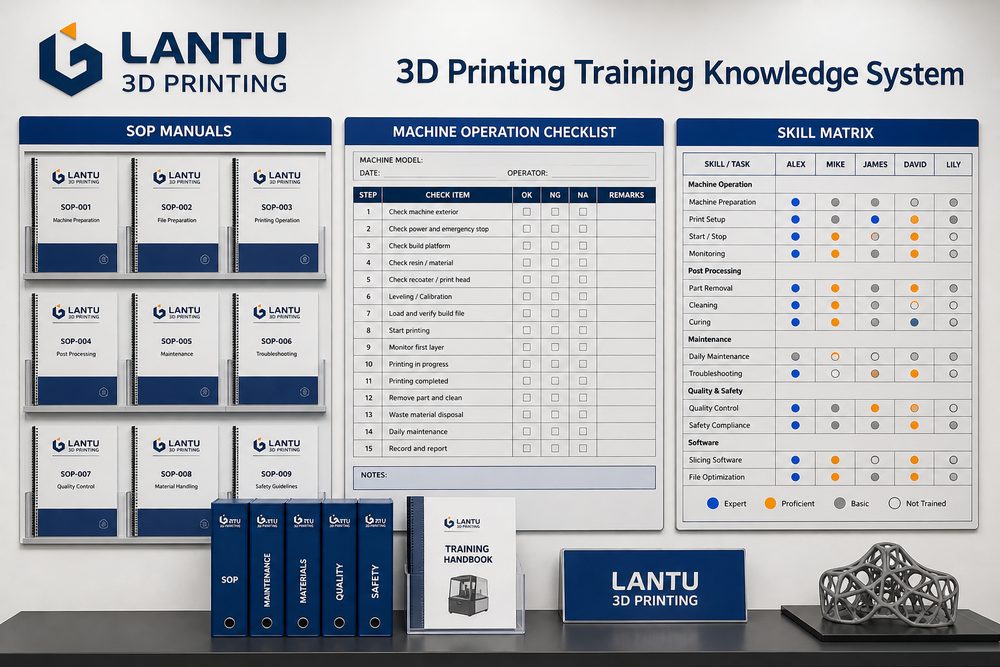
Companies should first define job competencies rather than broadly requiring someone to “understand 3D printing.” Design engineers need to master DFAM principles, minimum wall thickness, support effects, assembly clearance, and model repair. Process engineers need to understand material properties, build orientation, parameter windows, failure modes, and the impact of post-processing. Equipment staff need to be skilled in calibration, maintenance, fault diagnosis, and safe operation. Quality inspectors need to be familiar with dimensional measurement, appearance standards, functional verification, and record archiving.
Sales staff and project managers also need basic technical understanding. Otherwise, unreasonable promises may be made during requirement discussions regarding accuracy, lead time, or material performance. The clearer the role model, the more targeted the training plan, and the easier it is to evaluate whether a new employee can independently handle projects.
2. Training Path: From Operating Procedures to Engineering Judgment
Training can be divided into four stages. The first stage is safety and basic operation, including material storage, machine startup, cleaning and maintenance, waste disposal, and emergency shutdowns. The second stage is standard workflow, covering file checking, slicing, nesting, printing, post-processing, and inspection records. The third stage is defect analysis, using cases such as warping, delamination, clogged holes, support marks, and dimensional deviation to understand root causes. The fourth stage is solution design, enabling staff to recommend materials, processes, and delivery routes based on customer needs.
Each stage should include hands-on tasks and evaluation criteria. For example, a new employee should not only know that an SLS part needs powder removal, but also be able to judge whether the internal cavity has powder evacuation risks. They should not only know how to place supports, but also be able to explain the effect of supports on cosmetic surfaces and post-processing. The goal of training is to build engineering judgment, not to memorize parameter tables.
3. Knowledge Retention: Move Experience Out of Individuals and Into the Organization
Experience in the 3D printing industry is often highly fragmented. One engineer may know that a certain thin-walled part tends to warp, and one post-processing technician may know that a certain resin needs an extra primer layer before spraying paint. But if this experience stays only in individual minds, the team will repeat the same mistakes as it grows. Knowledge management should include material sheets, process sheets, defect databases, case libraries, and frequently asked questions.
It is recommended that every failed project undergo a brief review: what happened, which delivery metrics were affected, what the possible root causes were, what corrective actions were taken, and whether the results improved. The review does not need to be lengthy, but it should be searchable and reusable. Over time, the knowledge base will improve quotation accuracy, reduce rework, and help new employees get up to speed faster.
4. Cross-Department Collaboration: Turn Technical Capability into Customer Value
3D printing projects span sales, engineering, production, post-processing, quality inspection, and logistics. If information breaks down at any point, delivery will be affected. For example, a customer requests A-level appearance quality, but production treats the part as a functional component; engineering changes the print orientation, but quality inspection still measures against the old reference; post-processing finds clogged holes, but no feedback is sent back to the design stage to add powder evacuation holes.
Team building requires clear handoff points: requirement confirmation, process review, first article approval, abnormality feedback, and delivery review. Project management tools and platform-based systems can prevent information from relying on verbal transfer. This is exactly where lantu3D Printing is positioned: connecting these steps so that engineering capability is ultimately reflected in a stable, transparent, and traceable customer experience.
Conclusion: 3D Printing Team Capability Determines Long-Term Competitiveness
3D printing talent training should expand from machine operation to engineering judgment, quality awareness, and project collaboration. Through role models, phased training, knowledge retention, and cross-department workflows, companies can reduce dependence on individual experts and build repeatable delivery capability. Equipment is a production tool; team capability is the core asset that turns design into reliable physical parts.
Submit a model, drawing, image or written notes. Engineers will review material, process, finishing and delivery based on actual use.