Introduction: 3D Printing Knowledge Management Is Evolving from Experience Management to Data-Driven Operations
Many capabilities in the 3D printing industry come from experience: how to reduce support marks on a certain resin, how to prevent warping in PA12 thin-wall parts, how to prepare layer lines before painting, and which areas of a metal part should retain machining allowance. If this know-how exists only in the minds of a few engineers, recurring projects will keep running into the same problems.
1. Define Measurable Business Scenarios and Boundary Conditions
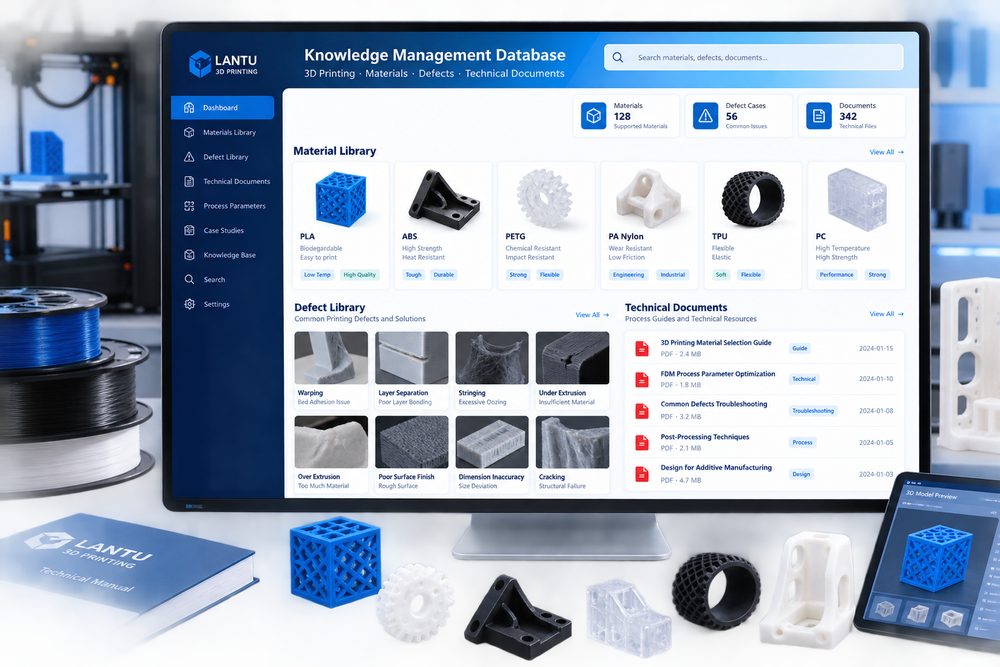
System building can start with a materials and process parameter library. For each material, record the application scenarios, typical wall thickness, recommended layer height, thermal deformation risk, surface finish, post-processing compatibility, and historical failure cases. For example, SLA-type ABS-like resins are suitable for appearance and assembly verification, but they should be used cautiously when long-term load is expected.
2. Break Down Risks and Delivery Responsibilities by Process Stage
The second category of knowledge is a design rules library. Consolidate minimum wall thickness, hole compensation, thread handling, support avoidance, drain holes, assembly clearances, and post-processing allowances into searchable entries, and pair them with visual examples. Each rule should include a recommended range and the reason behind it.
3. Embed Parameters, Data, and Acceptance Criteria into the System
The third category is a defect and review case library. Every print failure, rework, or customer complaint should be documented with the observed issue, root cause, corrective action, and preventive recommendations. Common defects such as warping, delamination, support breakage, cleaning residue, color deviation, and orange peel in painting can all be turned into illustrated reference cards.
4. Continuous Improvement: From Single-Order Reviews to Organizational Know-How
Knowledge management also requires an operating mechanism. It is recommended to use a fixed template for project retrospectives at the end of each job: project background, material and process, key parameters, issues and resolutions, customer feedback, and reusable conclusions. The technical lead should review the knowledge base monthly and remove outdated content.
Conclusion
When knowledge can be recorded, searched, and updated, 3D printing companies can reduce their dependence on a few individuals’ experience. A knowledge management system improves quotation accuracy, shortens training cycles, reduces repeated mistakes, and makes service quality more consistent.
Submit a model, drawing, image or written notes. Engineers will review material, process, finishing and delivery based on actual use.