Introduction: Quality That Is Not Recorded Cannot Be Proven
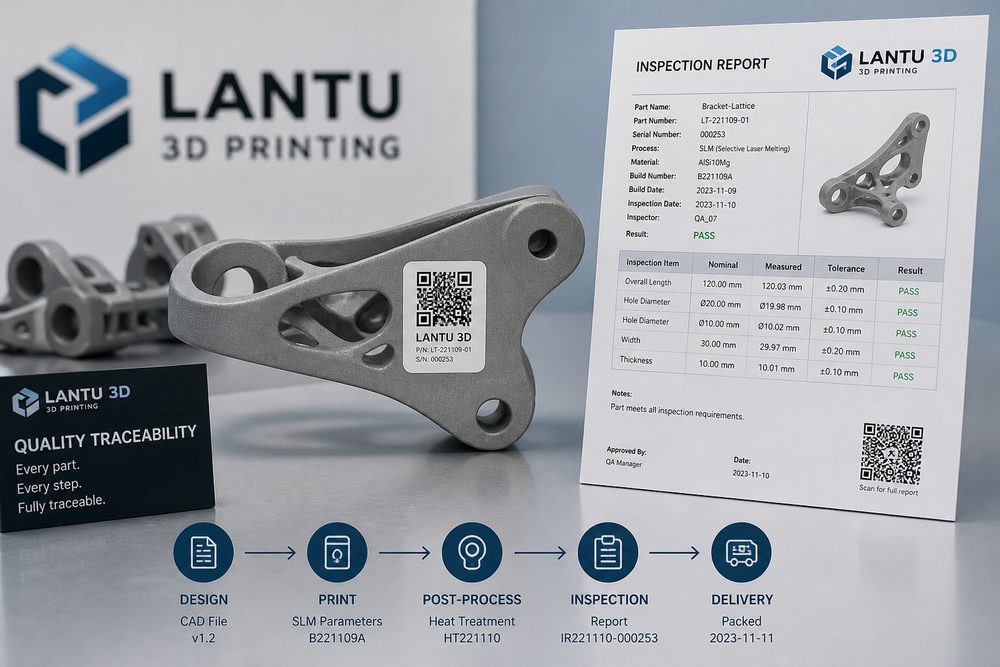
When a customer asks which powder lot was used for a part, on which machine it was built, whether it underwent heat treatment, and how the critical dimensions were inspected, if the team can only rely on memory, that means the quality system is still at the handcraft workshop stage. 3D printing involves many process variables, and model versions and parameter adjustments change frequently, so a traceability system is especially important for functional parts, medical models, automotive fixtures, and aerospace-related applications.
1. Traceability Starts with the Model Version
Quality traceability should not begin with printing, but with the design input. You need to record the original model, repair version, support version, slicing file, and customer approval file. Any changes to thickness reinforcement, hole compensation, chamfer modifications, or build orientation may affect the outcome. It is recommended that each project be assigned a unique number and that the model version be linked to the production lot so that any later issue can be traced back to the exact data set.
2. Material and Machine Records Are the Core of the Process
Material records should include the supplier, lot number, opening date, storage conditions, powder refresh ratio, or resin usage time. Machine records should include the machine ID, maintenance status, key parameters, ambient temperature and humidity, and any abnormal alarms. For metal printing, you must also record the build plate, shielding gas atmosphere, heat-treatment furnace batch, and subsequent machining information. These data do not all need to be shown to customers, but they must be searchable internally.
3. Post-Processing and Inspection Must Not Become a Black Box
Support removal, powder cleaning, sandblasting, dyeing, painting, polishing, heat treatment, and assembly all change the state of a part. Each operation should record the operator, time, process window, and any abnormal handling. Inspection records should clearly define the sampling ratio, measuring tools, critical dimensions, appearance standards, and disposition result. For high-requirement projects, photos, scan reports, or dimensional tables can also be attached.
4. Traceability Data Must Support Improvement
A traceability system is not meant to pile up forms; it is meant to help the team identify patterns. For example, dimensional deviation may increase after a certain machine has run continuously for more than a specific number of hours, a certain material lot may show poor color consistency, or a certain thin-wall structure may have a higher breakage rate during transportation. Only when traceability data are used for review does the quality system become part of production capability.
Conclusion
The essence of 3D printing quality traceability is to build an evidence chain from design to delivery. It makes problems traceable, responsibilities distinguishable, and experience reusable, while also giving customers greater confidence in complex manufacturing services. Blueprint3D promotes delivery transparency in 3D printing through a full-process management philosophy, and a traceability system is a key enabler.
Submit a model, drawing, image or written notes. Engineers will review material, process, finishing and delivery based on actual use.