Introduction: Capacity Planning is the Core Competitiveness of 3D Printing Service Enterprises
As 3D printing technology transitions from prototyping to mass production, capacity planning and scheduling optimization have become core challenges facing 3D printing service enterprises. Unlike traditional manufacturing processes (such as injection molding and CNC), 3D printing possesses unique process characteristics: long production time per unit (ranging from several hours to tens of hours), equipment utilization rates affected by various factors, high material switching costs, and complex post-processing procedures. These characteristics make traditional capacity planning methods difficult to apply directly, necessitating the establishment of a capacity management system specifically tailored to the characteristics of 3D printing.
Excellent capacity planning can significantly increase equipment utilization rates (from 40%-50% to 70%-80%), shorten lead times (from 5-7 days to 2-3 days), and reduce unit costs (by 20%-30%). Conversely, improper capacity planning can lead to equipment idling, order delays, customer churn, and reduced profits. This article systematically introduces capacity planning methods, scheduling optimization strategies, and digital management tools for 3D printing service enterprises, providing a practical guide for establishing an efficient operational system.
Analysis of Characteristics and Constraints of 3D Printing Production Capacity
3D printing capacity planning first requires understanding its unique process constraints. Time constraints are the most fundamental: the print time for each part ranges from tens of minutes to tens of hours, and the printing process cannot be interrupted (except for urgent orders). This means that the time granularity for capacity planning should be measured in hours, rather than the minute-level of traditional manufacturing. Equipment constraints include equipment quantity, equipment types (different processes, sizes, and materials), equipment status, and the multi-tasking capability of the equipment (a few processes support simultaneous printing of multiple parts).
Material constraints are equally important. Different materials (such as PLA, ABS, nylon, resin, metal powder) require different printing equipment and process parameters, and material switching involves cleaning time and material waste. For small-batch, multi-variety orders, frequent material switching significantly reduces effective production capacity. Post-processing constraints are a bottleneck unique to 3D printing: processes such as support removal, surface treatment, heat treatment, and quality inspection are required after printing, and the capacity of these processes often limits overall output. In particular, the capacity of post-processing steps requiring manual operation (such as support removal and sanding) is difficult to rapidly increase through equipment investment.
Order characteristic constraints include order batch size, delivery lead time requirements, priority, and technical complexity. Rush orders (24-48 hour delivery) can disrupt normal scheduling; large-volume orders (dozens to hundreds of pieces) may occupy equipment for several days; and high-complexity orders (requiring special supports, special materials, or special post-processing) can reduce equipment utilization. Understanding the nature of these constraints is a prerequisite for formulating sound capacity planning. It is recommended that enterprises establish a constraint matrix to quantify the impact of each constraint on capacity and identify critical bottleneck processes.
Demand Forecasting Methods and Capacity Requirement Calculation
Demand forecasting is the foundation of capacity planning. Demand for 3D printing services exhibits significant volatility and uncertainty: new product development cycles lead to concentrated demand surges, exhibition events cause short-term spikes in demand, and customer project delays result in sudden demand cancellations. Therefore, demand forecasting requires combining multiple methods: historical data analysis (analyzing order volumes, order types, and seasonal fluctuations over the past 12 months), customer interviews (understanding future project plans of key customers), market trend analysis (industry reports and competitor dynamics), and sales funnel analysis (tracking the conversion probability of potential orders).
Capacity requirement calculation involves converting forecasted demand into equipment time requirements. The basic formula is: Capacity Requirement (hours) = Σ (Order Quantity × Per-piece Print Time × Process Coefficient). The process coefficient accounts for factors such as material changeovers, equipment setup, and reprinting due to failures, typically ranging from 1.2 to 1.5. Calculations should be performed separately by equipment type, as the capacity of different equipment is not interchangeable. For example, capacity requirements for SLA equipment cannot be used interchangeably with those for FDM equipment. Additionally, post-processing capacity requirements must be calculated to ensure that post-processing capacity aligns with printing capacity.
Capacity requirements should also take the capacity buffer into account. Due to the relatively high failure rate of 3D printing (5%-15%) and the uncertainty of urgent orders, it is recommended to reserve a 20%-30% capacity buffer. This buffer can be established as "hot standby" capacity for accepting urgent orders or used for equipment maintenance and process optimization. Overcommitting capacity (promising 100% utilization) is one of the primary causes of delivery delays. Establishing a scientific model for calculating capacity requirements helps enterprises accurately assess their order acceptance capacity, thereby avoiding overcommitment or capacity waste.
Scheduling Optimization Strategies: From Experience-based Scheduling to Intelligent Scheduling
Scheduling optimization involves arranging the sequence and timing of order production under capacity constraints to maximize equipment utilization and minimize delivery lead times. Traditional manual scheduling relies on the experience of dispatchers, which is inefficient and difficult to optimize. Modern scheduling methods employ operations research optimization algorithms, such as genetic algorithms, simulated annealing, and particle swarm optimization, to find approximate optimal solutions under complex constraints. The objective functions of scheduling optimization typically include: minimizing total completion time (Makespan), minimizing average delivery delay, maximizing equipment utilization, and minimizing the number of changeovers.
Order combination strategy is a core technique in scheduling optimization. Combining small parts for printing (Nesting) can significantly improve equipment utilization. For example, the printing time for SLA machines is primarily determined by the number of layers and the exposure time per layer, and is largely independent of the quantity of parts (within the platform capacity). Therefore, combining multiple small parts for printing can drastically reduce the per-part cost. Combined printing requires consideration of part height (determined by the tallest part), material consistency (must be the same material), and support interference (sufficient clearance must be maintained between parts). Modern slicing software (such as PreForm and Chitubox) supports automatic layout features to maximize platform utilization.
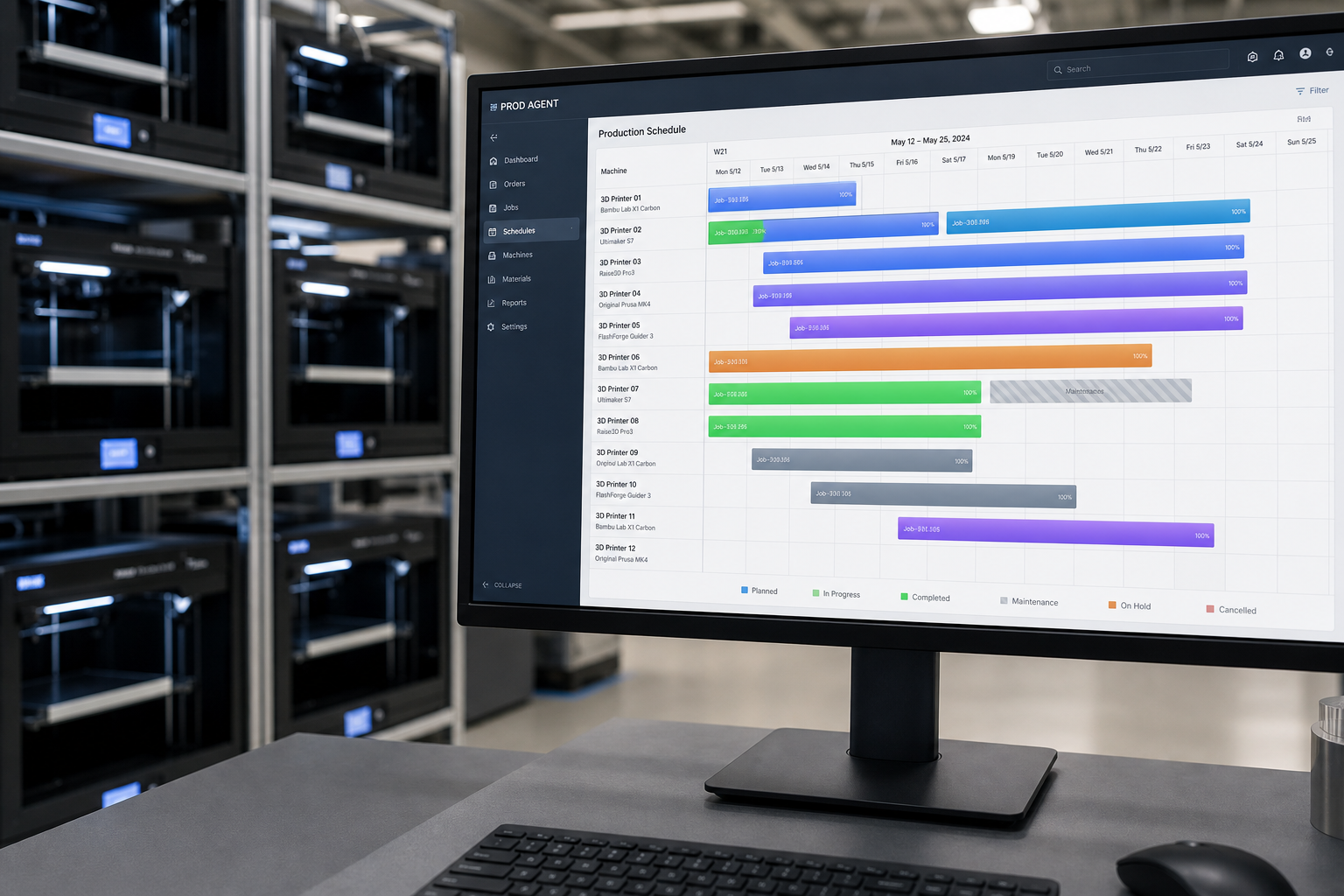
Priority management is another key aspect of scheduling optimization. Order priority should be comprehensively determined based on delivery urgency, customer importance, order profit margin, and strategic value. The ABC classification method can be adopted: Class A orders (high priority, such as urgent orders and key customer orders) are scheduled with priority; Class B orders (medium priority) are scheduled normally; Class C orders (low priority, such as sample orders) are scheduled flexibly. Scheduling should possess dynamic adjustment capabilities; when urgent orders are inserted, the system can automatically reschedule and evaluate the impact on existing orders. Establish a visual scheduling dashboard (such as a Gantt chart) to display equipment status and order progress in real time, facilitating quick decision-making by dispatchers.
Practical Methods for Improving Equipment Utilization
Equipment utilization rate is a core metric for capacity planning. The theoretical utilization rate of 3D printing equipment can exceed 90% (operating 24 hours), but actual utilization rates are typically only 40%-60%. The key to improving utilization lies in reducing equipment idle time. Idle time includes: order waiting time, material changeover time, equipment debugging time, reprinting time due to failures, and maintenance time. Through refined management, these idle times can be significantly reduced.
Continuous printing strategies are an effective method for improving utilization rates. By optimizing order batching and layout, equipment is enabled to run as continuously as possible, reducing idle time. For resin printing equipment, a continuous "print-wash-cure" workflow can be established to minimize waiting between processes. For FDM equipment, automatic filament feeding systems can be set up to avoid interruptions during overnight printing due to material shortage. Preventive maintenance is equally important; through regular maintenance (such as nozzle cleaning, rail lubrication, and platform calibration), downtime caused by unexpected failures can be reduced. Establish an equipment maintenance plan to arrange maintenance during order gaps or off-peak hours.
Bottleneck equipment management is crucial for enhancing overall production capacity. According to the Theory of Constraints (TOC), system output is determined by the bottleneck process. Identifying bottleneck equipment (typically post-processing or specific process equipment) and prioritizing the enhancement of its capacity can significantly boost overall output. Management strategies for bottleneck equipment include: prioritizing the assignment of highly skilled operators, ensuring sufficient material supply, reducing the number of changeovers, and considering outsourcing certain processes. For non-bottleneck equipment, utilization rates can be appropriately reduced to avoid the accumulation of excessive work-in-progress (WIP). Establish an equipment capacity monitoring system to track the utilization rate, failure rate, and output volume of each piece of equipment in real-time, providing data support for capacity optimization.
Digital Tools and Intelligent Management Systems
Digital management tools are essential support for modern capacity planning. Traditional Excel spreadsheets and manual scheduling are no longer sufficient to meet the management requirements of complex orders. Modern 3D printing management systems (such as MakerOS, 3DPrinterOS, AMFG) offer end-to-end management capabilities covering order reception, quoting, scheduling, production, and delivery. These systems typically integrate online quoting engines (automatically calculating prices based on part volume, material, and process), intelligent scheduling engines (automatically optimizing schedules considering multiple constraints), equipment monitoring modules (displaying equipment status, remaining time, and fault alarms in real-time), and customer service portals (allowing customers to view order progress, download files, and make online payments).
Data collection and analysis is the core value of digital management. By collecting equipment operational data (printing time, material consumption, failure rates, energy consumption), order data (types, batch sizes, profit margins, on-time delivery rates), and customer data (order frequency, preferences, satisfaction), multi-dimensional analysis models can be established. Analysis can uncover hidden capacity issues: abnormally high failure rates for certain order types, significantly lower efficiency in specific equipment compared to the average, and abnormal fluctuations in order volume during specific time periods. Data-driven decision-making is more scientific and timely than experience-based decision-making.
Artificial intelligence technology is being applied in the field of capacity planning. Machine learning models can forecast order demand, predict the probability of printing failures, and optimize scheduling plans based on historical data. For example, by analyzing historical printing data, AI models can predict the print time and failure probability for new parts, providing more accurate inputs for scheduling. Reinforcement learning algorithms can simulate different scheduling strategies and learn optimal scheduling strategies through trial and error. Although AI applications are still in the early stages, their potential is immense. It is recommended that enterprises monitor relevant technological developments and attempt to adopt them when conditions allow.
Outsourcing Strategy and Building Flexible Capacity
Relying solely on in-house equipment to meet fluctuating demand is not cost-effective, as meeting peak demand requires significant investment in equipment, which then sits idle during off-peak periods. Outsourcing is an effective strategy for building flexible capacity. Orders that exceed in-house capacity, or process requirements that in-house equipment cannot satisfy (such as special materials, oversized dimensions, or ultra-tight schedules), can be outsourced to partners. The key to an outsourcing strategy lies in establishing a reliable network of outsourcing suppliers and formulating outsourcing management processes.
The selection of outsourcing suppliers should comprehensively consider production capacity, quality, delivery time, price, and cooperativeness. It is recommended to select 3-5 suppliers to establish long-term cooperative relationships rather than sourcing on an ad-hoc basis. Long-term cooperation helps build mutual trust; suppliers are willing to reserve production capacity for partners and prioritize scheduling in emergency situations. The outsourcing management process includes: outsourcing decision criteria (when to outsource and how much to outsource), supplier allocation rules (allocation based on supplier expertise), outsourcing order tracking (ensuring on-time delivery), outsourcing quality inspection (avoiding quality risks), and outsourcing cost accounting (ensuring the economic viability of outsourcing).
Another direction for elastic capacity is the shared manufacturing model. By joining 3D printing shared manufacturing platforms (such as 3D Hubs, Xometry, MakeTime), idle capacity can be rented out, or external capacity can be rented to supplement insufficient in-house capacity. Shared manufacturing platforms reduce the transaction costs of outsourcing through standardized interfaces and automated quoting. For small and medium-sized 3D printing service providers, the shared manufacturing model is an effective tool for balancing capacity and demand. However, it should be noted that shared manufacturing platforms typically charge a commission of 15%-30%, and customer relationships are owned by the platform; long-term dependence may weaken one's own customer base. Therefore, shared manufacturing should serve as a supplementary measure rather than a primary business model.
Conclusion: Capacity planning is the operational core of 3D printing services
Capacity planning and scheduling optimization are core competencies for 3D printing service enterprises to achieve scalable and profitable operations. Through scientific calculation of capacity requirements, intelligent scheduling optimization, refined equipment management, and the application of digital tools, enterprises can significantly improve equipment utilization rates, shorten delivery cycles, and reduce operating costs, thereby gaining a competitive edge in a fierce market.
In the future, with the increasing application of 3D printing in mass production, capacity planning will face greater challenges: larger order batches, shorter delivery lead times, and higher quality requirements. New technologies such as automated scheduling, AI forecasting, Flexible Manufacturing Systems (FMS), and cloud manufacturing will be gradually applied to 3D printing capacity management. It is recommended that enterprises continuously monitor these technological trends and gradually establish a digital and intelligent capacity management system, shifting capacity planning from experience-driven to data-driven, and from passive response to proactive optimization, thereby laying a solid operational foundation for the long-term development of the enterprise.
Submit a model, drawing, image or written notes. Engineers will review material, process, finishing and delivery based on actual use.