Introduction: The Technological Revolution in Mold Manufacturing
Molds are known as the "Mother of Industry" in the manufacturing sector and are widely used in processes such as injection molding, die casting, and stamping. Traditional mold manufacturing processes are complex, have long lead times, and incur high costs; particularly for molds with complex cooling systems, machining is extremely difficult. The emergence of 3D printing technology has brought revolutionary changes to mold manufacturing. Through 3D printing, it is possible to manufacture complex cooling systems unachievable by traditional processes, rapidly produce mold inserts, and significantly shorten mold trial cycles, injecting new vitality into the mold manufacturing industry.
Design Principles of Conformal Cooling Channels
Conformal Cooling Channels are one of the most valuable applications of 3D printing in mold manufacturing. Cooling channels in traditional molds are typically manufactured using drilling processes, which can only create straight or simple curved channels that cannot closely follow the surface of the mold cavity, resulting in low cooling efficiency, uneven cooling, and significant product deformation. In contrast, conformal cooling channels can be designed to closely follow the surface of the mold cavity according to its shape, achieving uniform and efficient cooling. The design principles of conformal cooling include: channel layout (determining the channel path based on the cavity shape); channel cross-section (circular, elliptical, teardrop-shaped, etc., affecting cooling efficiency and manufacturing difficulty); channel diameter (usually 6-12mm, balancing cooling effect and printing difficulty); channel spacing (usually 15-30mm, ensuring uniform cooling); and connection design (inlet and outlet positions, channel connection methods). Through scientific conformal cooling design, mold cooling efficiency can be improved by 30-60%, the product molding cycle can be shortened by 20-40%, and product dimensional accuracy can be significantly improved.
3D Printing Mold Manufacturing Process
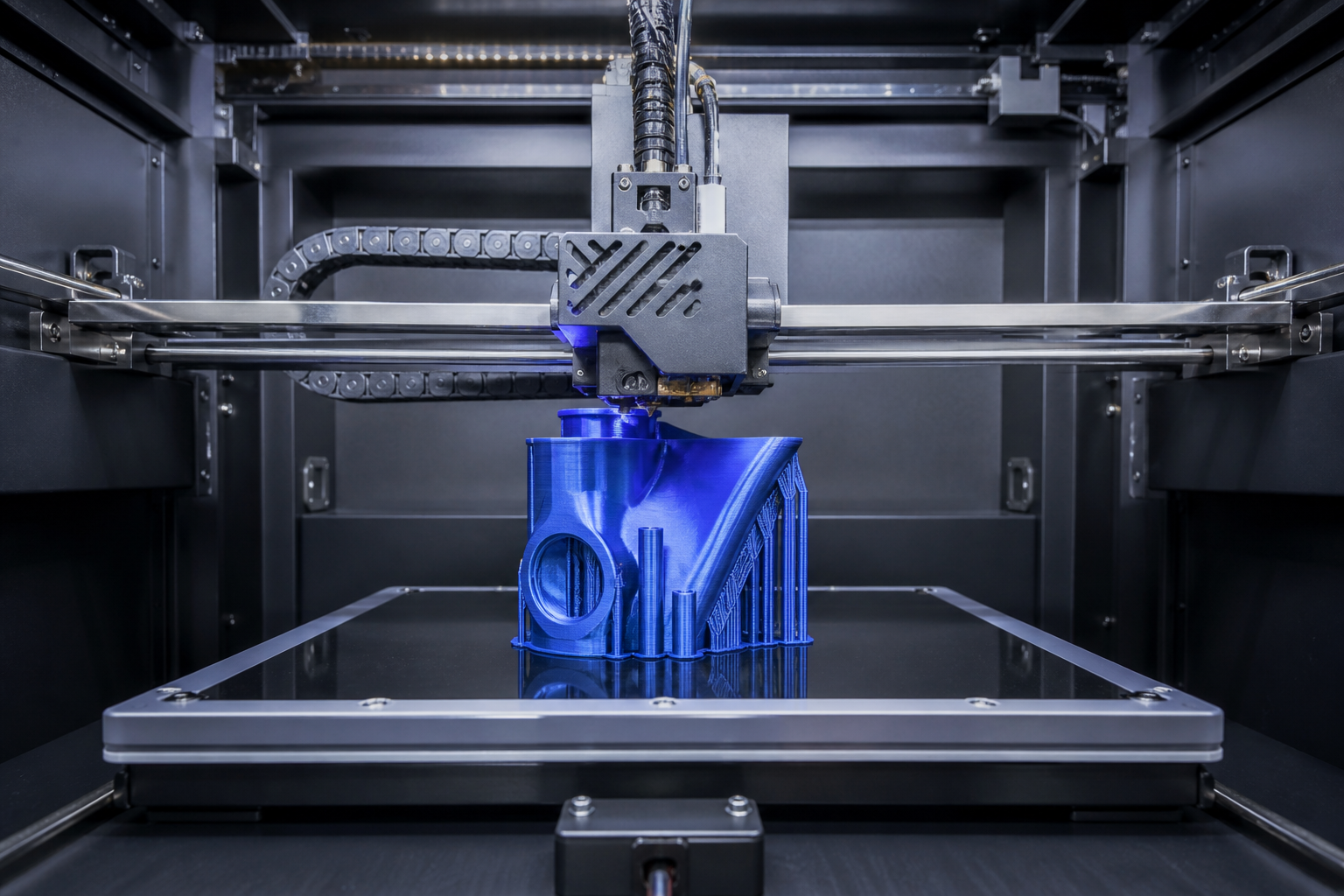
3D printed molds primarily utilize metal 3D printing processes, including SLM (Selective Laser Melting), DMLS (Direct Metal Laser Sintering), and EBM (Electron Beam Melting). The manufacturing workflow includes: mold design (CAD modeling, conformal cooling design, structural optimization); process planning (part splitting, support design, print orientation selection); 3D printing (metal powder melting, layer-by-layer deposition); post-processing (support removal, heat treatment, surface finishing); and assembly and debugging (assembly with mold base, cooling channel connection, mold trial adjustment). Material selection for 3D printed molds is crucial, and common mold steel materials include: H13 (hot-work tool steel, suitable for die-casting molds and hot forging molds); S136 (stainless steel, suitable for injection molds and molds for transparent parts); and 18Ni300 (maraging steel, high strength and high toughness, suitable for high-demand molds). Material selection requires considering factors such as the mold's working conditions (temperature, pressure, corrosivity), service life requirements, and adaptability to the printing process.
Rapid Manufacturing of Mold Inserts
Mold inserts are components within a mold that are prone to wear or require frequent replacement. Traditional manufacturing of inserts requires separate machining processes, resulting in long lead times and high costs. 3D printing technology enables the rapid manufacturing of complex mold inserts, significantly shortening the production cycle. For instance, for inserts with complex textures or intricate structures, traditional machining requires Electrical Discharge Machining (EDM) or electrochemical machining, taking days or even weeks; in contrast, 3D printing can complete the task within hours and is capable of fabricating complex structures unattainable by traditional processes. Application scenarios for 3D printed inserts include: complex texture inserts (leather grain, wood grain, geometric patterns); fine structure inserts (thin walls, deep cavities, micro-features); conformal cooling inserts (integrated conformal cooling channels); venting inserts (porous structural design to improve venting); and wear-resistant inserts (using wear-resistant materials or surface treatments). Rapid manufacturing of inserts not only shortens the mold production cycle but also reduces insert costs and enhances mold maintenance efficiency.
Strategies for Shortening the Mold Trial Cycle
Mold trial is a critical step in mold manufacturing, used to verify the correctness of mold design and product quality. The traditional mold trial process includes: mold manufacturing completion → mold trial → identifying problems → modifying the mold → re-trial → until qualified. This process usually requires multiple iterations, taking weeks or even months. 3D printing technology can significantly shorten the mold trial cycle: rapid mold manufacturing (3D printing molds is 50-70% faster than traditional machining); rapid mold modification (after discovering design issues, the mold or inserts can be quickly reprinted without re-machining); parallel mold trials (printing multiple design schemes simultaneously for parallel testing); pre-validating design (pre-validating mold design through mold flow analysis software to reduce the number of trials). Furthermore, a "soft tooling" strategy can be adopted: first use 3D printing to manufacture low-cost soft molds for trial production to verify product design; once the product design is finalized, use traditional processes to manufacture formal hard tooling for mass production. This strategy can significantly reduce mold trial costs and risks, and accelerate product time-to-market.
Mold Life and Performance Optimization
Mold life is a key indicator in mold manufacturing. The life of 3D printed molds is typically lower than that of traditionally machined molds, primarily due to issues such as anisotropy, internal porosity, and high surface roughness in 3D printed materials. Methods to improve the life of 3D printed molds include: material optimization (selecting printing materials suitable for mold applications, optimizing material heat treatment processes); process optimization (optimizing printing parameters, reducing internal defects, increasing density); post-processing strengthening (Hot Isostatic Pressing (HIP) treatment, surface coating, nitriding); structural optimization (avoiding stress concentration, adding fillet transitions, optimizing wall thickness distribution); and control of operating conditions (avoiding overloading, controlling working temperature, regular maintenance). Although the absolute life of 3D printed molds may not match that of traditional molds, their comprehensive economic benefits remain significant in application scenarios such as small batch production, rapid trial production, and complex structures. With the continuous advancement of 3D printing technology, the issue of mold life is gradually improving, and some 3D printed molds are already able to achieve over 80% of the life of traditional molds.
Cost-Benefit Analysis
The cost structure of 3D printed molds differs from that of traditional molds. Traditional mold costs primarily include: material costs, machining costs (CNC, EDM, grinding machines, etc.), labor costs, and overhead costs. 3D printed mold costs primarily include: equipment depreciation, material costs, post-processing costs, and labor costs. For simple molds, traditional manufacturing holds a cost advantage; for complex molds (especially those with conformal cooling channels), the cost advantage of 3D printing is significant. According to industry data, for molds with complex cooling systems, 3D printing can reduce manufacturing costs by 30-50% and shorten the manufacturing cycle by 50-70%. Furthermore, the indirect benefits brought by 3D printed molds are significant: shortening time-to-market, reducing mold trial costs, improving product quality, and lowering scrap rates. Therefore, when evaluating the economics of 3D printed molds, it is necessary to comprehensively consider direct costs and indirect benefits to conduct a life cycle cost analysis.
Typical Application Cases
3D printed molds have been applied in multiple industries. Case 1: An auto parts manufacturer adopted 3D printing to manufacture injection molds integrated with conformal cooling channels. The mold cooling efficiency increased by 40%, the product molding cycle shortened from 45 seconds to 28 seconds, annual production capacity increased by 60%, and mold manufacturing costs decreased by 35%. Case 2: An electronics enterprise used 3D printing to manufacture mold inserts for mobile phone cases. The inserts featured complex textures and venting structures. Traditional machining required 15 days, while 3D printing took only 2 days, with better texture quality. Case 3: A medical device enterprise adopted 3D printing to manufacture molds for transparent parts. The surface quality of the mold cavity reached a mirror finish, the product transparency met medical standards, and the mold manufacturing cycle was shortened from 8 weeks to 2 weeks. These cases fully demonstrate the immense value of 3D printing in mold manufacturing. With the continuous maturation of technology and the sustained decline in costs, the application scope of 3D printed molds will further expand, becoming an important process choice for mold manufacturing.
Future Development Trends
3D printing mold technology is still developing rapidly. Future trends include: material advancements (developing 3D printing materials specifically for molds to enhance strength, hardness, wear resistance, and corrosion resistance); process improvements (increasing printing accuracy, surface quality, and density to reduce post-processing workload); hybrid manufacturing (combining the advantages of 3D printing and traditional machining—3D printing complex structures combined with traditional machining for precision mating surfaces); intelligent design (leveraging artificial intelligence and generative design to automatically optimize conformal cooling channel designs); and standardization systems (establishing design, process, inspection, and performance standards for 3D printed molds). With the development of these technologies, 3D printing for molds will gradually shift from its current auxiliary role to become one of the mainstream processes in mold manufacturing, bringing more profound transformations to the mold manufacturing industry.
Conclusion
3D printing is bringing revolutionary changes to the mold manufacturing industry. Through innovative applications such as conformal cooling channel design, rapid manufacturing of mold inserts, and shortened mold trial cycles, 3D printing can significantly improve mold manufacturing efficiency, reduce manufacturing costs, and enhance mold performance. Although 3D printed molds still face some challenges in terms of service life, precision, and cost, these issues are being gradually resolved through continuous technological advancements and the accumulation of application experience. Mold manufacturing enterprises should actively embrace 3D printing technology, explore application scenarios suitable for their own businesses, and enhance their competitiveness. In the future, 3D printing will inevitably become an indispensable and important process in mold manufacturing, driving the entire industry to develop in a more efficient, flexible, and intelligent direction.
Submit a model, drawing, image or written notes. Engineers will review material, process, finishing and delivery based on actual use.