Overview of PEEK Material Properties
PEEK (Polyether Ether Ketone) is a semi-crystalline high-performance thermoplastic polymer. Since its commercialization by the British company Victrex in 1978, it has been hailed as the "crown" of engineering plastics. Its glass transition temperature (Tg) is 143°C, and its melting point (Tm) is 343°C. The long-term service temperature can reach above 250°C, and the short-term service temperature can even reach 300°C. PEEK possesses excellent chemical resistance; except for concentrated sulfuric acid, it is almost insoluble in any common solvent, and it can maintain stable performance in harsh environments such as acids, alkalis, oils, and steam.
In terms of mechanical properties, PEEK has a tensile strength of approximately 90-100 MPa and an elastic modulus of approximately 3.6-4.1 GPa. Although lower than that of metallic materials, its specific strength (strength/density) rivals that of many metals. PEEK has a density of only 1.3 g/cm³, approximately half that of aluminum alloys and one-sixth that of steel, giving PEEK parts significant advantages in lightweight applications. Furthermore, PEEK possesses excellent wear resistance, radiation resistance, and biocompatibility, making it an ideal material for high-end fields such as aerospace, medical devices, and the electrical and electronics industries.
PEEK 3D Printing Process Selection
PEEK材料的高熔点和高粘度特性对3D打印工艺提出了特殊要求。目前可用于PEEK打印的工艺主要包括:PEEK线材的FDM/FFF打印、PEEK粉末的SLS打印、以及PEEK细丝的FDM打印。其中,FDM工艺是最常用的PEEK打印方法,但需要打印机具备高温打印能力——喷嘴温度需要达到400-450°C,热床温度需要达到120-160°C,甚至需要配备腔室加热系统(80-120°C)以防止零件翘曲和开裂。
The SLS process utilizes PEEK powder for printing. Due to the uniform heating environment provided by the powder bed itself, SLS-printed PEEK parts typically exhibit superior dimensional stability and lower residual stress. However, the preparation of PEEK powder is challenging and costly, and the investment required for SLS equipment is significantly higher than that for FDM equipment. In recent years, companies such as EOS and 3D Systems have introduced SLS systems specifically designed for PEEK printing, offering more options for high-end applications. Another emerging process is the FFF printing of PEEK, which utilizes PEEK filaments on specially designed high-temperature 3D printers to achieve print quality comparable to that of injection-molded parts.
Detailed Explanation of Process Parameter Optimization
Optimizing FDM printing parameters for PEEK materials is crucial for ensuring successful printing. First is the nozzle temperature; the recommended printing temperature for PEEK typically ranges from 380°C to 420°C, depending on the specific printer model and PEEK material brand. Temperatures that are too low can lead to insufficient melting and poor interlayer adhesion, while temperatures that are too high may cause material degradation, bubbling, and unpleasant odors. Next is the bed temperature, which is recommended to be set between 120°C and 160°C to ensure good adhesion of the first layer to the build plate and to minimize part warping.
Control of the chamber temperature is particularly important for PEEK printing. Since the crystallization process of PEEK is highly sensitive to the cooling rate, if cooling is too rapid, the material will form an amorphous structure, resulting in reduced mechanical properties; if cooling is too slow, production efficiency decreases. The ideal chamber temperature should be controlled between 80-120°C to maintain a uniform temperature for the parts during printing and avoid thermal stress concentration. Furthermore, the printing speed should be appropriately reduced, typically recommended not to exceed 30-50mm/s, with the layer thickness controlled at 0.2-0.3mm, to ensure sufficient melting of the material and interlayer bonding.
Post-processing and Crystallinity Control
Post-processing of PEEK materials has a significant impact on their final properties. Since PEEK is a semi-crystalline polymer, its crystallinity directly determines the material's mechanical properties, chemical resistance, and thermal resistance. As-printed PEEK parts typically exhibit low crystallinity (approximately 15%-25%) and require annealing to increase crystallinity (up to 35%-45%). The typical annealing process involves holding at 200-250°C for 1-4 hours, followed by slow cooling (furnace cooling) to room temperature. Rapid cooling (quenching) leads to the formation of an amorphous state; while transparency improves, chemical resistance and thermal resistance significantly decrease.
In addition to annealing, PEEK parts can undergo post-processing such as machining, sanding, and polishing. Due to the relatively high hardness of PEEK, carbide tools must be used during machining, accompanied by sufficient cooling. For applications requiring high surface quality, sandpaper sanding (progressively transitioning from 400 grit to 2000 grit) can be applied, followed by polishing. PEEK can also undergo secondary processing through methods such as laser engraving, ultrasonic welding, and bonding, providing more possibilities for complex assemblies.
Breakthroughs in Medical Applications
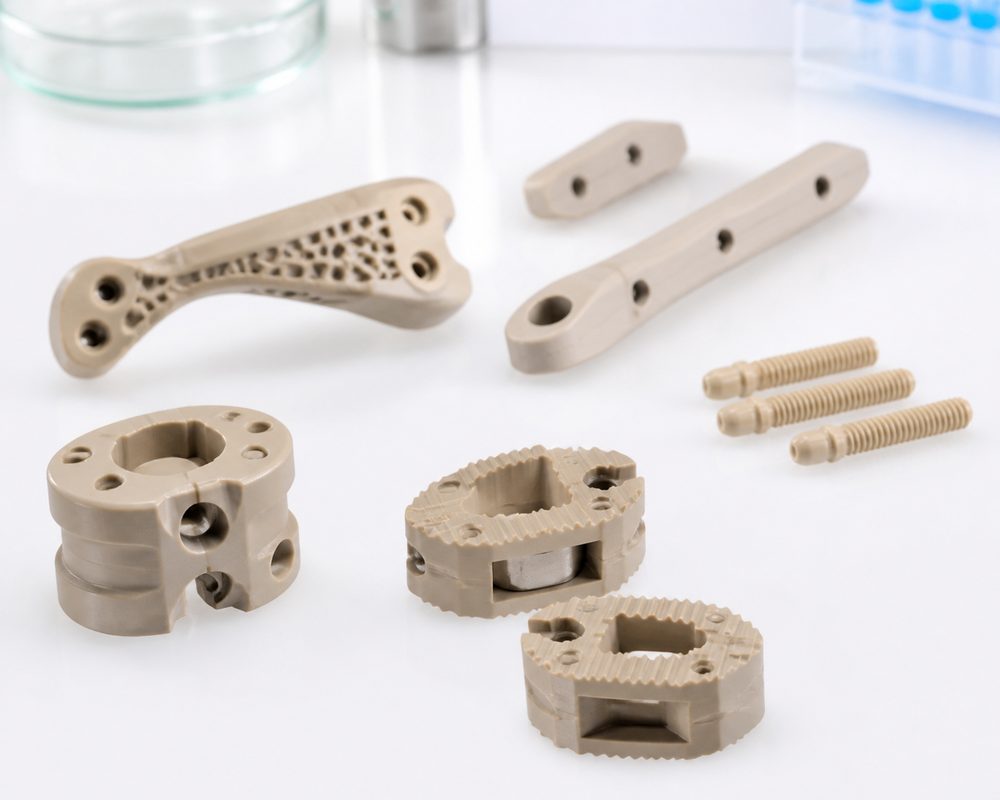
The application of PEEK materials in the field of medical devices is one of its most promising directions. PEEK possesses excellent biocompatibility (ISO 10993 certified), and its elastic modulus (approximately 3.6 GPa) is closer to that of human cortical bone (approximately 10-20 GPa) and far lower than that of titanium alloys (approximately 110 GPa); therefore, when used as orthopedic implants, it can effectively avoid the "stress shielding" effect and promote bone tissue healing. Currently, PEEK is widely used to manufacture implants such as spinal fusion cages, bone plates, bone screws, and skull repair patches.
3D printing technology offers unprecedented freedom for the application of PEEK in the medical field. Through 3D printing, fully personalized implants can be customized based on patient CT/MRI data to achieve perfect anatomical matching. For example, in cranioplasty, 3D-printed PEEK cranial implants can precisely match the patient's skull defect, not only restoring the protective function of the skull but also maintaining excellent aesthetic outcomes. In spinal surgery, 3D-printed PEEK interbody fusion cages can be designed with optimal shapes and porous structures based on the patient's anatomy to promote bone ingrowth and enhance the fusion success rate.
Aerospace and Industrial Applications
In the aerospace industry, PEEK materials are used to manufacture non-load-bearing structural components surrounding aircraft engines, cable insulation, and fuel lines due to their lightweight nature, high-temperature resistance, and chemical corrosion resistance. Airbus and Boeing have already employed components made from PEEK in multiple aircraft models. 3D printing technology enables the rapid manufacturing and iteration of these parts, significantly shortening the development cycle. For instance, PEEK brackets for aircraft seats manufactured via 3D printing not only reduce weight by 40% but also achieve structural optimization unachievable through traditional manufacturing.
In the industrial sector, PEEK material is used to manufacture various wear-resistant and corrosion-resistant components, such as pump bodies, valves, seals, and bearings. PEEK's wear resistance is superior to that of many metals; its coefficient of friction under dry friction conditions is only 0.3-0.4, with an extremely low wear rate. In the chemical industry, PEEK components can replace stainless steel and Hastelloy, operating long-term in strong acid and alkali environments while offering lighter weight and lower costs. In the electronics industry, PEEK's excellent electrical insulation properties and high-temperature resistance make it an ideal material for manufacturing chip carriers, connectors, and insulators.
Material Selection and Market Comparison
When selecting PEEK materials, in addition to considering basic mechanical properties, attention must also be paid to the brand and specifications of the material. Currently, major PEEK material suppliers in the market include Victrex (UK), Solvay (Belgium), Evonik (Germany), and others. The PEEK products from these companies each have distinct characteristics; for instance, Victrex's PEEK 450G is a general-purpose grade material suitable for most applications; PEEK 150XF is a wear-resistant grade material containing wear-resistant additives such as PTFE; and PEEK HT is a high-temperature grade material with a long-term service temperature reaching 300°C.
In addition to PEEK, there are several other similar high-performance polymers worth considering. PEI (Polyetherimide, trade name Ultem) has slightly lower heat resistance than PEEK, but it is also lower in cost and has lower printing difficulty; PPSU (Polyphenylsulfone) exhibits excellent hydrolysis resistance and toughness, making it suitable for medical device applications; PEKK (Polyetherketoneketone) has a slightly lower melting point than PEEK, but a slower crystallization rate, which facilitates interlayer bonding during the printing process. When making a selection, a comprehensive evaluation based on specific application requirements is necessary to choose the most suitable material.
Future Development Trends
The future development of PEEK material 3D printing will revolve around three directions. First is material modification, which involves adding fillers such as carbon fiber, glass fiber, and graphene to further enhance the mechanical properties, thermal conductivity, or electrical conductivity of PEEK. For example, carbon fiber reinforced PEEK (CF/PEEK) can achieve a tensile strength of 150-200 MPa and an elastic modulus of 20-30 GPa, approaching the performance level of aluminum alloys. Second is process innovation, involving the development of specialized equipment better suited for PEEK printing, such as FDM printers equipped with laser heating and PEEK-specific SLS systems. Finally, there is application expansion; with the reduction of PEEK printing costs and the optimization of performance, its applications in fields such as consumer electronics, automotive, and energy will continue to expand.
Furthermore, the recycling and sustainable development of PEEK materials are also important directions for the future. PEEK materials inherently possess excellent chemical resistance and thermal stability; theoretically, they can be recycled and reused multiple times without significant performance degradation. Developing efficient PEEK recycling processes not only helps reduce material costs but also reduces environmental pollution, aligning with the global trend of sustainable development. As 3D printing technology continues to mature and the cost of PEEK materials gradually decreases, PEEK 3D printing is expected to become one of the mainstream technologies in high-end manufacturing within the next decade.
Submit a model, drawing, image or written notes. Engineers will review material, process, finishing and delivery based on actual use.