
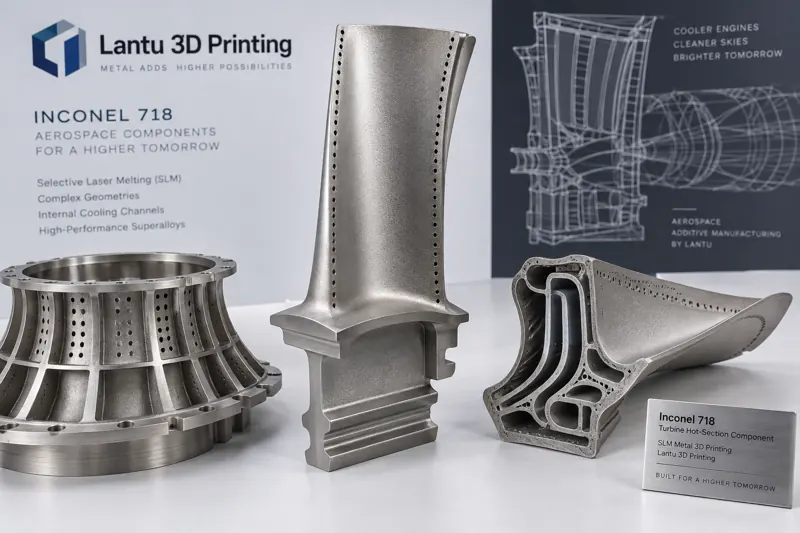
Introduction: Why Hot-Section Components Need Additive Manufacturing
Aero-engine hot-section components operate at high temperatures, have complex profiles, are produced in small batches, and require urgent delivery. With traditional processes, material utilization from forging blank to finished part is only about 15% to 20%, meaning large amounts of expensive alloy are machined into chips. Inconel 718 has high yield strength and severe work hardening, causing rapid tool wear and high labor hours per part during machining. SLM (Selective Laser Melting) builds parts layer by layer, increasing material utilization to more than 60%, while also enabling integrated forming of conformal cooling channels and lightweight structures. It is therefore an ideal path for weight reduction and rapid development of hot-section components.
1. Powder Characteristics Are the Starting Point of the Process
Inconel 718 is extremely sensitive to oxygen content. Gas-atomized spherical powder is recommended, with a particle size distribution of 15 to 53 microns, oxygen content controlled below 300 ppm, and flowability (Hall flow rate) better than 18 seconds per 50 grams. The proportions of niobium, molybdenum, and titanium in the powder directly affect Laves phase precipitation; when niobium segregation exceeds the threshold, low-melting-point eutectics can easily form at grain boundaries and become the origin of hot cracking. Before loading into the machine, sieving should be performed (a 53-micron sieve is recommended), along with moisture and apparent density testing, and metallographic reference samples should be retained.
2. Parameter Trade-Offs in the Laser Process Window
Hot-section load-bearing parts generally use a combination of laser power of 250 to 400 W, spot size of 80 to 120 microns, scanning speed of 800 to 1200 mm/s, and layer thickness of 30 to 50 microns. Volumetric energy density is recommended to be controlled at 55 to 75 J/mm³: too little energy causes lack of fusion and increased porosity, while too much energy leads to overburning, element loss, and intensified spatter. For the scanning strategy, a 67 to 73 degree interlayer rotation combined with checkerboard partitioning is recommended to reduce unidirectional heat accumulation. Preheating the build plate to 80 to 120°C can significantly suppress cracking.
3. Engineering Control of Hot Cracking and Residual Stress
During the final stage of solidification, Inconel 718 is prone to Laves phase precipitation along grain boundaries, accompanied by microcracks, especially at corners and abrupt transitions in thickness. In engineering practice, three measures are used: first, increase scanning speed and reduce layer energy to narrow the melt-pool thermal gradient; second, use gradient build-plate preheating and slow cooling for large parts; third, after forming, apply solution treatment (980 to 1020°C) plus two-step aging (720 and 620°C), allowing the Laves phase to dissolve back and strengthening phases to precipitate uniformly while releasing more than 80% of residual stress. Wire-cut separation after stress reduction is more stable than direct quenching.
4. Post-Processing and Dimensional Stability
Support removal should preferably be performed by wire cutting or EDM to avoid introducing microcracks through mechanical impact. Surface treatment uses sandblasting plus polishing to control Ra within 3.2 microns. Internal defects should be inspected by industrial CT (resolution no greater than 20 microns) and metallographic sampling, with requirements that volumetric porosity be below 0.5% and the maximum defect pore diameter be less than 200 microns. Load-bearing flow channels also require fluorescent penetrant inspection and pressure leak testing.
5. Quality Qualification from Prototype to Engine Installation
Hot-section components must undergo mechanical property matrix verification: tensile strength, yield strength, and elongation at room temperature and 650°C, as well as 100-hour rupture strength at 650°C. The microstructure must meet the requirements of dual-phase strengthening. For critical parts, first-article qualification and process capability evaluation (CPK not less than 1.33) must be carried out, and a complete traceability chain covering powder batches, process parameters, CT images, and mechanical results must be established before entering small-batch engine installation verification.
Conclusion
SLM of Inconel 718 is not simply a matter of melting powder; it is a systematic engineering process spanning powder quality control, parameter windows, stress-relief heat treatment, and engine-installation qualification. Only by mastering the two main threads of Laves phase control and residual stress control can additive manufacturing for aero-engine hot-section components advance from being printable to being trusted for installation.
Submit a model, drawing, image or written notes. Engineers will review material, process, finishing and delivery based on actual use.