
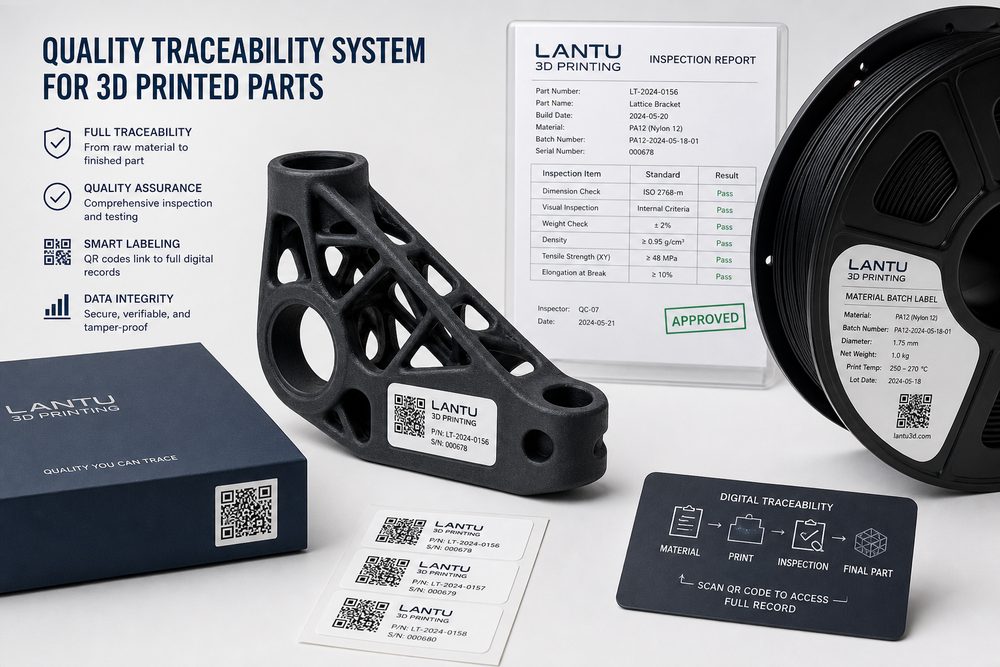
Introduction: Without traceability records, quality problems can only be judged from memory, making it difficult for enterprises to pinpoint the cause in materials, equipment, parameters, or operations
How to build a 3D printing quality traceability system so every part can state its origin clearly is not a single technical issue, but a system engineering effort that spans customer requirements, model data, process selection, production scheduling and delivery, and after-sales review. For a full-lifecycle management platform like Blueprints 3D, which covers everything from blueprint/design to physical delivery, the key is not whether something can be printed, but whether uncertain requirements can be turned into a manufacturable process that is planned, traceable, and deliverable. A common mistake among industry practitioners is to focus only on equipment parameters while ignoring order batches, verification checkpoints, quality records, and cross-department information flow, ultimately leading to rework, delays, or uncontrolled costs. This article focuses on 3D printing quality traceability systems and, combined with small-batch manufacturing scenarios, provides an actionable framework.
1. The traceability starting point is the model version
The quality of 3D printing depends first on the input file. You should record the customer's original file, the repaired file, the production file, and the change notes. Any wall-thickness increase, hole-position compensation, support adjustment, or part-splitting treatment should generate a version record. Otherwise, when the customer reports a dimensional or assembly issue, it becomes difficult to determine whether the cause is a design change, a file error, or production variation.
2. Material and equipment records should be sufficient, but not excessive
A traceability system does not need to be complex at the beginning, but key fields must not be missing: material name, batch number, opening date, machine ID, printing date, layer height, orientation, and post-processing parameters. For powder-bed processes, you should also record the ratio of fresh powder and the number of recycling cycles; for vat photopolymerization processes, you should record the resin batch, cleaning-fluid condition, and curing time. These fields can cover most quality analysis scenarios.
3. Inspection data should correspond to critical characteristics
Not every dimension needs to be fully inspected. The focus should be on critical characteristics that affect assembly, strength, and appearance. CTQ items can be marked on drawings or inspection sheets, such as hole spacing, snap-fit thickness, mounting-surface flatness, and thread depth. The inspection method should also be standardized so that different personnel do not use different reference bases, which would make the data incomparable.
4. Anomaly feedback loops are more important than the records themselves
After a defect is found, the defect type, quantity, possible cause, corrective action, and preventive measures should be recorded. Common defects such as warping, layer delamination, porosity, support marks, color variation, and dimensions that are too large or too small can all be built into a cause library. The value of a traceability system is not post-event accountability, but making the next batch more stable.
Conclusion: Turning experience into repeatable delivery capability
The core of how to build a 3D printing quality traceability system so every part can state its origin clearly is to turn scattered experience into standardized actions: requirements have an entry point, judgments have evidence, processes have records, anomalies have feedback loops, and results can be reviewed. Enterprises are advised to start with a high-frequency product category or a typical customer project, first establish the minimum viable process, and then gradually expand into a material library, process library, quoting rules, and quality traceability system. What Blueprints 3D focuses on is precisely this continuous capability-building from design blueprint to physical delivery, making 3D printing not just a prototyping tool, but a reliable node for rapid validation, small-batch production, and on-demand manufacturing for enterprises.
Submit a model, drawing, image or written notes. Engineers will review material, process, finishing and delivery based on actual use.