Introduction: The Cost of 3D Printing Services Is Often Consumed in Communication
When an enterprise customer submits a 3D printing request, it may seem that they only need to upload a model, choose a material, and wait for a quote. In reality, however, the order often involves intended use, accuracy, strength, appearance, post-processing, lead time, and acceptance method. If this information is scattered across chat logs, email attachments, and temporary phone calls, the manufacturing side cannot quickly assess risk, and the customer cannot promptly understand why the price changed, why the model needs revision, or why the delivery date was adjusted. Once communication costs spiral out of control, the overall project experience deteriorates even if the unit manufacturing price is not high.
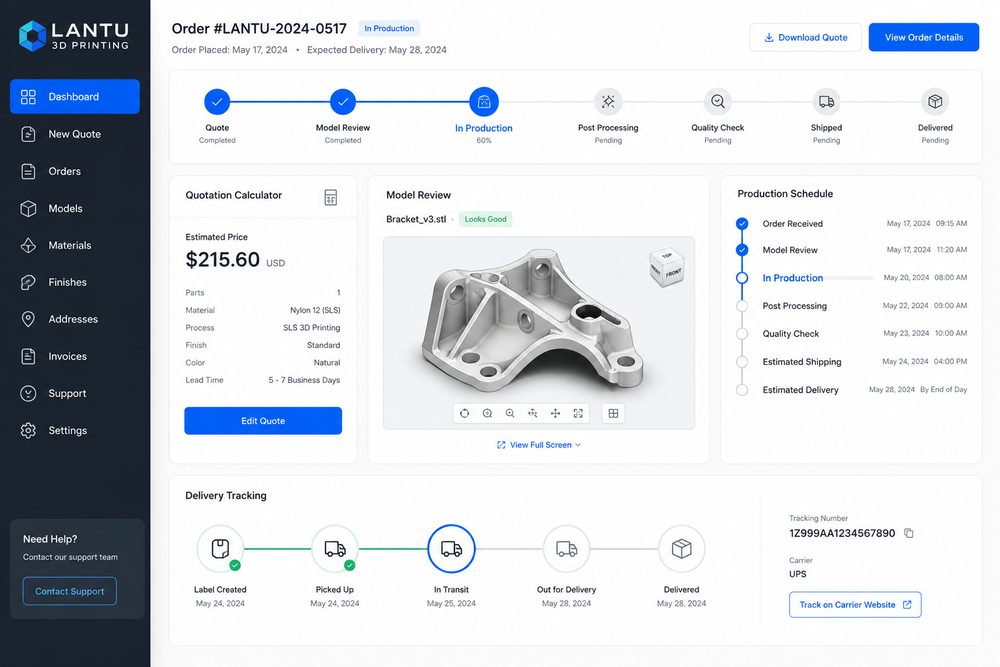
lantu3D focuses on end-to-end capability from design blueprints to physical delivery. A digital closed loop is not simply about launching a quotation form. It connects model review, process selection, cost breakdown, production progress, quality inspection, and delivery feedback so that every decision is recorded and every change is traceable. For enterprise customers working across multiple departments, this closed loop can reduce repeated explanations, lower rework risk, and establish a stable template for future repeat orders.
1. Quotation Stage: Making Price Match Clear Process Assumptions
3D printing quotes are typically affected by material volume, machine time, nesting efficiency, post-processing, inspection requirements, and lead time. If customers only see a total price, it is hard to judge whether the price is reasonable, and it is also difficult to make trade-offs when the budget changes. A digital quotation should clearly communicate the key assumptions, such as whether SLA photopolymer resin or SLS nylon is used, whether the layer thickness is 0.05 mm or 0.1 mm, whether sandblasting, dyeing, polishing, painting, or machining is included, and whether a dimensional report or expedited scheduling is required.
During quotation discussions, lantu3D also presents model risks at the same time: walls thinner than the recommended value, holes requiring compensation, large flat surfaces that may warp, enclosed cavities that are difficult to depowder, and metal parts that require support removal and heat treatment. This allows customers to adjust the model before quoting, rather than discovering problems after production begins. For multiple material options for the same part, the digital system can also show differences in cost, lead time, and performance, helping customers make engineering-based choices between budget and functional requirements.
2. Technical Review: Turning Hidden Risks into Confirmed Items
Many 3D printing orders fail not because the equipment is incapable, but because the requirements are not fully expressed. For example, a customer may ask for “high strength” without specifying the load direction, request a “good surface” without defining acceptable layer lines, or ask for “high dimensional accuracy” without providing critical tolerances. The technical review stage must turn these vague descriptions into actionable items: load-bearing locations, assembly relationships, appearance grade, critical dimensions, post-processing method, and acceptance criteria.
A digital closed loop can solidify the review conclusions into the order record. The model version, revision suggestions, customer confirmation time, reason for material selection, and risk warnings should all be retained. If changes occur later, the system should record the differences before and after the change, as well as the impact on price and lead time. lantu3D uses this approach to reduce misunderstandings caused by verbal communication and ensure that customers, engineers, production teams, and quality inspectors all work from the same information.
3. Scheduling Stage: Transparent Progress Is More Effective Than Frequent Follow-Ups
The delivery cycle of 3D printing depends not only on printing time, but also on nesting wait time, material preparation, cooling, post-processing, inspection, and packaging. If customers cannot see the process, they tend to ask repeatedly; if the manufacturing side has to respond manually every time, production rhythm is disrupted. Digital progress tracking should clearly separate key milestones such as “technical review completed,” “waiting for scheduling,” “printing,” “cooling,” “post-processing,” “quality inspection,” and “ready to ship.”
For batch orders, scheduling information should also be linked to machines and production batches. If a batch of parts is delayed due to rework during post-processing, the system should be able to explain the scope of impact instead of giving a vague notice of delay. lantu3D emphasizes transparent progress so that customers can arrange their projects earlier and internal teams can reduce repetitive communication. Transparency does not mean exposing every production detail; it means delivering the information needed for customer decisions in a timely manner.
4. Quality and Delivery: Bringing Acceptance Criteria into the Order Flow in Advance
If acceptance criteria are only discussed after delivery, disputes are almost inevitable. A digital order should confirm dimensional inspection, appearance standards, packaging requirements, and delivered documentation before production starts. For functional parts, critical dimension sampling records can be agreed upon. For display parts, color deviation, surface texture, and the acceptable repair range can be specified. For metal parts, the delivery state after heat treatment, support removal, sandblasting, or machining can be defined.
lantu3D decides whether to provide a dimensional report, material statement, post-processing record, or assembly recommendations based on project risk. At delivery, customers receive not only the finished part, but also the quality information related to the order. In this way, even if repeat orders, volume expansion, or material changes are needed later, decisions can be made quickly based on existing records. Once quality management is embedded into the service process, customer service shifts from passive Q&A to proactive problem prevention.
5. Review Stage: Making Every Order the Basis for the Next Efficiency Gain
The final step in the digital closed loop is delivery feedback. Whether the customer assembled the part successfully, whether wall thickness needs to be adjusted, whether the surface finish should be changed, and whether the next cycle needs to be shortened should all enter the order archive. For repeat customers, the system can automatically reference historical materials, processes, quotes, and quality records, reducing the need to start communication from scratch. For long-term projects, part-family management can also be established to link multiple versions, multiple batches, and multiple application scenarios.
This also makes supply chain management more stable. The manufacturing side can forecast commonly used materials and post-processing resources based on historical orders, while customers can receive more accurate lead times and prices. lantu3D applies digital transformation to service details, not by pursuing complex concepts, but by solving concrete problems such as slow quoting, difficult confirmation, opaque progress, and repetitive communication for repeat orders.
Conclusion
A digital closed loop from quote to delivery connects the model, process, cost, progress, quality, and feedback in 3D printing services. For customers, it reduces communication costs and improves delivery certainty. For the manufacturing platform, it accumulates reusable engineering data. lantu3D hopes to use this approach to upgrade 3D printing from a one-off processing service into a manufacturing collaboration process that is manageable, traceable, and continuously optimized.
Submit a model, drawing, image or written notes. Engineers will review material, process, finishing and delivery based on actual use.