Introduction: The Competitive Focus of 3D Printing Is Changing
In the past, 3D printing was often seen as a rapid prototyping tool, and the main evaluation criterion was whether a model could be made quickly. Today, as materials, equipment, software, and supply chains mature, the focus of competition in the industry is shifting toward stable delivery, engineering services, and digital collaboration. Customers no longer ask only, “How much does it cost to print one piece?” They also care about whether material performance is reliable, how batch consistency is ensured, whether data can be traced, whether designs can be optimized, and whether delivery can be integrated into the existing supply chain.
By around 2026, the 3D printing industry will continue to move from single-point equipment capability to system capability. What lantu3D Printing focuses on is not merely expanding production capacity, but building full-process management capabilities from blueprint, design, process, production, post-processing, to delivery.
1. Material Systems Will Continue to Expand, and Application Boundaries Will Become Clearer
Materials remain the core variable in industry development. Engineering plastics, elastomers, high-performance resins, metal powders, and composite materials continue to diversify, enabling 3D printing to cover more functional scenarios. Applications of PA12, PA11, TPU, heat-resistant resins, aluminum alloys, titanium alloys, stainless steel, and other materials will become more specialized.
At the same time, customers will take a more rational view of materials. Not every part needs the highest-performance material, and not every material is suitable for end use. Service providers need to offer use-case-based selection advice, test data, and risk explanations. Material databases and case experience will become important strategic assets for platform competition.
2. Automation and Quality Traceability Will Become the Prerequisite for Scaling
When orders grow from single-piece samples to small-batch and multi-variety production, the experience-driven model will hit bottlenecks. Automatic nesting, parameter recommendations, networked equipment, production dashboards, post-processing records, and archived inspection data will become key to improving efficiency. Quality traceability will also gradually shift from a requirement in high-end industries to a standard service capability.
In the future, customers will want to know which machine, which batch of materials, and which parameter file were used to produce each part, and what kind of post-processing and inspection it went through. Service providers that lack data records will find it difficult to take on projects with strict consistency requirements. Platform-based management will help companies integrate fragmented processes into verifiable delivery.
3. Design Service Value Is Rising, and DFAM Is Becoming a Differentiated Capability
As customer awareness improves, the profit margin of simple printing services will be compressed. Real value comes from design optimization: weight reduction, part consolidation, improved assembly, reduced support structures, increased strength, and shorter post-processing time. DFAM is not just about creating complex shapes; it is about redefining product structures after understanding process boundaries.
In the future, service providers will need stronger front-end engineering capabilities, including requirement analysis, structural evaluation, topology optimization, simulation validation, and sample testing. Service providers that can participate early in a client’s R&D process will be more competitive than processors that only accept finished models.
4. Distributed Manufacturing and Digital Inventory Are Accelerating Adoption
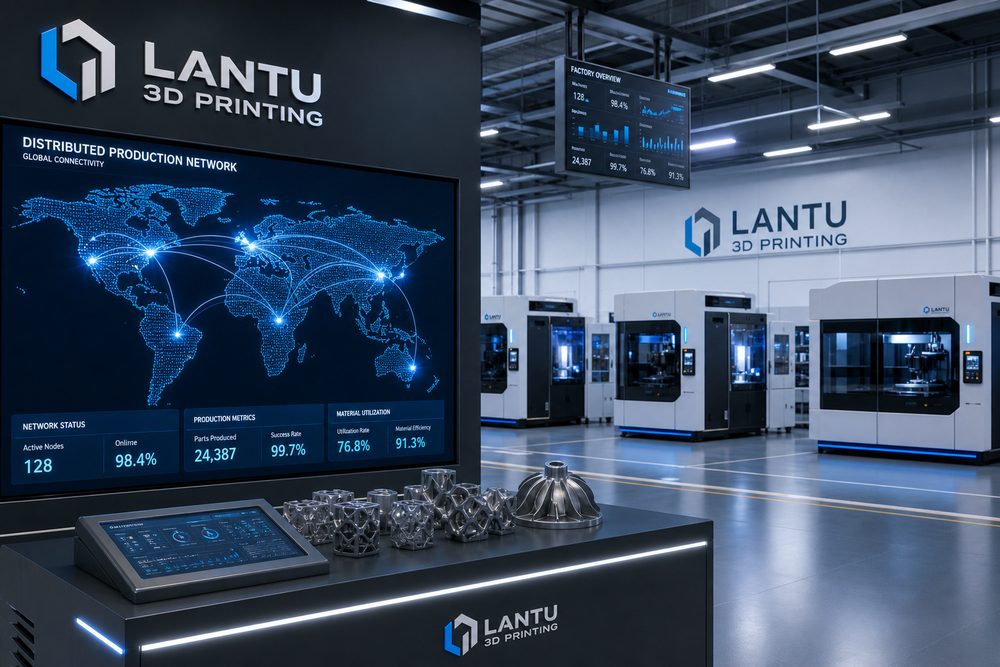
Spare parts, fixtures, low-frequency demand parts, and localized delivery are important application directions for distributed 3D printing. Enterprises do not need to store large amounts of low-turnover inventory for long periods; instead, they can keep validated digital files and produce them nearby when needed. This model can reduce inventory occupancy and transportation time, but only if files, materials, equipment, and inspection standards are consistent.
Digital inventory is not simply putting STL files into cloud storage. It is a complete data package that includes versioning, materials, processes, post-processing, acceptance criteria, and authorization scope. The lifecycle management emphasized by lantu3D Printing is well suited to supporting this closed loop from digital assets to physical delivery.
Conclusion: The Industry Will Move from “Able to Print” to “Able to Manage Delivery”
The future development of the 3D printing industry will not be determined solely by equipment speed or material variety, but by systematic capabilities. Material selection, design optimization, automated production, quality traceability, distributed delivery, and data security will together form the competitive barrier. For customers, when choosing a partner, the key is whether they can manage the complete lifecycle. For service providers, platform-based, standardized, and engineering-driven capabilities will be essential to navigating industry cycles.
Submit a model, drawing, image or written notes. Engineers will review material, process, finishing and delivery based on actual use.