Introduction: Why 3D Printing Services Are Still Stuck in the "Stone Age"
Today, as manufacturing accelerates its digital transformation, 3D printing itself is already a highly digital additive manufacturing process, yet the service process surrounding it generally remains stuck in the manual circulation stage of phone calls, emails, and Excel spreadsheets. In a typical custom-part delivery chain, the customer first needs to send drawings to a sales email address; sales then forwards them to a process engineer for evaluation; the engineer manually estimates supports, wall thickness, and printing time; the quotation is repeatedly revised in a WeChat group; production scheduling relies on a whiteboard; and progress updates depend on verbal inquiries. The result is that quotation cycles often take 2-3 days, delivery commitments are vague, acceptance standards are judged by both parties "based on experience," and once dimensions are out of tolerance or surfaces are inconsistent, responsibility is difficult to define.
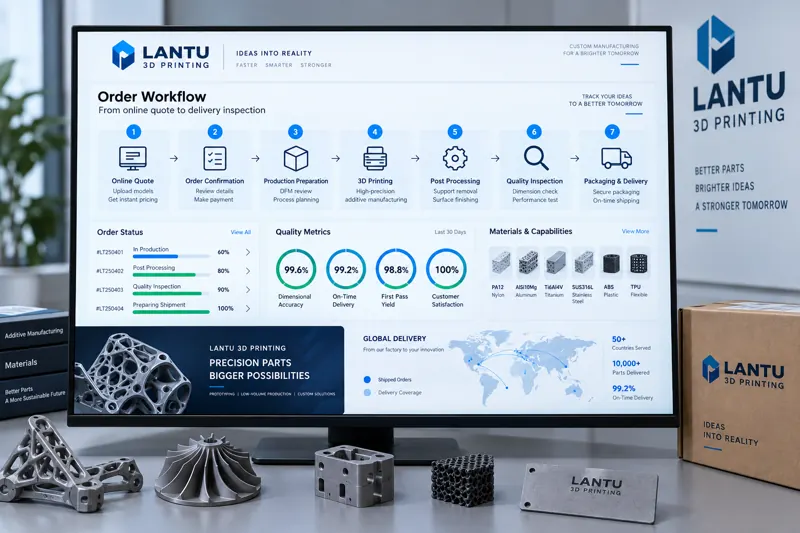
As a management and implementation platform covering the full lifecycle "from blueprint design to physical delivery," lantu3D has thoroughly reconstructed this chain: replacing scattered emails with unified digital orders, replacing subjective pricing with structured parameters, and replacing verbal commitments with traceable process records. This article breaks down this end-to-end method and provides process nodes, parameter thresholds, and acceptance checklists that can be directly applied.
1. Online Inquiry: Turning "Sending Drawings" into "Filling in Structured Requirements"
The first gateway of digitization is requirement structuring. Traditional inquiries often receive only an STL file, while the drawing intent, material preferences, quantity, lead time, and post-processing requirements all depend on follow-up questions. We transformed this into a standardized inquiry form that requires the following fields:
1. Geometry and tolerance: STL/STEP files + key dimensional tolerances, such as ±0.1 mm or ±0.2 mm, and annotations for critical mating surfaces; 2. Materials and processes: specify SLS nylon PA12, SLA photosensitive resin, SLM titanium alloy Ti6Al4V, etc. from a dropdown menu; 3. Post-processing: whether sandblasting, dyeing, anodizing, or CNC finishing is required; 4. Quantity and lead time: whether it is one prototype or a small batch of 50 pieces, and the expected delivery time; 5. Application description: functional part, appearance part, conformal cooling, or assembly verification.
Structured collection enables the system to complete a preliminary printability assessment within 30 seconds: whether wall thickness is below the process’s minimum feature size, such as about 0.2 mm for SLA and about 0.7 mm for SLS; whether overhang angles exceed the self-supporting limit, usually 45°; and whether there are enclosed cavities that prevent powder removal. Requirements that fail the preliminary assessment are automatically returned with modification suggestions, avoiding rework risks only being exposed during the quotation stage.
2. Automatic Quotation: From "Waiting for Manual Estimation" to "Second-Level Pricing"
Quotation is the core pain point in the customer experience. We break quotation down into a calculable cost model: material cost calculated by printing volume × material unit price + support loss rate, with SLS powder loss around 15%-25%; equipment machine time calculated by converting layer height of 0.1-0.15 mm into printing duration × equipment rate; post-processing labor hours, such as sandblasting at 0.5 h/piece, dyeing at 1 h/batch, and CNC finishing calculated by number of surfaces; quality inspection and packaging; and an expedite coefficient, where delivery within 48 hours usually applies a multiplier of ×1.3-1.6. After the model went online, quotations for standard parts were shortened from an average of 26 hours to automatic order generation in 90 seconds, and the unit prices for the same drawing at different quantity tiers, such as 1/10/50 pieces, are automatically displayed, allowing customers to intuitively compare economies of scale.
It is worth emphasizing that automatic quotation is not a bidding race where "the lower the better," but rather a way to make the cost structure transparent. What customers see is not a single fixed price, but a breakdown: material proportion, machine-time proportion, post-processing proportion, and delivery-time coefficient. This both builds trust and clearly explains "why it is expensive"—for example, the inert gas protection and high-power laser required for titanium alloy SLM naturally make it more expensive than nylon.
3. Order Review: Moving DFM Ahead of Contract Signing
After the quotation is confirmed, the process enters design for manufacturability review (DFM). This step is the first gate of quality traceability: engineers mark support positions in the system, recommend printing orientation, which affects layer lines and strength, and propose reinforcement plans for areas with insufficient minimum wall thickness. The review conclusions are written into the order’s digital archive and become the common baseline for subsequent production and acceptance. Practical data shows that moving DFM forward can reduce the first-article rework rate from about 18% to below 6%, because it blocks problems before the equipment starts.
4. Production Scheduling: A Real-Time Dashboard Beyond the Whiteboard
The biggest fears in small-batch production are "rush orders" and "equipment idling." We replace the whiteboard with a scheduling dashboard that automatically sorts tasks by equipment type, such as SLS/SLM/SLA, current load, powder batch, and delivery urgency. When powder removal for the previous batch is completed and the chamber temperature returns to the process window, with SLS preheating at about 185-195°C, the system automatically pushes the next batch of tasks. This increased the effective utilization rate of a single SLS machine from about 55% to 78%, while converting progress inquiries such as "where is my part now" into real-time customer self-service viewing.
5. Delivery Acceptance: Replacing Verbal Commitments with Data
The endpoint of digital delivery is a traceable acceptance package. The acceptance package attached to each order includes: printing parameter records, such as layer height, power, and chamber temperature; inspection reports for key dimensions, measured by CMM or calipers and marked with actual values and tolerance bands; comparison images before and after post-processing; and a unique serial number and QR code. Customers no longer accept based on "feel," but check each item against the baseline DFM conclusions.
Our recommended standard acceptance checklist: ① whether key dimensions fall within the tolerance band; ② whether mating surfaces have stepped layer lines that require finishing; ③ whether enclosed or thin-walled areas are complete with no missing material; ④ whether surface consistency meets the standard; ⑤ whether the serial number matches the drawing version. Completion of these five items is deemed qualified delivery, greatly reducing disputes.
6. Quantified Benefits from Experience Reconstruction
After connecting the five nodes above into an end-to-end digital chain, lantu3D compressed the typical custom-part delivery cycle from an average of 7 days to within 48 hours, reduced quotation time for standard parts from 26 hours to 90 seconds, lowered the first-article rework rate by about 12 percentage points, and improved effective equipment utilization by about 23 percentage points. More importantly, all interactions are accumulated as structured data, providing fuel for subsequent process optimization, cost prediction, and supply chain resilience building—this is precisely the essence that distinguishes "digitization" from merely "going online": the former generates reusable assets, while the latter only moves spreadsheets onto the internet.
Conclusion
The digitization of 3D printing services is not about piling up an ordering page, but about making all five gateways—inquiry, quotation, review, scheduling, and acceptance—structured, transparent, and traceable. For service providers, it means shorter cycles, higher equipment utilization, and less rework; for customers, it means clear quotations, predictable lead times, and evidence-based acceptance. Through this end-to-end reconstruction, lantu3D has transformed custom-part delivery from an "experience-based negotiation" into "data-based collaboration"—and that is the modern service experience additive manufacturing should provide.
Submit a model, drawing, image or written notes. Engineers will review material, process, finishing and delivery based on actual use.