Introduction: Customer Complaint Handling in 3D Printing Is Shifting from Experience-Based Management to Data-Driven Operations
In custom 3D printing services, customer complaints are unavoidable to some extent. Issues such as dimensional mismatch, surface scratches, color deviation, assembly difficulty, shipping damage, and delivery delays can all occur. What truly distinguishes service capability is whether the team can respond quickly, determine the facts, and provide an actionable solution.
1. Establish Quantifiable Business Scenarios and Boundary Conditions
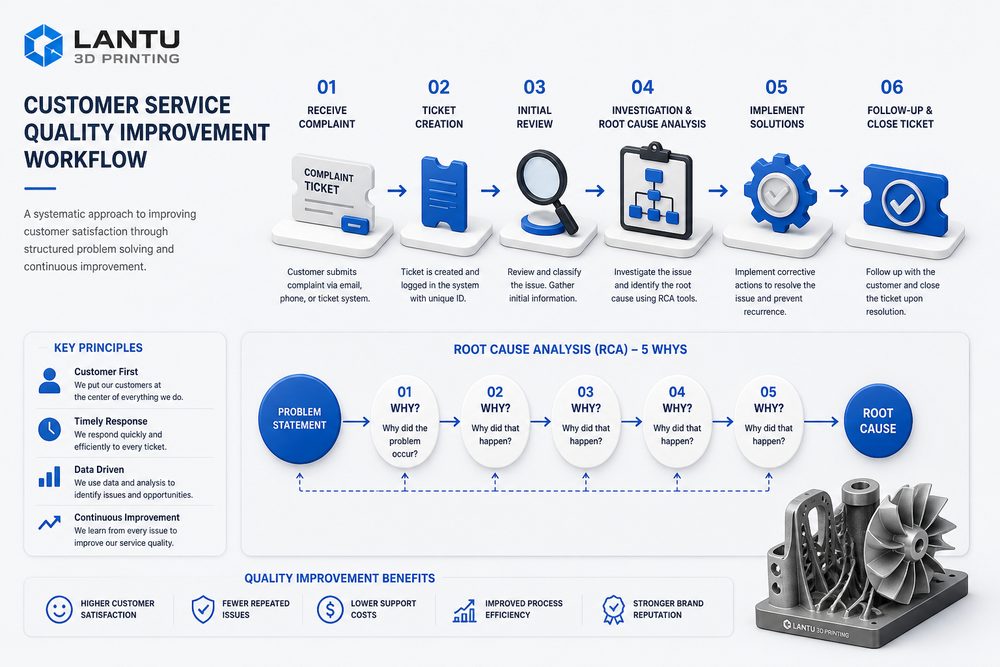
The first step in complaint handling is classification. Quality-related issues include dimensions, appearance, strength, materials, and functionality; delivery-related issues include delays, missing items, incorrect shipments, and packaging damage; communication-related issues include misunderstandings of requirements, unclear version confirmation, and inconsistent acceptance criteria.
2. Break Down Risks and Delivery Responsibilities by Process Stage
The second step is to define response time limits and assign responsibility. It is recommended to confirm receipt within 2 hours, complete an initial assessment within 24 hours, and provide a handling plan within 48 hours. Possible solutions include reprinting, rework, discounts, returns or exchanges, technical explanations, or design modification suggestions.
3. Standardize Parameters, Data, and Acceptance Criteria in the System
Complaint assessment must be based on traceable data. Reviewing the model version, printing parameters, material batch, inspection records, packaging photos, and logistics information makes it possible to distinguish production deviation, design risk, and shipping damage. If the issue is indeed caused by the service provider, the remediation timeline and responsibility should be clearly stated.
4. Continuous Optimization: From Single-Order Review to Organizational Capability Building
The most important element is the improvement loop. Every complaint should be recorded with its issue category, root cause, cost, resolution, and preventive measures. High-frequency issues should be converted into standard actions, such as adding wall-thickness reminders during quoting or adding protective separation packaging for painted parts before shipment.
Conclusion
A mature complaint handling mechanism shows customers professionalism, transparency, and accountability. For 3D printing companies, it not only reduces after-sales costs but also accelerates organizational learning. When complaints are managed in a data-driven way, the company can shift from reactive firefighting to proactive prevention.
Submit a model, drawing, image or written notes. Engineers will review material, process, finishing and delivery based on actual use.