Introduction: The decisive role of material selection
In 3D printing projects, material selection often determines the performance, appearance quality and cost level of the final product. Faced with a wide variety of 3D printing materials, how to make the right choice? This article will systematically introduce the characteristics of mainstream 3D printing materials and help readers establish scientific ideas for material selection.
lantu3D has a rich material library, from ordinary resin to high-temperature metal, which can meet the needs of various applications.
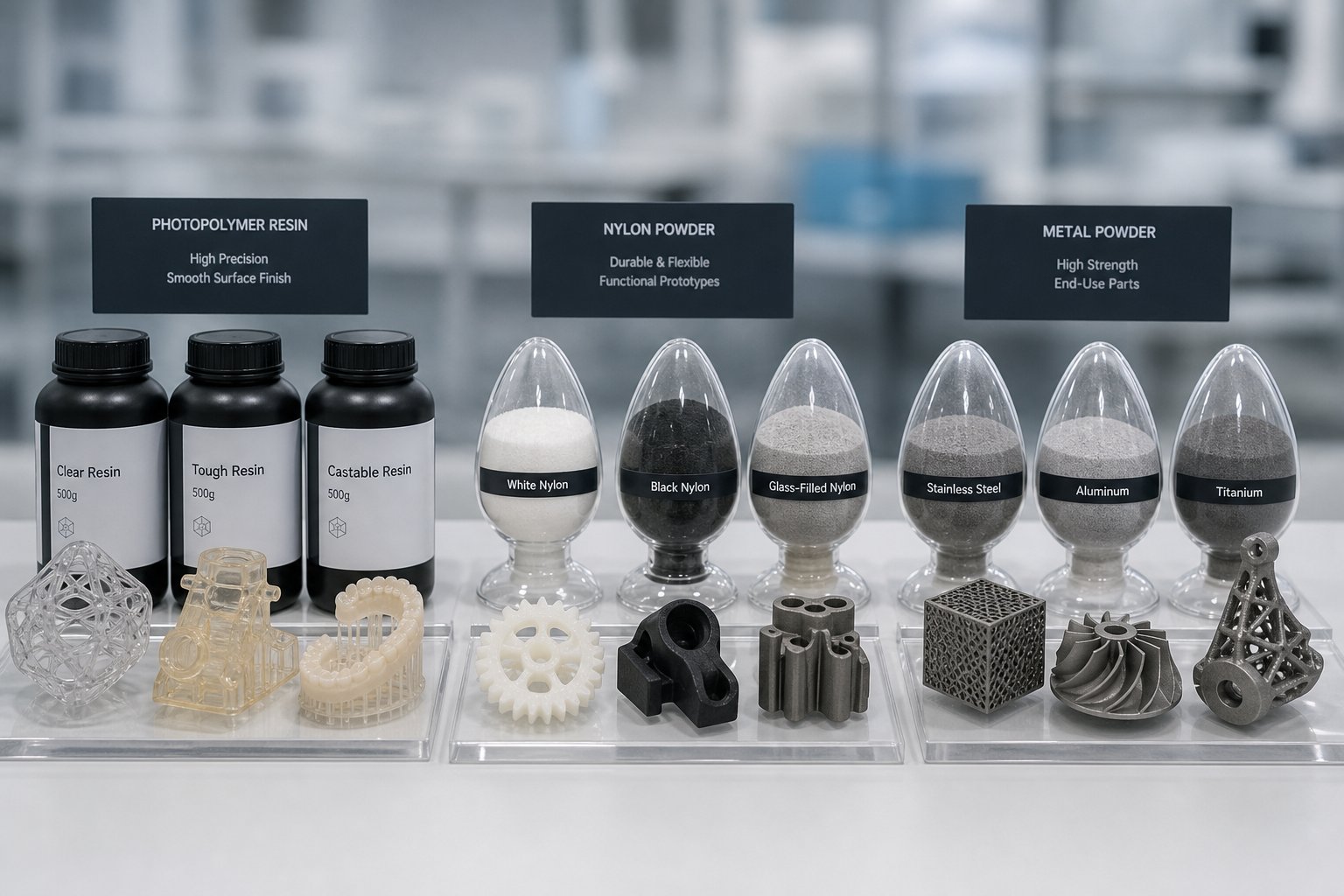
Light-curing resin material
Standard resin: The most common SLA material, with smooth and delicate surface and strong expressiveness of details, suitable for appearance verification and display models. The disadvantage is that it is brittle and not resistant to impact.
Tough resin: Adding toughening components can significantly improve the impact resistance, making it suitable for functional parts that require certain mechanical properties.
High temperature resistant resin: The heat deformation temperature can reach above 200℃, suitable for applications in high temperature environments.
Transparent resin: Can produce transparent or translucent parts, suitable for optical demonstrations and fluid visualization.
Engineering plastic materials
Nylon PA12: The preferred material for SLS process, with high strength, good toughness and fatigue resistance, suitable for functional parts and small batch production. Has excellent mechanical properties and chemical stability.
Nylon glass fiber: Adding glass fiber to PA12 greatly increases the stiffness and better dimensional stability, making it suitable for functional parts with precision requirements.
ABS: A commonly used material in the FDM process, with moderate strength and affordable price, suitable for conceptual models and simple functional parts.
PC: Polycarbonate, with high transparency and strong impact resistance, but it is difficult to print and requires professional equipment.
Metal materials
Stainless steel 316L: A commonly used material in SLM process, corrosion-resistant and high strength, suitable for tooling fixtures and small batches of metal parts.
Aluminum alloy AlSi10Mg: lightweight, high strength, good thermal conductivity, suitable for aerospace and automotive fields.
Titanium alloy Ti6Al4V: High specific strength, good biocompatibility, suitable for medical devices and high-end applications.
Mold steel: High hardness and good wear resistance, suitable for making injection molds and die-casting molds.
Special functional materials
TPU/TPE: Elastic material with adjustable Shore hardness, suitable for flexible applications such as seals and shock-absorbing pads.
PEEK: High-performance engineering plastic, resistant to high temperatures, chemicals, and high strength, suitable for medical implants and high-end industrial applications.
Carbon fiber reinforcement: Significantly increased stiffness and strength for weight-sensitive, high-performance parts.
Material selection decision-making process
Selecting 3D printing materials should follow the following steps:
1. Clarify application requirements: functional requirements, environmental conditions, appearance standards;
2. Screen material types: select material categories based on core requirements;
3. Compare material performance: compare key performance indicators of candidate materials;
4. Consider process adaptation: confirm whether the design is suitable for the printing process corresponding to the selected material;
5. Evaluate the cost budget: whether the material cost is within an acceptable range.
lantu3D’s material services
lantu3D provides professional material selection consulting services to help customers choose the most suitable materials according to specific applications. We have a material sample library so customers can intuitively experience the actual effects of different materials.
Summary
3D printing materials are rich in types, each with its own characteristics. An in-depth understanding of the performance characteristics of different materials and scientific selection based on specific application requirements are important guarantees for the success of the project.
Welcome to contact lantu3D to obtain detailed material technical information. Our technical team will provide you with professional material selection suggestions.
Submit a model, drawing, image or written notes. Engineers will review material, process, finishing and delivery based on actual use.