Introduction: Many projects treat samples as a stage for ‘checking the appearance’ and ignore functional, assembly, and material validation, leading to risks surfacing when production is scaled up
Passing the first sample is not luck: The six key checkpoints in the 3D printing sample validation process are not a single technical issue, but a systems engineering effort spanning customer requirements, model data, process selection, production scheduling and delivery, and after-sales review. For full-lifecycle management platforms like lantu3D, which move from blueprint/design to physical delivery, the key is not whether something can be printed, but whether uncertain requirements can be turned into a manufacturing process that is plannable, traceable, and deliverable. A common misconception among industry practitioners is to focus only on machine parameters while ignoring order batches, validation checkpoints, quality records, and cross-department information flow, ultimately causing rework, delays, or runaway costs. This article focuses on the 3D printing sample validation process and, in the context of low-volume manufacturing, provides an actionable framework.
1. Requirement confirmation must clarify the 'purpose'
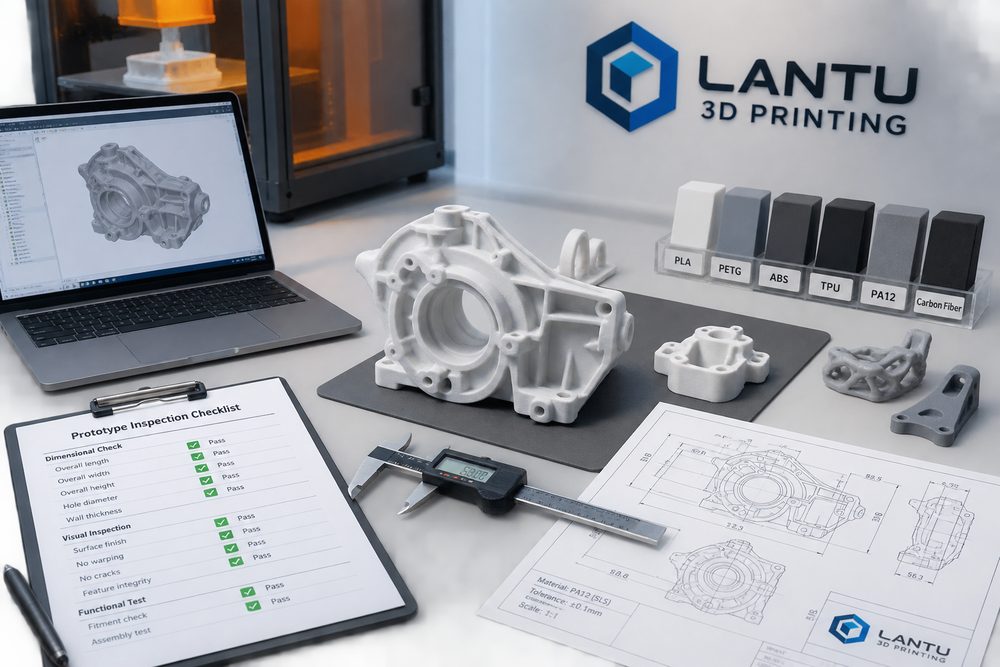
Before validation, the sample's purpose must be confirmed: appearance display, structural assembly, functional testing, or market trial sales. Different purposes correspond to different materials and acceptance priorities. Appearance samples focus on surface finish, color, and feel; functional samples focus on strength, heat resistance, wear resistance, and threaded connections; assembly samples focus on hole positions, snaps, clearances, and deformation. When lantu3D receives a model, it breaks requirements into four categories of information: design objectives, environmental conditions, critical dimensions, and failure risks, avoiding pricing based only on the file.
2. Model inspection determines trial production cost
Before printing, wall thickness, sharp corners, enclosed cavities, thin posts, overhang angles, and assembly clearances should be checked. If an SLA transparent part has large abrupt changes in thickness, curing shrinkage may cause warping; if an SLS nylon snap-fit lacks sufficient root fillets, repeated assembly may cause breakage; if a metal SLM part cannot be depowdered internally, post-processing risk will increase significantly. Each problem found during the model inspection stage usually saves hours to days compared with rework after printing.
3. Validation should measure not only dimensions, but also scenarios
Dimensional compliance does not mean the sample is qualified. A housing part may have accurate hole positions yet make abnormal noises after being snapped together; a bracket may be strong enough in static tests yet fail from fatigue in a vibration environment. Therefore, validation should include actual installation, load bearing, temperature, contact media, and frequency of use. When necessary, simplified fixtures can be designed to simulate assembly force, insertion/removal cycles, and load directions.
4. Review records should support the next iteration
Every sample validation should produce a problem list: problem description, likely cause, proposed modification, responsible person, and the validation method for the next version. Do not leave only verbal instructions like ‘change this here.’ For products that require multiple rounds of iteration, screenshots of each version, parameters, inspection data, and customer feedback can be archived to form a traceable chain of design decisions.
Conclusion: Turn experience into repeatable delivery capability
Passing the first sample is not luck: The core of the six key checkpoints in the 3D printing sample validation process is to turn fragmented experience into standard actions: requirements have an entry point, judgments have a basis, processes have records, exceptions have a closed loop, and results can be reviewed. It is recommended that companies start with a high-frequency category or a typical customer project, first establish the minimum viable process, and then gradually expand to material libraries, process libraries, quoting rules, and quality traceability systems. What lantu3D focuses on is precisely this capability building from design blueprints to physical delivery, enabling 3D printing to be not just a sample-making tool, but a reliable node for rapid validation, low-volume production, and on-demand manufacturing.
Submit a model, drawing, image or written notes. Engineers will review material, process, finishing and delivery based on actual use.