
Introduction: 3D printing is fast, but project risks do not disappear automatically
3D printing shortens the manufacturing cycle, but that does not mean project management can be simplified. On the contrary, because it is often used for new product validation, complex structures, small-batch customization, and urgent delivery, requirement changes and technical uncertainty are often higher. Tight deadlines, complex models, uncertain materials, and vague customer acceptance standards are the most common risk combinations service teams face.
Effective risk management does not make projects slower. Instead, it identifies potential problem points in advance and builds buffers into quoting, scheduling, and communication. lantu3D Printing embeds risk management into the process from inquiry to delivery, helping customers balance speed and reliability.
1. Risk identification: view problems from four dimensions — requirements, design, process, and delivery
Requirement risks include unclear use cases, vague appearance standards, unmarked critical dimensions, and a mismatch between lead time and budget. Design risks include insufficient wall thickness, overhang structures, enclosed cavities, insufficient assembly clearance, and broken mesh files. Process risks include material-performance mismatch, insufficient strength caused by print orientation, difficult support removal, machine scheduling conflicts, and complex post-processing. Delivery risks include inconsistent inspection standards, packaging and transportation damage, and last-minute customer changes.
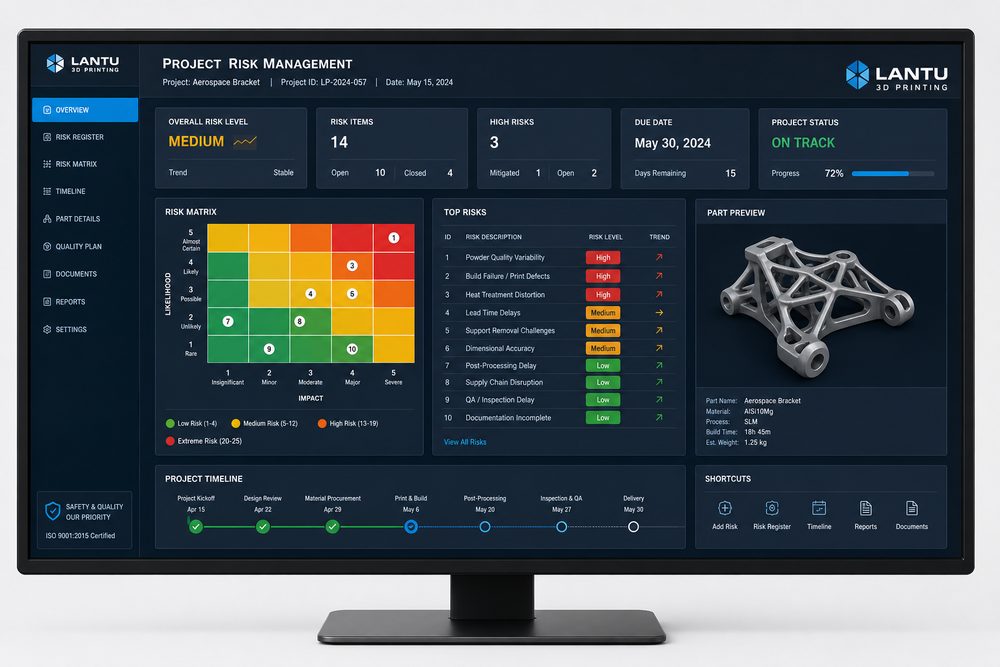
Before a project starts, a risk checklist can be used for a quick assessment. Each risk should be marked with its likelihood, impact, and responsible party. High-probability, high-impact items must be addressed clearly in the quotation and plan; they cannot be left until after production to solve.
2. Risk assessment: turn vague concerns into decision-making inputs
Risk assessment should be as quantitative as possible. For example, SLA cosmetic parts with wall thickness below 1 mm have a higher risk of support removal issues and deformation; large FDM parts will have a greater chance of warping if they are not designed in sections; if a metal part later needs a high-precision mating surface, heat treatment and CNC allowance should be considered. With experience data and process standards, “there may be a problem” can be converted into “first article verification is required” or “a process change is recommended.”
The assessment result should lead to a solution choice. Low-risk projects can move directly into production; medium-risk projects require sample verification or partial structural adjustments; high-risk projects should be staged, with materials, structure, or critical dimensions verified first before committing to batch delivery. This protects the service provider while helping the customer understand technical boundaries.
3. Risk control: reduce uncertainty with checkpoints and backup plans
The key to controlling risk is setting decision checkpoints. Common checkpoints include model review, process review, first article confirmation, post-processing confirmation, dimensional inspection, and pre-shipment photo confirmation. Each checkpoint should have clear inputs, outputs, and owners. For example, first article confirmation is not just taking a photo; it confirms the material, color, appearance surface, assembly relationship, and critical dimensions.
Backup plans are also important. For material risk, alternative materials can be prepared; for equipment risk, reserve machines can be scheduled; for lead-time risk, delivery can be split into phases; for structural risk, a sectioning or reinforcement方案 can be proposed. For customers, knowing the fallback path in advance is more valuable than temporary explanations after project failure.
4. Communication and review: risk management must become organizational memory
Risk management cannot work without communication. Sales, engineering, production, and quality inspection should share the same project risk record so that information does not remain only in one person's chat history. When a customer changes requirements, the impact on cost, lead time, and quality should also be assessed together, and the quotation should be reconfirmed if necessary.
After a project ends, a review should be conducted, especially for delayed projects, rework, customer complaints, and technical failures. The review should not focus mainly on assigning blame, but on documenting rules: which structures need to be flagged in advance, which material combinations are high risk, which inspection standards are easily misunderstood, and which supply-chain links need alternatives. With long-term accumulation, the risk library will significantly improve the team's response speed.
Conclusion: only controlled risks can support reliable delivery
The core of risk management in 3D printing projects is to expose, quantify, and incorporate uncertainty into the process in advance. Through requirement identification, engineering assessment, checkpoint control, backup planning, and post-project review, service teams can reduce rework, delays, and communication disputes. As a lifecycle management and realization platform, lantu3D Printing emphasizes making every project deliverability-ready from the blueprint stage, rather than pushing risks all the way to the production floor.
Submit a model, drawing, image or written notes. Engineers will review material, process, finishing and delivery based on actual use.