1. Why Delivery Risks Must Be Managed Before Order Acceptance
Many 3D printing delivery disputes do not truly originate in the workshop, but in the commercial stage. A customer verbally says “make it a bit stronger, the higher the accuracy the better, ship as soon as possible,” and sales accepts everything to win the order. Only when engineering schedules production does the team discover that the model’s minimum wall thickness is only 0.4 mm, below the process limit; the required ISO 10993 medical-certified material is not available in the material library; and the ±0.02 mm tolerance is beyond the capability of existing equipment. At this point, canceling the order hurts the customer relationship, while forcing production damages reputation. Leaving such uncertainties to be resolved after order acceptance is the most costly approach. The essence of order review is to set up a feasibility gate between quotation and acceptance, making it clear before contract signing whether the job can be done, under what boundaries it can be done, and how any unmet requirements should be confirmed in writing.
2. The Core of Order Review: Turning Vague Needs into Manufacturable Specifications
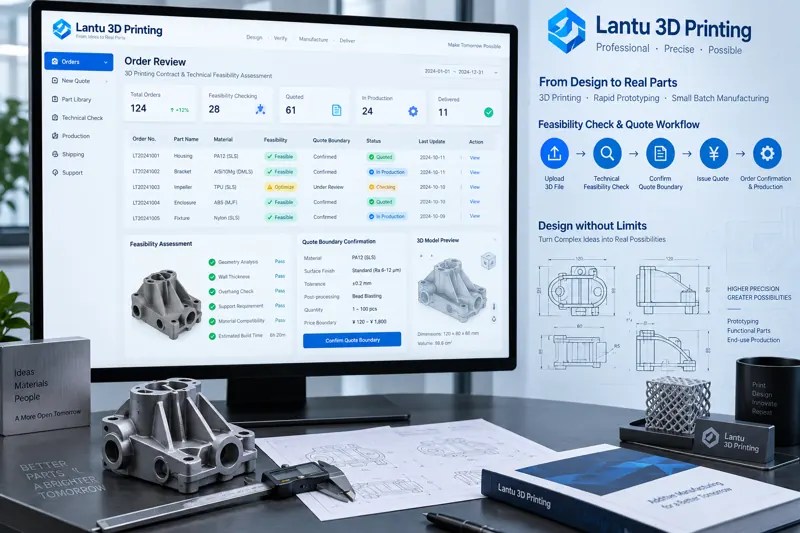
Order review is not a formality; it is the process of translating vague customer language into verifiable engineering parameters. It usually includes two parallel review tracks: one is the technical feasibility review, in which engineering determines whether the model matches the selected process; the other is the commercial boundary review, in which quotation and sales confirm the delivery schedule, post-processing scope, and warranty terms. Together, they produce a structured Order Review Record that defines technical specifications, delivery commitments, and the change management mechanism, serving as the common basis for subsequent production scheduling and acceptance.
3. Risk Breakdown: What Happens Without Review
Accepting orders without review commonly creates three types of hidden risks. The first is geometric non-manufacturability: minimum wall thickness, overhang angles, enclosed cavities, and assembly interference are not checked, and only during printing does the team discover that supports cannot be removed or that strength is insufficient. The second is mismatch between capability and commitment: certifications, accuracy, or post-processing expected by the customer, such as anodizing or sterile cleaning, exceed the standard capability package but are written into the contract. The third is unclear boundaries: delivery time, number of revisions, retained samples, and warranty scope are not agreed in writing, leading to conflicting interpretations during acceptance. Most of these three types of issues can be resolved before order acceptance with a one-page review form; if delayed until delivery, they can lead to rework, compensation, or even lost customers.
4. An Executable Order Review Process
It is recommended to break the review into three actions. First, technical feasibility review: engineering checks each item against the material-process capability sheet, including model minimum wall thickness, for example SLA is recommended to be ≥0.8 mm and SLS ≥1.0 mm; self-supporting overhang angle, usually ≥45°; feasibility of powder removal from enclosed cavities; and whether the tolerance chain of assemblies exceeds equipment capability, with common metal SLM dimensional tolerance at ±0.1 mm/100 mm. Second, commercial boundary review: quotation and sales jointly confirm the delivery schedule, post-processing scope, retained samples, and warranty terms, and provide written add-on boundaries and pricing for requirements beyond standard capability. Third, handover after review approval: output a standardized Order Review Record defining technical specifications, delivery commitments, and the change process, then hand it over to production planning for scheduling.
5. Implementation Essentials: Quotation Boundaries and Cross-Department Handover
The key is to solidify quotation boundaries into a matrix: what geometric limits, material certifications, accuracy tolerances, and post-processing scopes are covered by the standard capability package, and how additional cost and lead time are calculated for anything beyond that scope. Helping customers understand before signing the contract “what can definitely be done and what needs separate discussion” is far cheaper than arguing after the fact. At the same time, establish a cross-department handover checklist—technical specifications, delivery date, acceptance criteria, and change contact must all be complete before release, preventing information distortion between sales, engineering, and production. Order review does not delay delivery; it uses one written confirmation page to block 80% of potential disputes before order acceptance, ensuring every order reaching the workshop is clear, feasible, and verifiable.
Submit a model, drawing, image or written notes. Engineers will review material, process, finishing and delivery based on actual use.