Introduction: Intellectual Property Risks in 3D Printing Projects Are Not Limited to Model Leakage
In 3D printing services, what a customer delivers is not just an STL file. Many projects also include product appearance concepts, internal structural solutions, assembly relationships, material selection logic, test data, cost budgets, and even launch plans. Without clear boundaries for intellectual property and data security, risks can arise at multiple stages: files may be sent to the wrong people, version confusion may expose design intent, process parameters may be reused inappropriately, outsourcing and post-processing may lack confidentiality constraints, or delivery photos may be used for promotion without authorization. For enterprise customers, these issues can affect product launch timing, patent strategy, and competitive advantage.
lantu3D treats 3D printing as a lifecycle management process from blueprint design to physical delivery, so intellectual property protection should not stop at a verbal promise of "no sharing after receipt." Instead, it should be embedded in every step of requirement communication, quotation review, production execution, quality recording, and after-sales service. Only by putting files, people, permissions, and records under one unified set of rules can collaboration efficiency improve while reducing the risk of leaks and ownership disputes.
1. File Intake: Define Ownership, Usage, and Confidentiality Level
At project kickoff, the ownership and authorization scope of the model files should be confirmed first. CAD, STEP, STL, OBJ files, or engineering drawings provided by the customer should default to being used only for this quotation, manufacturing, and delivery, and should not be used for training, display, resale, or reference in unrelated projects. For sensitive projects involving new product development, medical devices, robot structures, or consumer electronics housings, it is advisable to label the confidentiality level at the intake stage, for example: general, internal-restricted, or strictly confidential. Strictly confidential projects should restrict downloading, copying, and screenshots, and all communication should be centered on the project number rather than sending full models directly in public groups.
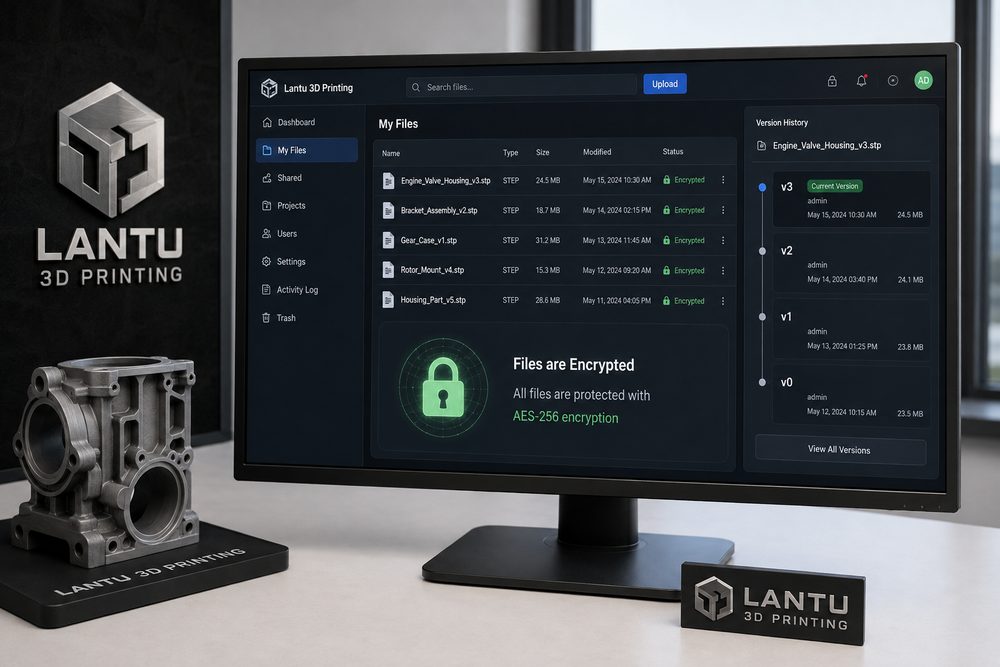
Version tracking is also important during file intake. It is recommended to record the upload time, change description, confirmer, and replacement scope whenever the customer updates a model. Even if the customer changes only a small hole position, a new version number should be generated instead of overwriting the original file. This not only helps prevent the production side from using an outdated version by mistake, but also allows the decision-making process to be reconstructed if disputes arise later.
2. Permission Tiers: Not Every Participant Needs to See the Full Picture
3D printing projects usually require multiple roles to work together, including sales, engineering review, scheduling, operations, post-processing, quality inspection, and logistics. The key to intellectual property protection is ensuring that each role only accesses the information needed to complete its task. Quotation staff need to know the material, dimensions, quantity, and lead time, but may not need to download the source CAD; machine operators need sliced files and process requirements, but may not need the customer’s business background; logistics staff need shipping information and packaging requirements, but should not access complete design files.
Permission tiers can be implemented through project management systems, folder permissions, and operation logs. For highly sensitive projects, it is recommended to use read-only previews, expiring links, watermarked preview images, and download approval. Even internal teams should avoid leaving model files scattered long-term across personal computers, chat tools, and temporary cloud drives. The standard practice is to archive the production-related files in a controlled directory after the project is completed and clean up temporary files regularly.
3. Process Data Boundaries: Platform Know-How and Customer Proprietary Design Must Be Kept Separate
Many intellectual property disputes do not come from the model itself, but from the boundaries of process data. The placement strategies, support schemes, post-processing methods, and inspection experience formed by the service provider during the project may belong to platform know-how; the customer’s structural logic, functional requirements, test objectives, and proprietary application scenarios should belong to the customer or be managed according to the contract. Before cooperation begins, both parties should clarify which data can be accumulated into general process knowledge and which data must be sealed with the project.
For example, if a customer provides a complex flow-channel component, lantu3D can accumulate a general lesson such as “for thin-walled flow channels in SLA, cleaning time should be controlled to prevent residual liquid blockage,” but it cannot disclose the customer’s channel shape, dimensions, industry, or performance metrics. This boundary definition both protects the customer’s rights and allows the platform to continuously improve manufacturing capability.
4. Outsourcing and Post-Processing: Extend Confidentiality Requirements to the Supply Chain
3D printing delivery sometimes requires external resources such as painting, electroplating, CNC secondary machining, heat treatment, screen printing, or assembly. If the outsourcing process lacks confidentiality constraints, models, photos, or samples may also be leaked. The standard approach is to manage outsourced partners by tier, sign confidentiality clauses, restrict their access to the full project background, and provide only the minimum necessary information. For strictly confidential projects, measures such as segmented processing, anonymous numbering, masking key structures, and no-photography rules can be used.
Outsourcing handoff records should also be archived, including the quantity transferred, sample number, processing requirements, return time, and exception records. If scrapped parts or rework occurs during post-processing, the method of disposing of remnants should be recorded to prevent sensitive parts from being discarded casually. Remnant management that seems minor is especially important during new product development and patent application stages.
5. Delivery Records: Prove Compliant Performance and Support Future Reorders
Intellectual property protection does not mean deleting all data after delivery. For repeat-order projects, necessary delivery records should be retained within the authorized scope, including the final version number, materials and process, quantity, quality inspection results, packaging photos, and customer confirmation records. These data can help quickly restore production conditions for future reorders and can also prove that the platform fulfilled its obligations in the event of a quality dispute. The key is to establish in advance what to retain, how long to retain it, and who can access it.
If the customer requires source files to be deleted after the project ends, the deletion scope and exceptions should be clearly defined. For example, financial orders, delivery receipts, and quality traceability records may need to be retained according to legal or business requirements, while source CAD files and temporary slicing files can be cleaned up as agreed. A transparent archiving strategy is more professional and more practical than a simple promise to "delete everything."
Conclusion: The Clearer the Security Boundaries, the Higher the Collaboration Efficiency
The goal of intellectual property protection in 3D printing is not to create communication barriers, but to let customers confidently entrust their designs to the platform and to turn the platform’s know-how into controllable delivery capability. Through file intake standards, permission tiers, version tracking, process data boundaries, outsourcing management, and delivery archiving, companies can protect core assets while iterating rapidly. This is exactly where the value of lantu3D lies: not only turning models into parts, but also helping customers manage the risks, data, and responsibility boundaries between design and physical delivery.
Submit a model, drawing, image or written notes. Engineers will review material, process, finishing and delivery based on actual use.