Introduction: When “One File” Can Replicate a Factory
In the era of traditional manufacturing, product barriers were built on molds, production lines, and supply chains. In the age of additive manufacturing, however, core assets are often compressed into an STL or STEP file of only a few megabytes. Once a design model is leaked, competitors can reproduce your part on any 3D printer without investing in equipment. This is the new challenge that 3D printing brings to enterprises: intellectual property is no longer merely a year-end report for the legal department, but an engineering issue that must be addressed in advance across the entire chain from design modeling to physical delivery. This article reviews the risk characteristics, types of rights, and practical ownership verification and prevention methods in 3D printing scenarios.
1. Three Unique Characteristics of IP Risks in 3D Printing
First, digital assets are extremely easy to copy and distribute without loss. Unlike physical prototypes, model files can be copied infinitely at zero cost, and every copy is identical to the original file, making the traditional physical barrier of “you can’t reproduce it just by looking” ineffective. Second, distributed manufacturing expands the exposure surface. When companies send models to external contract manufacturers, testing agencies, or overseas service providers for printing, the files pass through multiple uncontrolled nodes, and retention at any point may create long-term risks. Third, the threshold for reverse engineering has been greatly lowered. With 3D scanning and mesh repair algorithms, even if only the finished product is obtained, a printable model can be reconstructed within hours, making the self-protection approach of “delivering only the physical part, not the drawings” no longer reliable.
2. Four Core Rights That Must Be Clarified
In the context of 3D printing, enterprises need to distinguish at least four boundaries of rights. The first is copyright. As an original three-dimensional expression, a model file is automatically protected upon creation, and the creation time can be fixed through digital watermarking and file hash evidence preservation. The second is patent rights. When a part structure, lattice topology, or printing process is novel and inventive, it should be protected through invention or utility model patents to prevent others from mass-manufacturing the same design. The third is trademark rights. Embedding brand logos, exclusive textures, or laser-engraved serial numbers on delivered parts serves both anti-counterfeiting purposes and as a physical extension of brand assets. The fourth is trade secrets. For undisclosed process parameters that create competitive advantages, such as layer thickness, scanning strategies, and post-processing formulas, protection should rely on confidentiality agreements and tiered access control rather than public patents.
3. Design Model Stage: Build Ownership Verification at the Source
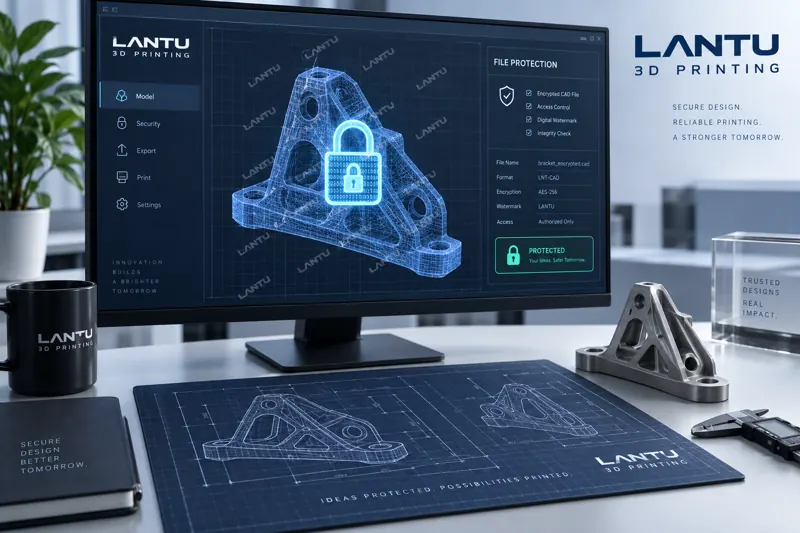
The most effective protection begins the moment a file is generated. Enterprises are advised to embed invisible digital watermarks during CAD export—writing corporate identifiers or serial information into mesh vertices through low-frequency perturbations that are invisible to the naked eye but can be extracted and verified with dedicated tools. At the same time, all externally shared model files should undergo hash evidence preservation and be recorded on-chain or hosted by a trusted timestamp service, forming legal evidence that “this design already existed on a specific date.” For files that must be sent externally, companies should adopt view-only formats or watertight desensitized versions. For example, provide only the closed mesh required for printing while stripping editable sketches and dimensional constraints to reduce the risk of reverse modification. Finally, every external file transfer must be accompanied by tiered access permissions and electronic logs, making it traceable who downloaded the file, when it was downloaded, and which batch it was used for.
4. Manufacturing and Delivery Stage: Control Risks Through Contracts and Traceability
Once the model reaches the contract manufacturer, protection shifts toward institutional controls. First, confidentiality and ownership clauses must be established upfront. The entrusted manufacturing contract should clearly state that “ownership of the model files and derivative data belongs to the client, and the contractor shall not retain, reproduce, transfer, or use them for its own production,” with agreed liability for breach of contract. Second, follow the principle of minimum necessity: send only the files required for the current batch, and require the supplier to issue confirmation of file deletion or data clearing after printing is completed. Third, ensure end-to-end traceability: from quotation BOM lists and printing parameter records to quality inspection reports, create associated delivery archives so that responsibility nodes can be quickly identified if an ownership dispute arises. Finally, implement physical anti-counterfeiting: use laser engraving, micro-textures, or embedded verifiable serial codes on delivered parts so that both end users and rights holders can verify authenticity.
5. Enterprise Implementation Checklist and Common Misconceptions
For small and medium-sized enterprises that have just established 3D printing capabilities, implementation can proceed according to the following checklist: ① establish a hierarchical design file directory distinguishing “public display version / external printing version / internal source file version”; ② apply watermarking and hash evidence preservation to all core models; ③ sign standardized confidentiality agreements with all contract manufacturers, testing agencies, and logistics providers; ④ add brand identifiers and serial codes to externally delivered parts; ⑤ regularly audit the circulation and retention of model files. Misconceptions to avoid include: believing that “it is safe as long as only the physical part is provided and no drawings are shared” (reverse engineering can already break this barrier), relying entirely on partners’ self-discipline for confidentiality (contracts and technical constraints are both required), and ignoring the trade secret nature of process parameters (parameter leakage can be equally fatal).
Conclusion
3D printing lowers the threshold of manufacturing to “one file plus one machine,” and also transforms intellectual property from rights on paper into an engineering challenge spanning the entire digital and physical chain. Robust protection is not about post-incident rights enforcement, but about embedding watermarking and evidence preservation in the design stage, controlling risks through contracts and traceability in the manufacturing stage, and closing the loop with physical anti-counterfeiting at the delivery stage. Only by moving ownership verification measures forward into every link can enterprises enjoy the agility of additive manufacturing while safeguarding the core value they create.
Submit a model, drawing, image or written notes. Engineers will review material, process, finishing and delivery based on actual use.