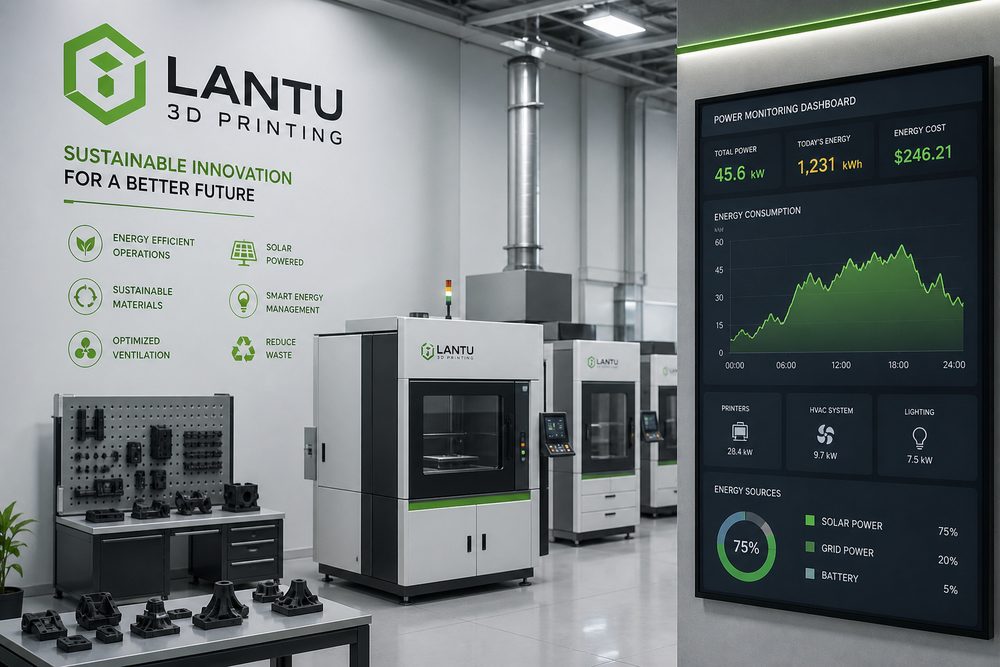
Introduction: As equipment counts rise, preheating, temperature maintenance, laser sintering, compressed air, ventilation, and post-processing all become costs that cannot be ignored
Reducing costs is not just about materials: The five levers for optimizing energy consumption in 3D printing are not a single technical issue, but a systems engineering effort spanning customer needs, model data, process selection, production scheduling and delivery, and after-sales review. For an end-to-end lifecycle management platform like lantu3D, which moves from blueprint/design to physical delivery, the key is not "whether it can be printed," but whether uncertain demand can be transformed into a manufacturable process that is plannable, traceable, and deliverable. A common misconception in the industry is to focus only on machine parameters while overlooking order batches, validation checkpoints, quality records, and cross-department information flows, ultimately leading to rework, delays, or runaway costs. This article, centered on optimizing energy consumption in 3D printing and combined with small-batch manufacturing scenarios, offers an actionable framework.
1. Measure first, then optimize
The first step in energy management is to record electricity consumption across different machines, materials, and batches. It can be tracked by stages: preheating before printing, printing process, cooling and waiting, post-processing, and standby. If you only look at the monthly electricity bill, it is difficult to tell whether energy use comes from low equipment utilization, batches that are too small, or repeated post-processing runs.
2. Batch consolidation lowers unit energy consumption
Powder-bed and vat photopolymerization equipment often carry fixed preheating or setup costs. If only a small number of parts are printed each time, unit energy consumption rises significantly. By consolidating batches according to material, delivery date, and post-processing method, utilization can be improved. But consolidation must not sacrifice delivery schedules, so a maximum waiting time and an exception rule for urgent orders should be established.
3. Parameter optimization must balance quality
Reducing energy consumption cannot be as simple as shortening curing time or lowering temperature. Parameter adjustments must be verified through sample testing and quality inspection. For non-critical appearance parts, layer thickness can be increased appropriately to reduce print time; for internal validation parts, unnecessary high-precision settings can be reduced; but load-bearing parts and assembly parts should still prioritize stable performance.
4. Post-processing also needs energy management
Cleaning, curing, drying, spray booths, air compressors, and ventilation systems can all consume significant amounts of energy. It is recommended to consolidate similar post-processing tasks and avoid frequent starts and stops of equipment. For equipment that must run at constant temperature or for long periods, establish power-on and power-off schedules and maintenance plans. Green manufacturing is not about sacrificing delivery, but about reducing wasteful consumption.
Conclusion: Turn experience into repeatable delivery capability
The core of reducing costs is not just about materials: The five levers for optimizing energy consumption in 3D printing is to turn fragmented experience into standard actions: there is an entry point for demand, a basis for judgment, records for the process, a closed loop for exceptions, and a reviewable outcome. Companies are advised to start with a high-frequency product category or a typical customer project, first establish a minimum viable process, and then gradually expand to a material library, process library, quoting rules, and quality traceability system. What lantu3D focuses on is exactly this kind of continuous capability building from design blueprint to physical delivery, making 3D printing not just a prototyping tool, but a reliable node for rapid validation, small-batch production, and on-demand manufacturing.
Submit a model, drawing, image or written notes. Engineers will review material, process, finishing and delivery based on actual use.