Introduction: Printing Complete Does Not Mean Delivery Complete
Many 3D printing projects pass inspection on the production side, only to experience slender part breakage, edge chipping, scratches on dyed surfaces, or compression marks on transparent components during transit. The cause is not always rough handling by logistics providers; in many cases, the packaging design simply does not understand the part geometry. The lightweight, thin-wall, hollow, and complex-curved characteristics common to 3D printed parts mean their compression resistance differs from that of traditionally machined parts, so packaging must be treated as part of the delivery engineering process.
1. Design Packaging Based on Structural Risk
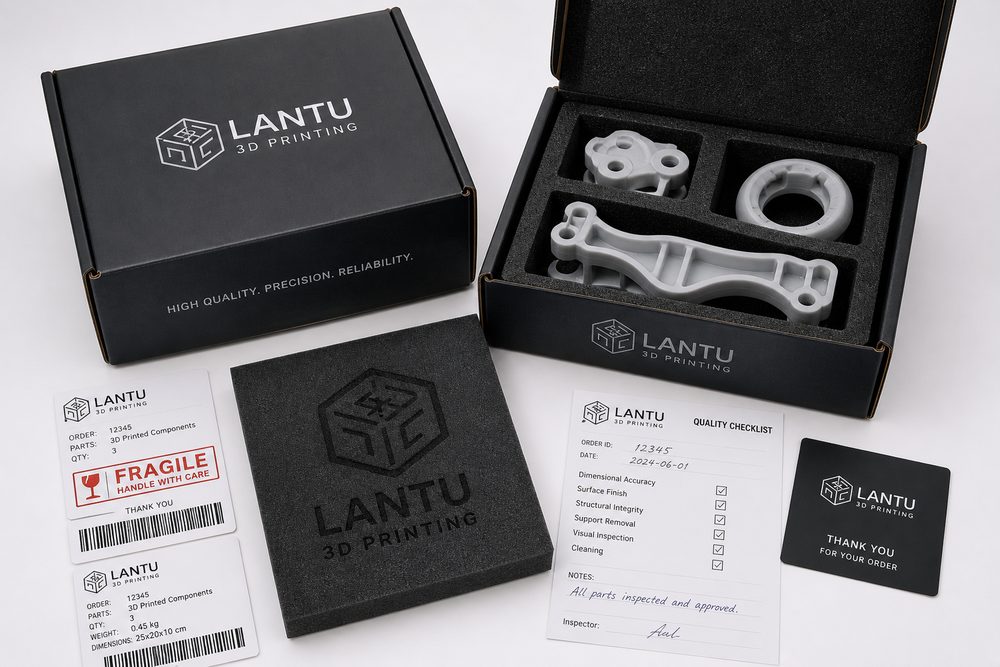
Before packaging, identify cantilevers, slender columns, thin walls, sharp corners, mating surfaces, and cosmetic surfaces. For brittle resin parts, use foam restraints with localized supports to prevent movement inside the box; for nylon powder parts, use flexible separators to prevent parts from rubbing against each other; for metal parts, control stacking loads and surface scratching. For long parts and thin sheet-like parts, it is recommended to add a rigid backer board or a custom tray to prevent bending and deformation during transport.
2. Packaging Information Should Support Traceability and Inspection
Each package unit should be labeled with the order number, part number, batch number, quantity, orientation notes, vulnerable areas, and unpacking instructions. For multi-part assembly projects, it is recommended to include the parts list and assembly relationships in the parcel to reduce the customer's secondary verification cost. If the same order contains multiple materials or post-processing states, they should be bagged separately and divided into zones with color labels to avoid confusion on site.
3. Transit Conditions Must Match Material Characteristics
Different materials have different sensitivities to temperature, humidity, and light exposure. Some photopolymer resin parts should avoid prolonged direct sunlight; high-precision thin-wall parts need protection from softening or warping caused by hot vehicle compartments; dyed nylon parts should be moisture-protected and kept from rubbing against dark packaging materials. For high-value or urgent shipments, the shipping method should not be chosen on price alone, but also on delivery time stability, number of transfers, and compensation terms.
4. Closed-Loop Inbound Inspection Reduces Disputes
Before delivery, photos of the parts before packaging, critical dimension inspection photos, and packing photos can be taken as evidence of the pre-shipment condition. If the customer finds an abnormality after arrival, opening photos, damaged locations, outer box condition, and part batch information should be used to quickly identify the cause. Incorporating logistics issues into after-sales data helps optimize packaging materials and carton designs over time instead of handling each case ad hoc.
Conclusion
Packaging and shipping are not low-value steps; they are the final line of defense for 3D printing service quality. Only by integrating structural risk, material characteristics, and acceptance evidence into management can printed parts arrive at the customer in the correct condition. Blueprint3D emphasizes end-to-end realization from design to delivery, and logistics management is an indispensable part of that process.
Submit a model, drawing, image or written notes. Engineers will review material, process, finishing and delivery based on actual use.