Technical Principles of Light-Curing High-Toughness Resin
Photocurable tough resin (Tough Resin) is a class of engineering-grade resin materials developed based on SLA/DLP/LCD photocuring technologies. Its core characteristic is the significant improvement of impact resistance and elongation while maintaining the forming accuracy of photocuring. Traditional standard photocurable resins often exhibit drawbacks such as high brittleness and proneness to fracture due to high cross-linking density. In contrast, tough resins, through molecular structure modification, introduce flexible chain segments into the cured network, thereby increasing the elongation at break to 20%-50% while maintaining high tensile strength, approaching the performance level of engineering plastics.
From a chemical composition perspective, high-toughness photocurable resins are typically based on epoxy acrylates or polyurethane acrylates, combined with functional monomers, photoinitiators, and various additives. The introduction of polyurethane acrylate is crucial—the soft segments (such as polyethers or polyesters) within its molecular chains impart flexibility to the material, while the hard segments (such as isocyanates) ensure its strength and modulus. This microphase separation structure enables the material to effectively disperse stress when subjected to force, preventing rapid crack propagation.
Key Performance Indicators and Test Methods
Evaluating the performance of light-curing high-toughness resins requires focusing on several core indicators. Tensile strength typically falls within the range of 40-60 MPa, tensile modulus ranges from 1.5-2.5 GPa, and elongation at break can reach 30%-60%, significantly higher than the 5%-10% of standard resins. Impact strength (Izod or Charpy) is a direct indicator of toughness; the unnotched impact strength of high-toughness resins typically exceeds 50 kJ/m². Furthermore, Heat Deflection Temperature (HDT) is an important parameter, with the HDT of most high-toughness resins falling between 45-60°C, making them suitable for general engineering applications.
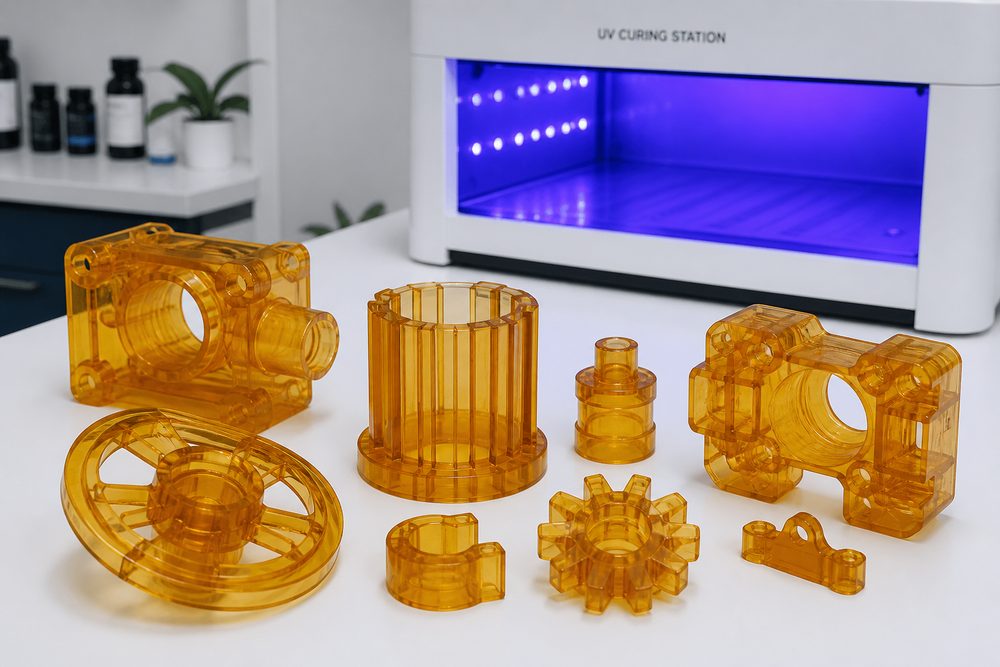
In practical testing, in addition to standard ASTM or ISO tests, attention must also be paid to the long-term stability of the material. Photocurable resins still contain residual monomers after curing, and these monomers may migrate or continue to react over time, leading to changes in material properties. Therefore, post-curing is particularly critical for high-toughness resins—typically, continuous irradiation at 60-80°C for 30-60 minutes ensures the material achieves its optimal performance state.
Applicable Scenarios and Typical Applications
High-toughness UV-curable resins are best suited for applications that require withstanding certain mechanical loads or demand a degree of flexibility. In the consumer electronics sector, they are commonly used to manufacture components such as phone cases, earphone housings, and smartwatch straps that require drop and bending resistance. When these components are subjected to impact, the toughness of the material can effectively absorb energy, preventing brittle fracture. In the automotive industry, high-toughness resins can be used to manufacture functional parts such as interior trim, ventilation ducts, and snap-fits; their excellent dimensional stability and surface quality also meet the aesthetic requirements of automotive interiors.
In the field of industrial manufacturing, high-toughness resin is the preferred material for manufacturing fixtures, jigs, and assembly aids. These tools are subject to frequent use and must withstand repeated stresses; standard resins are prone to fracture during use, whereas high-toughness resins can significantly extend tool life. Furthermore, in the medical device sector, high-toughness resins are also used to manufacture auxiliary medical devices such as surgical guides and dental models that require a certain degree of flexibility, though attention must be paid to the biocompatibility certification of the materials.
Suggestions for Process Parameter Optimization
The print parameter settings for high-toughness resin differ significantly from those for standard resin. Due to the typically higher material viscosity, the exposure time on LCD 3D printers needs to be appropriately extended, usually by 20%-50% compared to standard resin. It is recommended to control the layer thickness between 0.05-0.1mm; excessively thick layers will lead to insufficient interlayer adhesion, affecting the overall toughness. Additionally, since the curing shrinkage rate of high-toughness resin is slightly higher than that of standard resin, it is necessary to reserve an appropriate shrinkage allowance during design or perform scaling compensation in the slicing software.
Post-processing significantly impacts the final performance. In addition to standard cleaning (using isopropyl alcohol or specialized cleaning solutions) and post-curing, it is recommended to perform an "annealing" process for high-toughness resins—maintaining the temperature for 1-2 hours at 5-10°C below the Heat Deflection Temperature (HDT), followed by slow cooling. This process relieves internal stress and reduces the risk of part warpage and cracking. Furthermore, for applications requiring high transparency, low-shrinkage formulations should be selected, and the oxygen inhibition effect during the curing process should be controlled.
Comparative Analysis of Mainstream Market Products
Currently, mainstream high-toughness photopolymer resin products on the market each have their own distinct features. Formlabs' Tough 2000 Resin is renowned for its balanced strength and toughness; with a tensile strength of 45 MPa and an elongation of 30%, it is an ideal choice for functional prototypes. Anycubic's Tough Resin is notable for its cost-effectiveness, offering good toughness at only half the price of imported brands. Elegoo's 8K Tough Resin is optimized for high-resolution printers, capable of achieving fine detail reproduction at 0.02 mm.
Domestic resin brands have also made significant strides in recent years. Through unique polyurethane modification technology, they have achieved excellent performance with a tensile strength of 55 MPa and an elongation at break of 45%, while offering a distinct price advantage. When selecting materials, in addition to focusing on basic mechanical properties, factors such as storage stability, color stability, and odor should also be considered. For professional applications, it is recommended to conduct small-batch testing to verify that the material performance meets actual requirements.
Future Development Trends and Technology Outlook
The future development of high-toughness photocurable resins will center on three directions. First is the introduction of bio-based materials, utilizing renewable resources (such as vegetable oils and rosin) to prepare photocurable resins, which reduces carbon emissions while maintaining good performance. Second is functional modification, such as developing high-toughness resins with self-healing capabilities that can achieve self-repair triggered by heat or light when microcracks form, thereby extending the service life of parts. Finally, there is adaptation to high-speed photocuring; with the popularization of high-speed photocuring processes such as Carbon's CLIP technology and Formlabs' LFS technology, developing high-toughness materials compatible with these new processes will become an important direction.
In summary, photocurable high-toughness resins, acting as a bridge between the precision of traditional photocurable resins and the performance of engineering plastics, are continuously expanding the application boundaries of photocurable 3D printing. For engineers and designers, a deep understanding of the characteristics of these materials, along with their rational selection and application, will enable the full utilization of the advantages of 3D printing in rapid prototyping and small-batch manufacturing, accelerating product development cycles and reducing manufacturing costs.
Submit a model, drawing, image or written notes. Engineers will review material, process, finishing and delivery based on actual use.