
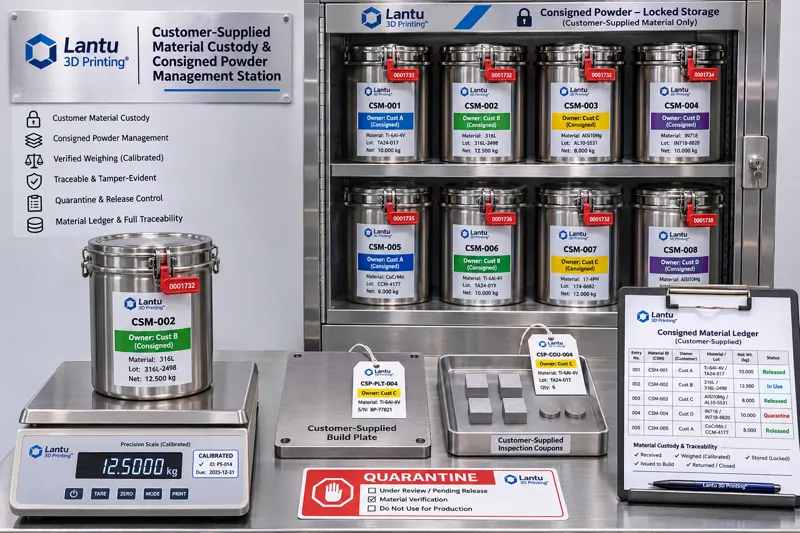
Introduction: After a Customer Delivers a Drum of Powder to the Shop Floor
In on-demand manufacturing, it is common for customers to provide powder, build plates, model files or dedicated tooling: an aerospace customer may specify a particular batch of Ti6Al4V powder and require unused material to be returned; a medical customer may supply a validated resin batch to preserve the biocompatibility evidence chain; a tooling customer may send build plates for conformal-cooling inserts with the order. At this point, the most easily overlooked issues are not print parameters but who owns these items, whether they can be mixed with in-house material, how unused material is returned, and on what basis losses are settled. ISO 9001:2015 Clause 8.5.3 defines such items as “property belonging to customers or external providers” and requires their identification, verification, protection and safeguarding. Any loss, damage or unsuitability must be reported to the customer and documented information retained; AS9100D and IATF 16949 impose even stricter reporting-time requirements. In practice, most disputes do not arise from build failure, but from a receiving record with an unclear net weight: customer powder is merged into an in-house reclaimed-powder container, 1.3 kg less residual material is returned, or rejected parts are treated as waste without authorization. As a lifecycle management platform supporting delivery from drawings to physical parts, lantu3D manages customer-supplied assets as an independent, auditable data chain parallel to the build, rather than simply attaching a label in the warehouse.
I. Define “Customer-Supplied” Clearly: Four Asset Categories and Ownership Boundaries
Customer-supplied property is not a single material category, but comprises four categories of objects with the same ownership principle and different control methods. Each must be listed during quotation and technical-agreement stages to prevent unclaimed items at delivery. 1. Customer-supplied powders and wires: metal powders, nylon PA12 powder, photopolymer resins and filaments shall be uniquely identified by grade + lot number + container seal number. Ownership remains with the customer throughout, while the manufacturer has only entrusted processing rights; 2. Customer-supplied build plates and furnace-coupon carriers: LPBF build plates may be required for delivery with the part or for return, and their material, thickness, initial flatness and whether repeat blasting is permitted must be recorded; 3. Customer-supplied models and parameter files: STL/3MF files, CAD source files, customer-frozen process parameter packages, and PMI/MBD annotations belong to the customer. Only controlled copies and hash values shall be retained; 4. Customer-supplied tooling, gauges and comparison samples: locating fixtures, CMM gauges, signed and sealed samples are returnable physical items and require separate identification numbers and condition photographs.
Four boundary clauses should be fixed in the agreement: customer-supplied materials must not be diverted to other orders; must not be blended with in-house materials or materials from other customers unless written customer approval specifies the blend ratio and lot numbers; whether rejected parts and non-recoverable powder are to be returned must be governed by written instructions; and, upon project completion, model copies shall be deleted or archived as agreed, with a deletion record issued. ISO/ASTM 52901 requirements for additive-manufacturing purchasing information can serve as the framework for technical agreements, making “material owner,” “blendability” and “residual-material disposition” determinable fields rather than vague statements such as “properly safeguarded.”
II. Incoming Receipt: Convert Verbal Handover into an Auditable Custody Ledger
The incoming-receipt objective is simple: every subsequent weighing operation must be traceable to an original numbered record. A customer-supplied material number CSM-YYYYMMDD-### is recommended as the primary key. The ledger should include at least: material-owner code, order number, material category, grade, lot number, number of containers and seal numbers, gross/tare/net weight (electronic scale accuracy no less than ±1 g, with calibration certificate within validity), COA/COC number, receipt date, storage-location code, status label (pending reinspection/released/quarantined/pending return), reinspection report number, and dual signatures from handler and reviewer.
Reinspection does not repeat the customer’s testing; it confirms that “the condition has not changed during transport and before/after opening.” For metal powder, Hall flow rate may be measured according to GB/T 1482; 15–53 μm powder for LPBF typically requires ≤25 s/50 g. D50 may be verified according to GB/T 1480 or by laser diffraction. Ti6Al4V oxygen content should be checked against the customer certificate, with receiving limits of ≤1000 ppm oxygen and ≤300 ppm nitrogen; moisture may be cross-verified by Karl Fischer testing or chamber dew point ≤−40 ℃. For photopolymer resin, record viscosity at 25 ℃ and batch expiry date. For model files, calculate the SHA-256 hash and record units, coordinate system, geometry-repair items and volume difference before and after repair. If any item exceeds the technical-agreement threshold, immediately attach a “quarantine” label and report in writing to the customer within 24 hours. It must not be put into production first with paperwork completed later—this is precisely where Clause 8.5.3 is most often breached.
III. Dedicated Material Use: Three Hard Rules for Physical Segregation, Sealing and No Blending
Segregation depends on physical controls, not slogans. Rule one: one customer, one location; one lot, one container. Customer powder containers shall be stored in separate locked cabinets or on separate pallets. Colour coding and seal numbers shall be linked to the customer-supplied material number. Screening equipment and powder containers must not be shared with in-house reclaimed powder; shared equipment must undergo changeover clearance. Rule two: reclaimed powder shall not return to customer-supplied material by default. Even if it has the same grade and lot number, powder screened after LPBF processing has undergone thermal cycling, resulting in oxygen/nitrogen increases and particle-size drift. If the customer provides written permission for return flow, it must be limited by the same lot number, screen mesh size, blend ratio—commonly ≤30% in engineering practice—and oxygen increase ≤100 ppm. The blending record shall be maintained as a version-controlled recipe and written back into the build parameter package. Rule three: retain evidence for four clearance steps—empty the powder chamber, vacuum clean, wipe with anhydrous ethanol, and conduct first-part confirmation. After clearance, weigh residues (recommended ≤0.5 g/m² or no visible residue by visual inspection), complete the clearance record and obtain second-person verification before changing to the next customer-supplied lot.
A typical failure scenario is when a night shift, trying to meet a delivery deadline, pours Customer A’s remaining powder into Customer B’s container of the same grade to “make up a full charge.” The two powder lots differ in oxygen content and particle-size distribution, changing the density and fatigue-scatter band of the final parts, while the inspection report states only “Ti6Al4V.” Afterwards, it is impossible to prove which container was used. Physical segregation, seals and documented clearance fundamentally protect the attribution of inspection conclusions.
IV. Consumption Settlement: Issued Material, Recovery and Residual Material Must Reconcile
Nearly all settlement disputes arise from inconsistent definitions. “Net consumption” and “non-recoverable loss” must be defined separately and frozen in the data dictionary:
W_net = W_issued − W_recovered_usable − W_returned; W_loss = W_net − W_part − W_coupon − W_support. Here, W_issued is the net issued material weight; W_recovered_usable is screened recovered powder deemed reusable, which remains customer property but returns to custody status; W_returned is the actual returned residual material; and W_part/W_coupon/W_support are respectively the built weight of conforming parts, furnace coupons, and supports + build plate. The closure discrepancy |W_loss − measured loss| should be ≤1.5%. If exceeded, suspend return sign-off and issue a nonconformance report. A warning limit of ≤2.0% is recommended for the non-recoverable loss rate W_loss/W_issued; metal LPBF is typically 0.8%–1.5%, while photopolymer residual liquid and cleaning losses are slightly higher. Exceeding the limit requires root-cause attribution to screening, depowdering or transfer operations.
Example: A customer-supplied Ti6Al4V order comprises three builds. Issued material is 18.500 kg; usable recovered powder after screening is 12.850 kg; returned residual material is 1.320 kg; built parts + supports + furnace coupons total 4.150 kg; and non-recoverable powder from depowdering and screening is 0.180 kg. Net consumption = 18.500 − 12.850 − 1.320 = 4.330 kg, and 4.330 = 4.150 + 0.180, giving full reconciliation. The non-recoverable loss rate is 0.180/18.500 ≈ 0.97%, within the warning limit. Note that 12.850 kg of recovered powder must not be counted as cost consumption; it represents a status transfer of customer property. If 4.330/18.500 is incorrectly reported as a 23.4% loss, a commercial dispute will result directly. In shared-build scenarios, net consumption should be allocated to parts weighted by “scan time × number of layers × support volume.” Freeze the rule version before calculation, and use the number of conforming delivered parts as the denominator so that rejected rework is amplified by yield.
V. Machine Release and Lot Binding: Customer Material Must Not Exist Only in the Ledger
Even a complete ledger cannot prevent a broken chain if the build job identifies only the material grade. Machine-release controls should enforce six bindings: enter the customer-supplied material number and seal number in the work order; record parameter-package version number and hash; record machine number and chamber dew point; place furnace coupons in the same lot and orientation; make the “material owner” field mandatory in inspection records; and attach a customer-supplied material declaration page to the delivery report. CMM dimensional reports, tensile/density reports and powder reinspection reports shall all be indexed under the same customer-supplied material number to form a traceable evidence package. Acceptance rules should address uncertainty bands according to ISO 14253-1, while laboratory competence should be confirmed to ISO/IEC 17025. If the parameter package changes during production, reassess customer-material suitability through the ECN process; verbal authorization to “continue using the previous parameter version” is prohibited.
VI. Residual-Material Return and Scrap Disposal: Someone Must Sign at the End
Three actions are required at project closeout. First, reweighing and sealing: reweigh residual material, recovered powder and build plates separately, apply new seals, and attach a return list containing customer-supplied material number, net weight, status, number of containers and photographs. Together with the customer receipt acknowledgement, this forms a closed loop. Second, written disposition instructions: return residual material / transfer to the next batch / retain for 30 days / authorize destruction. One of these four options must be signed by the customer’s designated contact. Send a reminder seven days before the retention period expires; if no response is received, act according to the technical agreement’s default clause and retain records. Third, scrapped parts and unusable powder: safety-critical or confidential parts shall receive destructive identification, such as drilling or corner cutting, before disposal as authorized by the customer. They must not leave the facility as ordinary scrap. If non-recoverable powder contains reactive metals, transfer it in accordance with the MSDS and hazardous-waste manifest requirements, then enter the manifest number back into the ledger.
VII. 30-Day Implementation and Checklist
Week 1: revise the technical-agreement template and add a “Customer-Supplied Asset List” appendix, defining material owner, blendability, residual-material disposition and reporting deadline as fields. Week 2: establish customer-supplied material numbering rules and custody ledgers; provide separate locked cabinets, colour coding, seals and calibrated electronic scales. Week 3: revise work-order and inspection templates to make “material owner / customer-supplied material number / parameter-package hash” mandatory. Week 4: run a real order end to end and conduct one simulated return sign-off. After implementation, perform an eight-point self-check: ① are ownership details listed for all four asset categories; ② is every scale calibration certificate valid; ③ are incoming-reinspection thresholds written into the agreement; ④ is there one location per customer with intact seals; ⑤ are material-change clearance records double-verified; ⑥ is blending supported by written authorization and a recipe version number; ⑦ do consumption closure discrepancy and loss rate have warning limits; ⑧ are return acknowledgements and hazardous-waste manifests entered back into the ledger?
Conclusion
Customer-supplied material governance is not a warehousing detail. It translates the legal and standards-based obligation of “customer property” into measurable figures: one customer-supplied material number, one ledger with tare weight, one material balance that reconciles within 1.5%, and one return list signed by an accountable person. When issued material, recovery, residual material and built parts reconcile, and the parameter package and inspection records can be traced back to the same lot, delivery includes not only conforming parts but also an auditable account of customer assets. For platforms focused on delivery from drawings to physical parts, this account is as important as the dimensional report.
Hantar model, lukisan, imej atau nota bertulis. Jurutera akan menyemak bahan, proses, penyempurnaan dan penghantaran berdasarkan penggunaan sebenar.