
Introduction: The Trade-off Between Lightweighting and Temperature Resistance
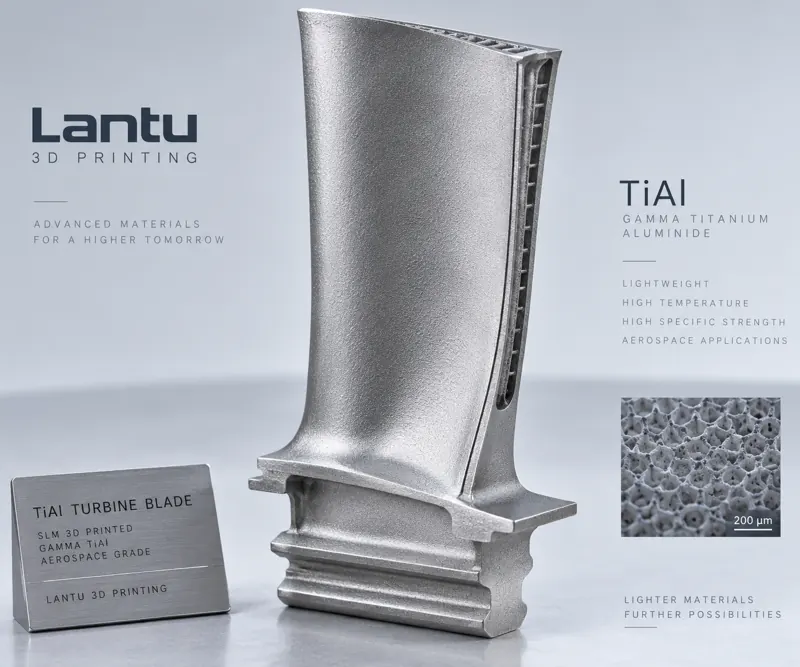
Aero engines and gas turbines continue to demand lower weight and higher temperature capability. Nickel-based superalloys have a density of about 8.2 g/cm³, leaving limited room for weight reduction. In contrast, γ-TiAl intermetallics, such as Ti-48Al-2Cr-2Nb in atomic percent, have a density of only 3.9–4.2 g/cm³, roughly half that of nickel-based alloys, while being capable of long-term service at 700–800°C. Using these materials in temperature-bearing structural components such as low-pressure turbine blades and compressor casings is an important pathway for aerospace lightweighting. However, TiAl has high intrinsic brittleness, low thermal conductivity, and aluminum that oxidizes readily, making conventional forging and casting extremely difficult. Laser powder bed fusion (LPBF) has therefore become one of the most promising forming methods.
1. Why TiAl Is Well Suited to Additive Manufacturing
γ-TiAl typically has room-temperature ductility below 2%, a narrow hot-working window, and high material loss and cost in conventional machining and forging. LPBF bypasses the challenges of large-deformation processing through layer-by-layer melting, enabling near-net-shape blade preforms with complex internal cooling channels. For low-volume, high-mix high-temperature components, additive manufacturing offers clear advantages in lead time and design freedom, while also supporting rapid iterative validation before engine installation.
2. Core Process Challenges in LPBF
TiAl faces three typical issues in LPBF. The first is hot cracking and cold cracking, caused by steep temperature gradients and high residual stresses resulting from low thermal conductivity. The second is the high laser reflectivity and high vapor pressure of aluminum, which can easily lead to balling, spatter, and porosity. The third is increased interlayer oxygen content, which can form embrittling oxide films and reduce ductility and fatigue performance. These factors require the process window, atmosphere, and post-processing to be designed as an integrated closed loop.
3. Process Window and Parameter Control
In engineering practice, commonly used process ranges include laser power of 150–350 W, scanning speed of 600–1200 mm/s, and layer thickness of 30–50 μm, combined with substrate preheating at 200–400°C. Some systems use heated build plates at around 500°C to reduce thermal-stress cracking. Excessive energy density can cause keyholing and over-melting, while insufficient energy density results in inadequate densification. The target relative density should be kept consistently above 99.5%. Checkerboard or stripe scanning strategies, together with rotated scan directions, are also used to suppress residual stress concentration.
4. Atmosphere and Oxygen Control
The high reactivity of aluminum makes TiAl extremely sensitive to oxygen. The oxygen content in the build chamber is recommended to be controlled below 500 ppm, and the oxygen content of titanium aluminide powder should preferably be below 0.1 wt%. Powder handling and part removal should be carried out in a fully argon-filled glovebox or inert environment to prevent moisture absorption and oxidation. Stable atmosphere management is a prerequisite for suppressing embrittlement and ensuring batch-to-batch consistency, as well as for preventing abnormalities during subsequent heat treatment.
5. Post-Processing and Microstructure Control
As-built LPBF TiAl typically contains lack-of-fusion pores and interlayer defects. Hot isostatic pressing, or HIP, at approximately 1180–1250°C and 150–200 MPa is required to close porosity, followed by heat treatment to obtain an α2+γ lamellar microstructure that balances strength, toughness, and creep resistance. Proper heat treatment can stabilize room-temperature tensile strength and tensile strength at 700°C in the ranges of 600–700 MPa and 700–800 MPa, respectively, meeting the service requirements of temperature-bearing structural components.
6. Performance and Typical Applications
TiAl components optimized through coordinated process and post-processing strategies have already undergone engine installation validation in aero-engine low-pressure turbine blades, jet flaps, and compressor components. Their value does not lie in a single performance limit, but in the combined advantage of halving density while improving temperature resistance. At the same service temperature, they significantly reduce weight, thereby improving thrust-to-weight ratio and fuel efficiency. This is the core logic behind using additive manufacturing for high-temperature lightweight components.
Conclusion
LPBF forming of γ-TiAl is a systems engineering challenge spanning materials, processing, and post-processing. Only by controlling the narrow process window, inert atmosphere, and HIP plus heat treatment steps can this difficult-to-process lightweight high-temperature material be transformed into repeatable, batch-producible aerospace structural components. For manufacturers pursuing lightweighting and high thrust-to-weight ratios, TiAl additive manufacturing is moving from research toward engineering implementation.
Submit a model, drawing, image or written notes. Engineers will review material, process, finishing and delivery based on actual use.