Introduction: From Manufacturing Services to Capability Empowerment
The traditional 3D printing service model is "the customer provides the model, and the service provider prints it." In this model, the service provider is only a manufacturing executor, with limited value creation. Modern professional 3D printing service providers are now transforming into "capability enablers": through technical training, design guidance, knowledge sharing, and other methods, they help clients master 3D printing design principles and manufacturing characteristics, thereby improving clients' independent design capabilities. This transformation not only increases the added value of the service, but also builds deeper customer loyalty. As clients' design capabilities improve, the relationship between both parties evolves from simple "print orders" into a strategic partnership of "co-innovation."
The Three Levels of Technical Training: Awareness, Skills, Mastery
For different types of clients, the technical training system should be divided into three levels. The awareness level is aimed at managers and decision-makers, focusing on the technical principles, application value, and cost structure of 3D printing to help clients build a holistic understanding of the technology. The skills level is aimed at design engineers, providing in-depth explanations of design for manufacturability (DFM) principles, process parameter selection, and comparisons of material properties, enabling engineers to independently design printable models. The mastery level is aimed at advanced users, exploring advanced topics such as topology optimization, lattice structure design, and multi-material applications, helping clients unlock the full potential of 3D printing. This tiered training system ensures that every learner receives knowledge suited to their needs.
Training Content Design: A Complete Path from Theory to Practice
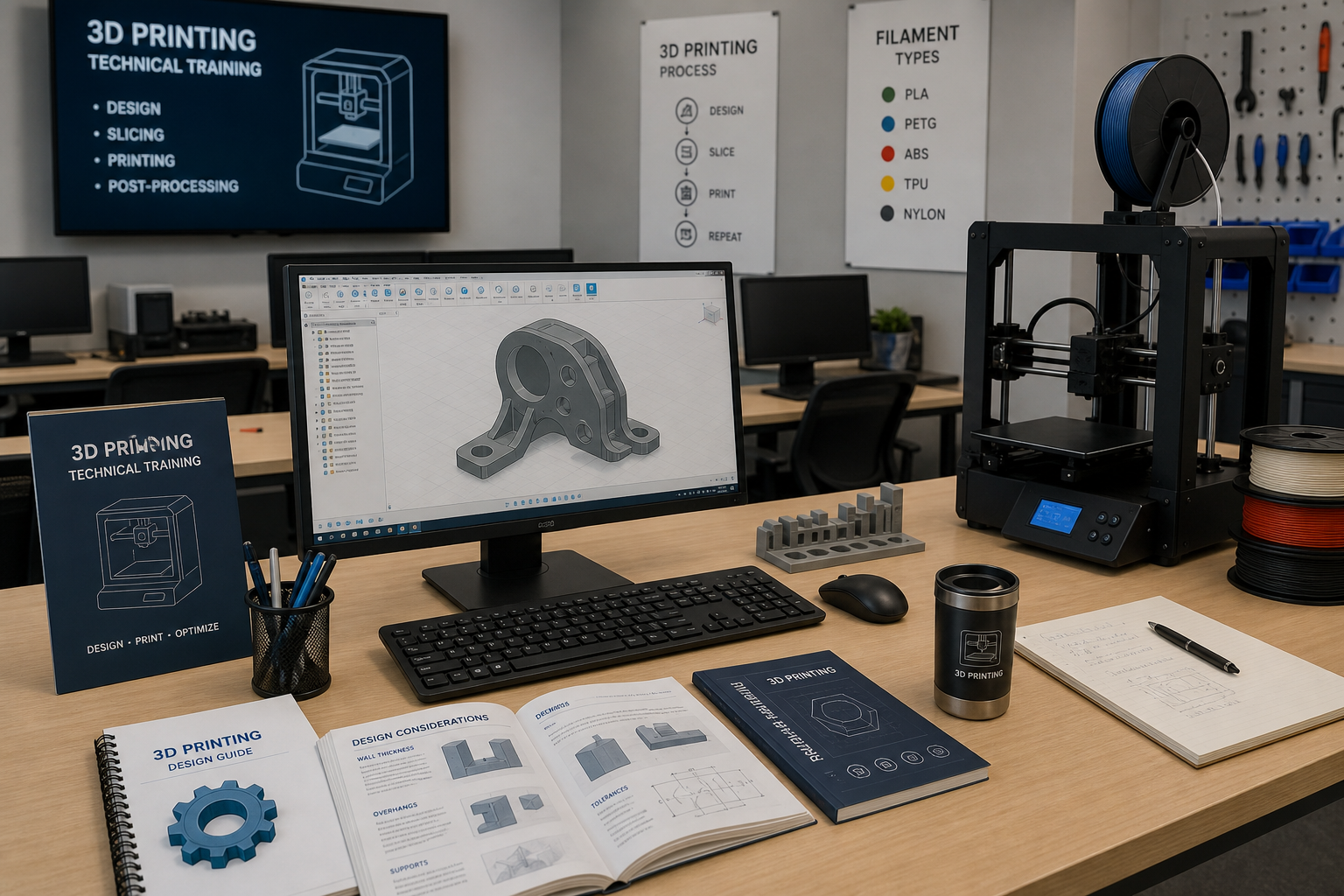
High-quality training content must balance theory and practice. The theoretical portion includes the principles of 3D printing technologies (comparisons among SLA, SLS, SLM, and other processes), fundamentals of materials science (performance characteristics of resins, nylon, and metals), and design principles (wall thickness, supports, tolerances, and more). The practical portion guides learners through the full workflow from design to printing using real cases: starting with requirement analysis, then moving through model design, manufacturability checks, process selection, printing parameter setup, and finally physical verification. Each practical step is accompanied by detailed work instructions and FAQs to ensure learners can complete tasks independently. Training content should also be updated regularly to keep pace with the latest developments in technology and materials.
Online Learning Platform: Knowledge Retention and Continuous Empowerment
Offline training is limited by time and location, while an online learning platform enables continuous knowledge transfer. Professional 3D printing service providers should build their own online knowledge base, including design guideline documents, process parameter databases, case studies, video tutorials, and more. The knowledge base should be organized by topic and support keyword search so that clients can quickly find the information they need. In addition, an online Q&A community can be created so that clients can exchange experiences and solve problems with each other and with engineers. An online learning platform is not only an extension of training tools, but also a window through which the service provider can demonstrate professionalism and build industry influence. Continuously updated high-quality content will attract more potential clients.
Design Review Service: Real-World On-the-Spot Training
Design review is an important practical scenario for technical training. When reviewing client models, engineers not only point out problems, but also explain why the problems occurred and how to solve them; this is itself a form of one-to-one training. An excellent design review report should include four parts: problem description (what it is), root cause analysis (why it happened), revision suggestions (what to do), and expected results (what will change after revision). Through repeated design review interactions, clients' design capabilities will gradually improve—from frequently encountering manufacturability issues at the beginning to proactively avoiding common mistakes later, and ultimately achieving the goal of independently designing high-quality printable models.
Certification System: Establishing Standards for Client Capability Levels
To encourage clients to continue learning and improving, a client design capability certification system can be established. Certification is divided into three levels—beginner, intermediate, and advanced—each corresponding to different capability standards and benefits. Beginner certification requires mastery of basic design for manufacturability principles, and certified clients can enjoy priority review channels. Intermediate certification requires the ability to independently design complex structures, and certified clients can gain permission for self-configuring process parameters. Advanced certification requires design optimization skills, and certified clients can become co-development partners of the service provider. The certification system not only motivates clients to learn, but also provides the service provider with a basis for tiered customer management.
Submit a model, drawing, image or written notes. Engineers will review material, process, finishing and delivery based on actual use.