The Unique Value of After-Sales Service in 3D Printing Services
The after-sales service of a 3D printing service company is fundamentally different from that of traditional manufacturing. In traditional manufacturing, after-sales service mainly revolves around product repair, spare parts supply, and troubleshooting; in 3D printing services, however, after-sales service must cover the entire process from design validation, process optimization, quality inspection, delivery tracking, to continuous improvement. Because each part in 3D printing can be different, after-sales service must be able to handle highly customized needs and respond quickly to customer design changes and quality feedback. An excellent after-sales service system not only solves customer problems, but also serves as an important source of information for continuous improvement. Statistics show that 70% of product improvement ideas come from customer feedback. By establishing standardized after-sales service processes, companies can systematically collect, analyze, and use customer feedback, turning individual experience into organizational capability.
Designing a Customer Issue Response Process
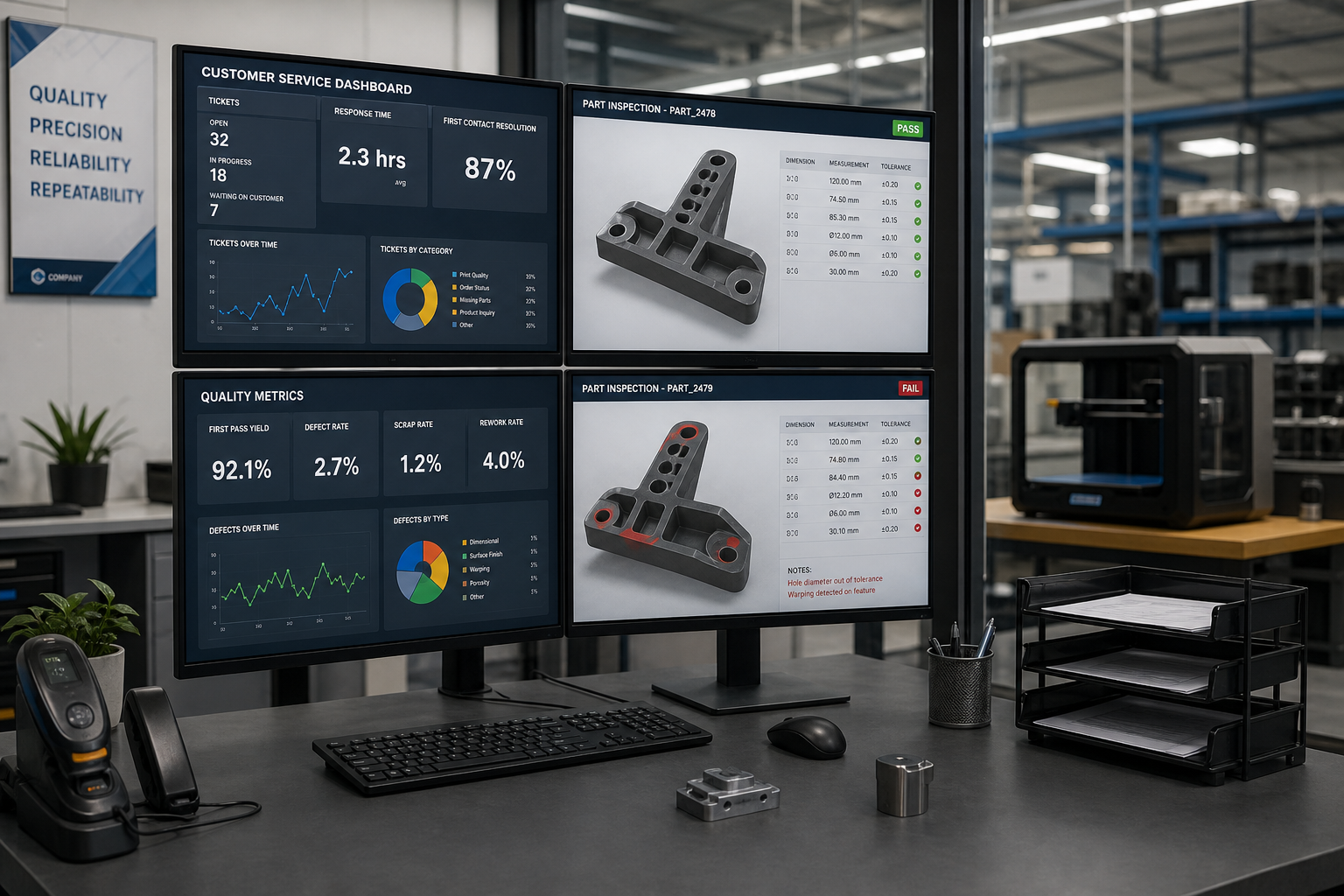
An efficient issue response process is the cornerstone of the after-sales service system. A complete response process should include six steps: issue intake, issue classification, initial diagnosis, solution development, solution execution, and result verification. During issue intake, multiple contact channels should be provided, and a response should be made within 15 minutes during working hours. Issue classification is key to rapid routing. Depending on the nature of the issue, customer issues can be divided into design issues, quality issues, delivery issues, and technical consultation issues. Each type of issue should have clear response and resolution time limits. For example, design issues should receive initial feedback within 4 hours, and quality issues should receive root cause analysis within 24 hours.
Quality Issue Analysis and 8D Reports
When a quality issue occurs, in-depth root cause analysis is key to preventing recurrence. The 8D report is a commonly used quality issue-solving methodology in manufacturing, including forming a team, problem description, temporary containment actions, root cause analysis, permanent corrective actions, verification of effectiveness, preventive actions against recurrence, and team recognition. The 8D method emphasizes data-driven and systematic thinking, avoiding superficial solutions. In 3D printing services, common root causes of quality issues include STL file defects, inappropriate process parameter selection, material problems, post-processing mistakes, and human operating errors. Through systematic 8D analysis, these root causes can be identified and targeted preventive measures can be formulated. The conclusions of each 8D report should be updated in the company’s lessons-learned database.
Corrective and Preventive Action System
Corrective and preventive actions are the core mechanism of a quality management system for turning problems into improvement opportunities. Corrective actions address problems that have already occurred and eliminate their root causes; preventive actions target potential problems and prevent them from occurring. Key elements of establishing a corrective and preventive action system include trigger criteria, processes, a tracking system, and effectiveness evaluation. In 3D printing services, common triggers include repeated quality issues from the same customer, process drift affecting critical dimensions, excessive differences in material performance between batches, and customer complaint rates exceeding thresholds. For each action, a responsible person and completion deadline should be assigned, and progress should be reported to management regularly. Through strict corrective and preventive action management, companies can demonstrate the seriousness of their approach to quality issues and strengthen customer confidence.
Customer Satisfaction Management and NPS Improvement
Customer satisfaction is the ultimate indicator of after-sales service quality. Net Promoter Score is currently the most commonly used quantitative satisfaction metric, measuring customer loyalty through a single question: How likely are you to recommend us to others? The calculation method for NPS is the percentage of promoters minus the percentage of detractors. Industry benchmark companies usually have NPS scores between 50 and 70, while excellent 3D printing service companies should aim for above 40. Specific measures to improve NPS include conducting satisfaction follow-ups within 24 hours after project delivery, establishing a customer success manager system, regularly providing customer service quality reports, and offering value-added services to high-value customers. For customers who give low scores, in-depth interviews should be conducted to understand the root causes and develop a recovery plan.
Standardized Documentation System for After-Sales Service
Standardized documentation is the guarantee that after-sales service can be replicated, measured, and improved. A complete after-sales service documentation system should include service process documents, service record forms, knowledge base documents, and service report templates. The development of the documentation system should follow the principle of process first, documentation second. First, verify the effectiveness of the process through pilot operation, and then codify it into standard documents. Documents should be reviewed and updated regularly, ensuring
Submit a model, drawing, image or written notes. Engineers will review material, process, finishing and delivery based on actual use.