
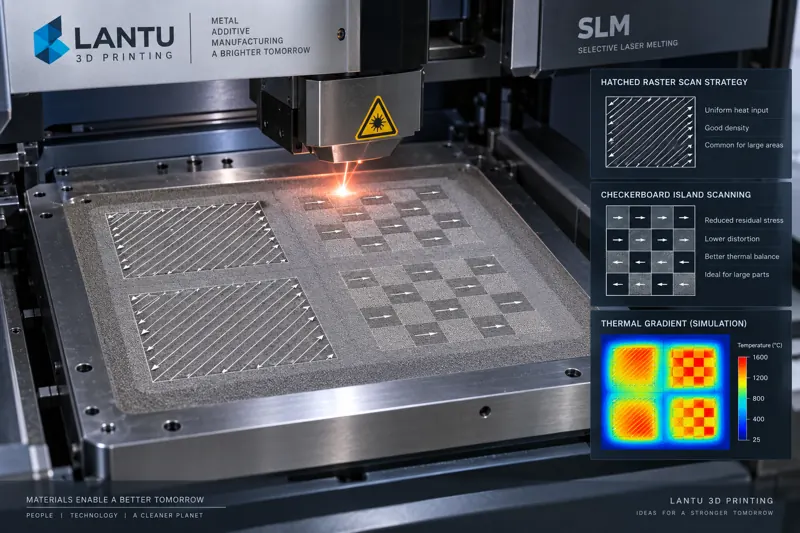
Introduction: Why Scanning Strategy Determines the Fate of a Metal Part
In SLM (Selective Laser Melting), engineers often focus on three major parameters: laser power, scanning speed, and powder layer thickness, while overlooking an equally critical factor: scanning strategy. With the same 316L stainless steel powder and the same layer thickness, simply changing the scanning path from unidirectional stripes to chessboard partitioning with 67-degree interlayer rotation can reduce the warpage of the same cantilever thin-wall part from 0.8 mm to less than 0.3 mm. In essence, scanning strategy controls the spatiotemporal distribution of the melt pool, thereby determining temperature gradients, residual stress, and final deformation. This article systematically reviews the engineering selection logic of SLM scanning strategies.
1. Geometric Principles of Mainstream Scanning Strategies
SLM scanning strategies can be divided into three categories by path topology: stripe scanning divides a single layer into parallel bands, with the laser moving back and forth along a fixed direction; chessboard scanning divides a single layer into multiple small islands, each filled with a serpentine path, while adjacent islands alternate scanning directions; island partitioning divides the layer into blocks at a larger scale. Stripe scanning has the longest path and good continuity, but heat accumulates along a single direction, making directional shrinkage more likely. Chessboard scanning interrupts heat flow through short paths and alternating directions, making it a mainstream solution for warpage control. In engineering practice, island sizes are commonly set at 5 to 10 mm. If the islands are too small, overlaps increase and powder spatter becomes more severe.
2. Interlayer Rotation Angle: The Key to Residual Stress Decoupling
Rotating the scanning direction layer by layer is a core method for suppressing anisotropy and interlayer stress. A classic value is 67 degrees, close to the golden angle. Compared with a fixed 90-degree interlayer rotation, 67 degrees can break up texture with fewer periodic repetitions, offset the stress directions of adjacent layers, and reduce accumulated bending. Tests show that for AlSi10Mg thin-wall parts, 67-degree interlayer rotation can reduce the peak longitudinal residual stress by about 30% and warpage by about 25% compared with 0-degree same-direction scanning. However, a larger rotation angle is not always better; it must be coordinated with island size and energy density.
3. Matching Boundaries of Energy Density and Scanning Parameters
The scanning strategy must fall within a reasonable volumetric energy density window. Taking 316L as an example, the typical VED range is 50 to 80 J/mm³, corresponding to a laser power of 200 to 280 W, a scanning speed of 800 to 1200 mm/s, a spot size of 0.1 mm, and a layer thickness of 30 microns. The hatch spacing inside an island is usually 3 to 4 times the spot size, about 0.10 to 0.14 mm. Excessive energy density can cause balling and pores, while insufficient energy density leads to lack of fusion. Adjusting the scanning strategy, such as adopting small chessboard islands, locally changes heat dissipation. Therefore, after changing the strategy, the process window must be recalibrated instead of directly applying parameters from stripe scanning.
4. Temperature Field Assistance: Substrate Preheating and Interlayer Temperature
The root cause of residual stress is the severe temperature gradient in the melt pool. Preheating the substrate to 120 to 200°C, or higher for titanium alloys, can significantly reduce temperature differences, lower stress levels by 20% to 40%, and reduce the risk of cracking. Some machines introduce interlayer holding or inert gas circulation to stabilize interlayer temperature. When printing large thin-wall parts or crack-sensitive materials such as Inconel and Ti6Al4V, the combination of preheating and chessboard scanning is often more effective than simply adjusting power. It should be noted that excessive preheating can weaken laser absorption by the powder and accelerate oxidation, so it must be controlled within the material process window.
5. Verification and Release of Scanning Strategies
Any change in scanning strategy should be released based on quantifiable indicators: use coordinate measuring machines to compare deviations between the actual contour and the digital model, use X-ray diffraction or the blind-hole method to measure residual stress distribution, and use industrial CT to inspect lack of fusion and pores at island boundaries. It is recommended to establish records linking strategies, parameters, and test specimens, and to perform first article inspection for critical parts. When switching materials or wall thickness ranges in batch production, process validation should be repeated to avoid directly transferring successful experience from one material to another.
Conclusion
SLM scanning strategy is not an isolated path selection, but a process system formed together with energy density, interlayer rotation, and substrate preheating. Chessboard partitioning controls warpage, 67-degree interlayer rotation decouples stress, a proper VED ensures fusion, and preheating reduces temperature gradients. Only by integrating these elements into a standardized process validation workflow can deformation and cracking risks be controlled while ensuring density. In metal 3D printing mass production, lantu3D achieves stable delivery through this systematic management of scanning strategies.
Submit a model, drawing, image or written notes. Engineers will review material, process, finishing and delivery based on actual use.