Introduction: Why Metal 3D Printing Can Be “Printable” but Difficult to Deliver
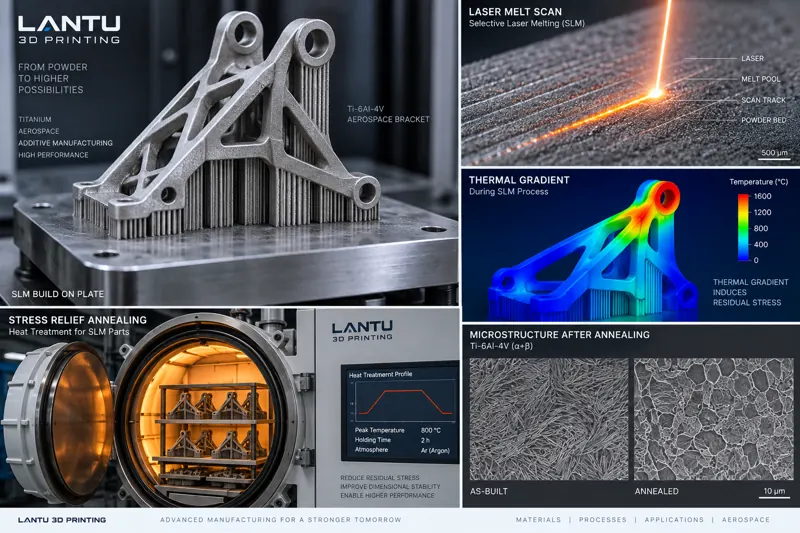
In SLM (Selective Laser Melting) metal 3D printing, laser power is typically 200–400 W, the spot diameter is about 80–120 μm, and the melt pool temperature can exceed 1600°C, while the surrounding powder bed is only about 80–120°C. This severe localized thermal gradient, which can reach 10⁵–10⁶ K/m, causes each track to undergo melting, solidification, and cooling within milliseconds. The material expands and then contracts, generating alternating tensile and compressive internal stresses between adjacent layers and scan tracks. When accumulated residual stress exceeds the yield strength of the material or the bonding strength between layers, defects such as build plate warping, part cracking, edge curling, and dimensional drift occur. Many companies can “print the part,” but struggle to “print it accurately, consistently, and ready for delivery.” The root cause is often uncontrolled residual stress.
1. Three Main Sources of Residual Stress and How to Identify Them
Residual stress in SLM mainly comes from three mechanisms: thermal gradient stress caused by constrained rapid cooling and shrinkage of the melt pool, phase transformation stress such as volume change during martensitic transformation, and reaction forces from support constraints, where supports and the build plate restrict free shrinkage. Taking Ti6Al4V as an example, peak residual stress in the as-built state is commonly in the range of 300–600 MPa. For nickel-based alloys and martensitic precipitation-hardening steels such as Inconel 718 and 17-4PH, phase transformation makes the stress distribution even more uneven. In engineering practice, X-ray diffraction (XRD) and neutron diffraction are commonly used to map surface or internal stress. Sectioning combined with contour scanning can also be used to back-calculate deformation. Establishing a “stress–distortion” correlation on trial parts is the prerequisite for effective control.
2. Four Key Process Methods for Stress Control
1. Build plate preheating. Raising the build plate temperature from room temperature to 150–200°C, or around 200°C for titanium alloys, significantly reduces the overall thermal gradient and can lower residual stress by 20%–40%. Aluminum alloys may require higher preheating combined with an inert atmosphere. Note that preheating temperature is limited by the oxidation threshold of each material. Titanium and aluminum require strict oxygen control, typically with oxygen content below 0.1%.
2. Scan strategy optimization. Using island or chessboard scanning instead of long unidirectional scan lines can interrupt continuous stress chains. Combined with 67°–90° layer-to-layer rotation and bidirectional staggered scanning, it helps balance stress in different directions. A scan speed of 700–1400 mm/s is generally recommended depending on material and layer thickness. Excessive speed can cause lack of fusion, while too low a speed creates excessive heat input and may increase stress.
3. Matching parameters with layer thickness. Common layer thickness ranges from 20–60 μm. Thin layers, such as 30 μm, have a smaller heat-affected zone but lower productivity, while thick layers, such as 60 μm, improve efficiency but increase stress. Laser power density, spot size, and layer thickness must be coordinated so that volumetric energy density (VED) stays within the suitable process window for the material, such as about 40–80 J/mm³ for Ti6Al4V, avoiding both overheating and lack of fusion.
4. Support and geometry design. For overhangs and thin walls, supports are not only required for forming; they also act as stress release paths. Using block-type or tapered transition supports, controlling overhang angles at 35°–45° or greater, and positioning large flat surfaces parallel to the build plate to shorten unsupported spans can significantly reduce edge curling. For thin-walled ring-shaped parts, adding process ribs and removing them during post-processing is an effective way to suppress ovalization.
3. Post-Processing: Process Windows for Annealing, HIP, and Aging
Stress-relief annealing is a standard pre-delivery step for most metal parts. Ti6Al4V commonly uses near-beta or alpha-plus-beta annealing at 530–650°C for 1–4 hours, releasing 40%–70% of residual stress without significant microstructural coarsening. For 17-4PH, stress relief is often performed at about 480–620°C. It should be noted that annealing may reduce part of the high strength of the as-built state, so strength margin must be reserved during the design stage.
Hot isostatic pressing (HIP) is typically performed at 920–1120°C under 100–200 MPa inert gas pressure for 1–4 hours. It can close internal pores, raise density to more than 99.5%, and eliminate most residual stress at the same time. HIP is a critical process for aerospace load-bearing components, but it may cause dimensional changes of about 2%–5%, so machining allowance must be planned in advance.
Aging treatment is used for precipitation-strengthened alloys. Inconel 718 is aged at about 620–720°C to precipitate the γ'' phase and improve strength. Aluminum-silicon-magnesium alloys such as AlSi10Mg use T6 aging to optimize hardness. The process sequence is important: in general, HIP or stress-relief annealing should be performed first, followed by aging for strengthening, to prevent strengthening phases from overgrowing during high-temperature stress relief.
4. Dimensional Stability Verification and Delivery Loop
In engineering projects, it is recommended to establish a four-stage dimensional inspection chain: as-built, annealed, finish-machined, and in-service. A coordinate measuring machine (CMM) should be used to compare the part with the CAD model and record deformation of critical features. For load-bearing parts, remeasurement after stress relaxation, such as checking again after 72 hours at room temperature, should be added to confirm that there is no secondary creep or drift. Before delivery, XRD sampling can be used to verify whether residual stress has been reduced to the target threshold, such as below 150 MPa. The annealing curve, HIP parameters, and inspection reports should be archived together to form a traceable quality closed loop.
Conclusion
Residual stress in SLM metal 3D printing is not something to be completely “eliminated,” but something to be understood, controlled, and released. By reducing stress generation through build plate preheating, scan strategy, parameter matching, and support design, then accurately releasing and strengthening the part through annealing, HIP, and aging according to the material system, and finally locking in stability through dimensional chain inspection and stress sampling, manufacturers can move metal parts from simple forming to true engineering delivery. lantu3D has developed mature process windows for stress-controlled printing and post-processing of titanium alloys, superalloys, stainless steels, and other metal parts, helping customers avoid cracking and dimensional drift risks from the first-article stage.
Submit a model, drawing, image or written notes. Engineers will review material, process, finishing and delivery based on actual use.