Introduction: The Construction Industry Enters the 3D Printing Revolution
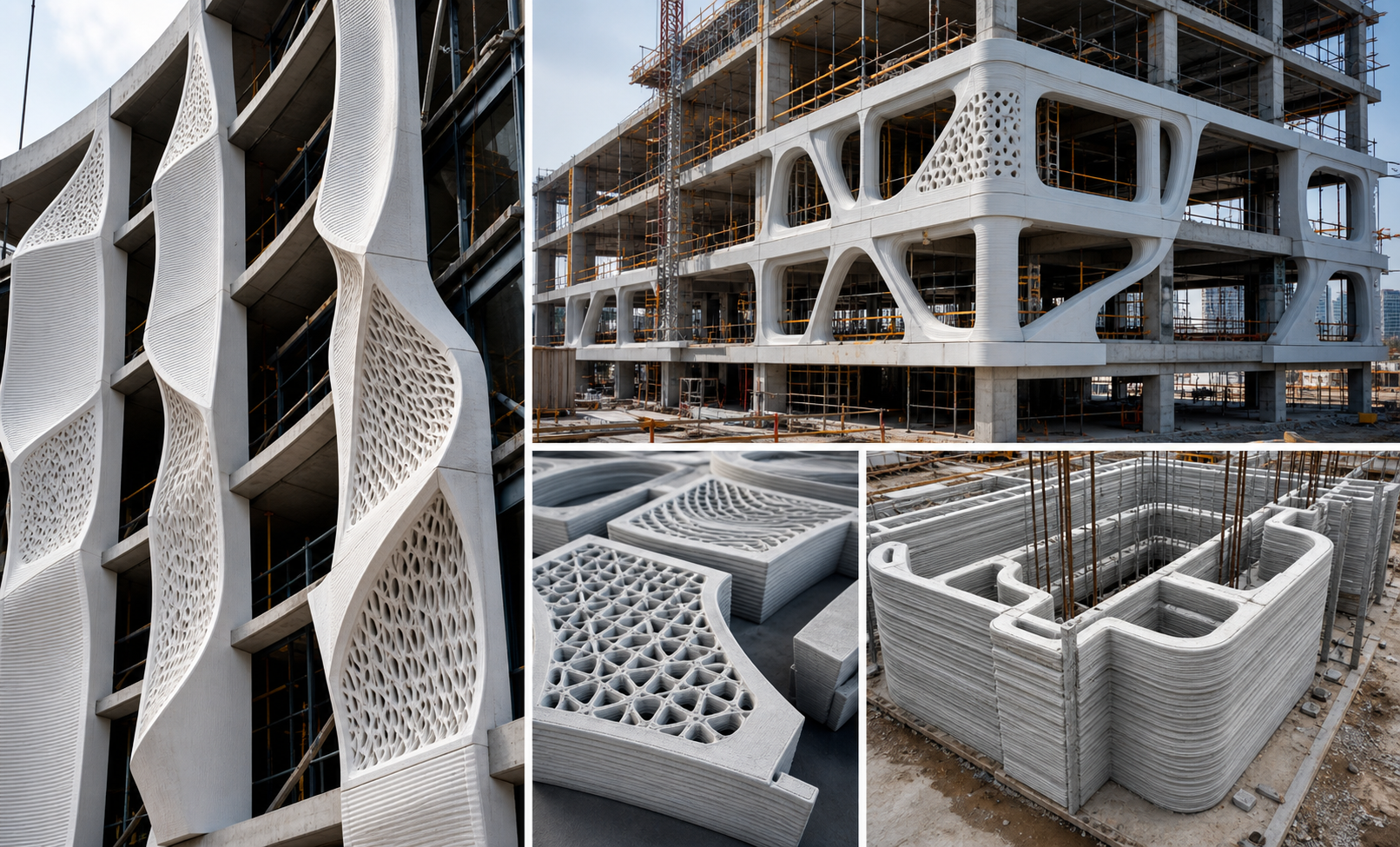
The construction industry is one of the largest manufacturing sectors in the world, and also one of the least digitized. Traditional construction relies on mold casting and on-site processing, which makes irregular components and complex geometries costly and time-consuming. 3D printing brings a completely new manufacturing paradigm to the construction industry: it can directly produce components of virtually any complexity without molds, greatly shortening production cycles, reducing mold costs, and enabling unlimited creative architectural design. From decorative irregular curtain wall panels to functional ventilation ducts and custom formwork for construction, 3D printing is creating value across multiple stages of the construction industry. For manufacturers of building components, mastering 3D printing technology has become an important way to enhance competitiveness.
Material Systems and Selection Strategies for Architectural 3D Printing
Material selection for 3D printing in the construction industry differs significantly from that in traditional manufacturing. The current mainstream material systems include polymer-based composites (such as glass fiber reinforced concrete and polymer-modified mortar), metal structural parts (such as steel structural nodes and decorative metal components), and emerging concrete 3D printing. Polymer-based composites are suitable for decorative components and lightweight structural parts, offering advantages such as low weight, good weather resistance, and high design freedom. Metal structural parts are suitable for load-bearing nodes and large connecting components, with excellent strength and durability. When selecting materials, it is necessary to comprehensively consider factors such as the component's service environment (indoor/outdoor, contact/non-contact), mechanical performance requirements, weather resistance requirements, and cost budget. Building a material performance database that records the long-term performance of each material in different environments is key to optimizing material selection.
Design and Manufacturing Process of Irregular Curtain Wall Panels
Irregular curtain wall panels are one of the most representative applications of architectural 3D printing. Traditional curtain wall panels are limited by mold manufacturing and typically can only achieve simple geometric shapes. 3D printing, however, can realize any complex curved form—from double-curved surfaces to free-form surfaces, from parametric textures to biomimetic shapes—freeing designers' creativity from manufacturing constraints. In terms of manufacturing processes, SLS or SLA is usually used to print a master mold, followed by silicone replication or vacuum casting to produce the final component. For large-format curtain wall panels, a segmented printing and assembly approach can be adopted, with precise positioning structures ensuring assembly accuracy. Surface finishing is a critical step in curtain wall panel production: by using spraying, electroplating, anodizing, and other processes, a variety of textures and color effects can be achieved to meet the aesthetic requirements of architectural design.
3D Printing Applications in Construction Formwork
Construction formwork is another important application of 3D printing in the construction industry. Traditional formwork is mostly standardized, but irregular structures (such as curved beams, spiral staircases, and double-curved ceilings) require custom formwork, which is expensive and time-consuming. 3D-printed formwork can accurately reproduce the design shape while being lightweight, easy to assemble and disassemble, and reusable. In terms of material selection, high-strength engineering plastics (such as ABS and PC) or fiber-reinforced composites are typically used to ensure that the formwork does not deform or leak slurry during concrete pouring. Formwork design must take into account details such as draft angles, connector design, and rib reinforcement layout to ensure construction feasibility and formwork service life. By applying 3D-printed formwork, the construction efficiency of irregular structures can be improved by more than 50%, and construction costs can be reduced by more than 30%.
Quality Control: Special Requirements for Construction Components
Quality control for construction components is stricter than for industrial parts because these components are directly related to structural safety and service life. Quality control includes three aspects: dimensional accuracy control, material performance testing, and appearance quality inspection. In terms of dimensional accuracy, the tolerance requirements for construction components are usually within ±2 mm, and the requirements are even stricter for assembly interfaces (±0.5 mm). In terms of material performance, multiple tests are required, including compressive strength, tensile strength, weather resistance, and fire rating, to ensure compliance with building codes. In terms of appearance quality, surface flatness, color variation, bubbles, cracks, and other defects must be checked. Establishing dedicated quality inspection standards and testing procedures for construction components is key to ensuring delivery quality. For important projects, third-party inspection and certification should also be carried out to strengthen customer confidence.
Cost Optimization Strategies for Scaled Production
Orders for construction components typically have the characteristics of "small batches, many varieties." How to achieve economies of scale under such demand conditions is the challenge faced by service providers in architectural 3D printing
Submit a model, drawing, image or written notes. Engineers will review material, process, finishing and delivery based on actual use.