Introduction: Information gaps between departments can lead to overpromised quotes, uncommunicated engineering risks, production delays awaiting confirmation, and repeated customer communication
How to align sales, engineering, and production: Designing a cross-department collaboration mechanism for 3D printing is not a single technical issue, but a systems engineering challenge spanning customer requirements, model data, process selection, production scheduling, delivery, and after-sales review. For a full-lifecycle management platform like lantu3D, which manages the entire process from blueprint/design to physical delivery, the key is not “whether it can be printed,” but whether uncertain requirements can be transformed into a manufacturable process that is plannable, traceable, and deliverable. A common mistake among industry practitioners is focusing only on machine parameters while ignoring order batches, validation checkpoints, quality records, and cross-department information flow, ultimately causing rework, delays, or runaway costs. This article centers on the 3D printing cross-department collaboration mechanism and, in the context of small-batch manufacturing, offers a practical framework.
1. Unify the demand intake
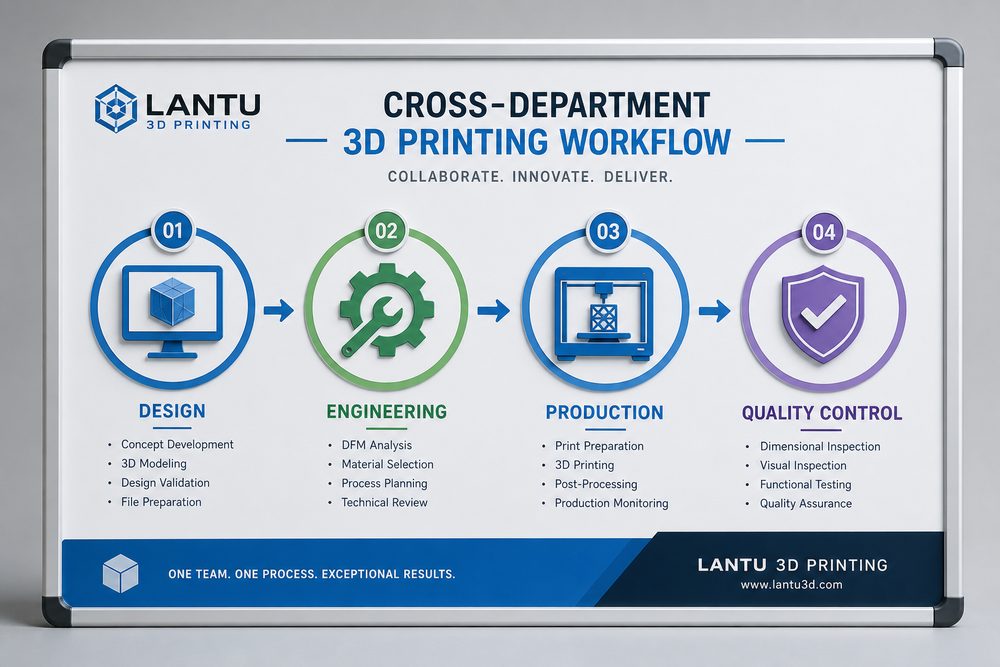
Customer requirements should not remain only in chat logs. Sales should enter the intended use, quantity, material preferences, lead time, budget, appearance requirements, assembly relationships, and confidentiality requirements into a unified form. During engineering review, the same information should be used to assess risks, preventing sales, engineering, and production from each working from a different version.
2. Move technical review earlier
For complex structures, urgent deadlines, or high-value orders, technical review should be conducted before quoting. Review priorities include model printability, material compatibility, post-processing feasibility, inspection methods, and delivery risks. Technical review does not slow down sales; it reduces later rework and complaints.
3. Handover documents should replace verbal explanations
The handoff from engineering to production should include production-release files, materials, equipment, layer thickness, orientation, support requirements, critical dimensions, and acceptance criteria. The post-processing team also needs color, surface finish level, masking locations, and packaging requirements. Verbal handoff may work when order volume is low, but it breaks down once parallel projects increase.
4. Exception escalation must have clear rules
When model defects, equipment failures, material shortages, failed quality inspection, or delivery risks occur, there should be rules defining who escalates to whom and within how much time. Do not wait until the delivery date to notify the customer. Transparent exception management allows customers to participate in decisions, such as accepting phased delivery, changing materials, or extending post-processing time.
Conclusion: Turn experience into repeatable delivery capability
How to align sales, engineering, and production: The core of designing a cross-department collaboration mechanism for 3D printing is to convert fragmented experience into standardized actions: there is an intake for requirements, a basis for decisions, records for the process, a closed loop for exceptions, and a reviewable outcome. Companies are advised to start with one high-frequency product category or one typical customer project, establish a minimum viable process first, and then gradually expand into a material library, process library, quoting rules, and quality traceability system. This is exactly the kind of continuous capability building that lantu3D focuses on, enabling 3D printing to be more than a prototyping tool and instead become a reliable node for rapid validation, small-batch production, and on-demand manufacturing.
Submit a model, drawing, image or written notes. Engineers will review material, process, finishing and delivery based on actual use.