
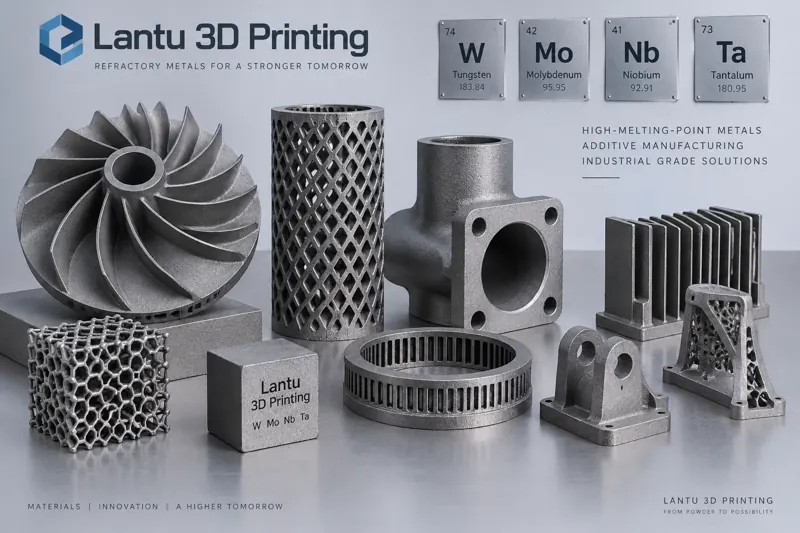
Introduction: Why Refractory Metals Need Additive Manufacturing
Tungsten, molybdenum, niobium, and tantalum are known as "refractory metals," with melting points of 3422°C, 2623°C, 2477°C, and 3017°C respectively, generally exceeding 2000°C. They are irreplaceable in aerospace hot-section components, nuclear energy and fusion first walls, electronic packaging, and high-temperature tooling. Yet it is precisely these high melting points that make conventional forging and machining extremely difficult: cutting tungsten relies heavily on EDM and abrasive waterjet processes, with low material utilization, long lead times, and limited ability to integrally form complex internal cavities. Laser powder bed fusion (LPBF) can directly “grow” metal parts into near-net shapes, theoretically solving this dilemma. In actual printing, however, high reflectivity, strong oxygen affinity, and severe thermal stress caused by high melting points often lead to cracking and embrittlement. This article focuses on the LPBF process route for refractory metals: how to overcome the three key barriers of high melting point, oxygen control, and crack suppression.
1. Breakdown of Printing Challenges for Four Refractory Metals
Refractory metals are not a single process family; each of the four materials has its own “temperament.” Tungsten (W) has the highest melting point and low laser absorptivity, about 30%–40% at 1064 nm, requiring the highest volumetric energy density. Molybdenum (Mo) is similar to tungsten but oxidizes more easily, and increased oxygen content causes significant embrittlement. Niobium (Nb) and tantalum (Ta) have relatively lower melting points, but interstitial solid solution of oxygen, nitrogen, and hydrogen raises the ductile-to-brittle transition temperature, making them brittle at room temperature. The common challenges are threefold: first, high reflectivity causes unstable melt pools and strong balling tendency; second, high oxygen affinity causes powders to absorb moisture and oxidize in the build chamber, forming brittle oxide films along grain boundaries; third, the combination of thermal expansion coefficient and thermal conductivity creates large thermal gradients, causing interlayer tensile stress to exceed the yield strength and induce cracking. Understanding these differences is the prerequisite for selecting a process window.
2. Oxygen Content Control: Full-Chain Sealing from Powder to Build Chamber
For refractory metals, oxygen is the number one enemy. Practice shows that the oxygen content of printed parts should be controlled below 100 ppm, while critical load-bearing parts may require below 50 ppm. This requires two lines of defense to work simultaneously. First, the oxygen pickup of gas-atomized powder must be low; suppliers should sieve and package the powder under an inert atmosphere, and after arrival the powder should be sealed for storage and sampled for moisture content. Second, LPBF equipment must be equipped with closed-loop oxygen-content control in the build chamber. Industrial solutions introduce high-purity argon into the chamber to maintain oxygen partial pressure below 100 ppm and a dew point below -40°C. Some tungsten parts also need to be printed on a build substrate preheated to 200°C–400°C to reduce thermal shock. Any chamber opening for powder replenishment or incomplete inert-gas purging can undo an entire night of effort through grain-boundary embrittlement.
3. Process Window: Synergy Between High Energy Density and Substrate Preheating
Refractory metals require much higher volumetric energy density than titanium or aluminum alloys to achieve full melting. Typical parameter ranges include laser power of 200–400 W, scanning speed of 200–800 mm/s, and layer thickness of 20–40 μm, corresponding to an energy density of about 100–300 J/mm³. The challenge is that insufficient power leads to lack of fusion and high porosity, while excessive power causes spatter and overheating. More importantly, substrate and powder-bed preheating are critical. Molybdenum and niobium can significantly reduce cracking at around 200°C, while tungsten, due to its extremely high melting point, often requires substrate preheating to 800°C–1000°C using dedicated LPBF equipment with an integrated heating platform to reduce the cooling rate. In terms of scan strategy, strip/island scanning combined with 67° interlayer rotation can disperse the direction of thermal-stress accumulation and is less prone to cracking than unidirectional scanning.
4. Crack Suppression: Thermal Stress, Grain-Boundary Embrittlement, and Alloying
Cracking is the most persistent failure mode in LPBF of refractory metals. Mechanistically, it can be divided into two categories: hot cracking during solidification and cooling, caused by constrained shrinkage under high temperature gradients; and room-temperature intergranular brittle cracking, caused by segregation of oxygen/carbon impurities at grain boundaries. There are three suppression methods. First, substrate preheating combined with a lower cooling rate directly reduces the peak thermal stress. Second, alloying or dispersion-strengthening elements can be introduced to improve grain boundaries. For example, Mo-La₂O₃ and TZM molybdenum alloys use lanthanide oxides to pin grain boundaries and refine grains, significantly improving room-temperature ductility; these have become mature grades for molybdenum printing. Third, stress-relief annealing or hot isostatic pressing (HIP) after printing can close internal micropores and relax residual stress. It should be noted that tungsten itself is extremely brittle. Pure tungsten printed parts are mostly used for radiation shielding, counterweights, and high-temperature tooling, while load-bearing structures should preferably use alloy systems such as W-Cu and WNiCu.
5. Typical Alloys and Application Targets
Beyond pure metals, alloy systems are more commonly used in engineering. Tungsten systems: W-Ni-Cu and W-Cu are used for high-density counterweights, heat dissipation, and electrical contacts; pure W is used for fusion first walls and X-ray targets. Molybdenum systems: TZM (Mo-0.5Ti-0.1Zr) and MHC (Mo-La₂O₃) are preferred high-temperature structural materials, used in aerospace engine nozzle liners and high-temperature furnace components. Niobium systems: C103 (Nb-Hf-Ti) and other niobium-hafnium alloys are used in rocket thrust chambers. Tantalum systems: pure Ta and Ta-10W are entering chemical corrosion-resistant components and medical implants due to their excellent corrosion resistance and biocompatibility. When lantu3D undertakes orders for such high-melting-point materials, it first conducts powder oxygen and moisture testing and process-window test coupons, then uses witness samples from the same build to calibrate density and hardness, ensuring that every batch of refractory-metal parts is searchable, re-testable, and traceable.
Conclusion
LPBF of refractory metals is not simply a matter of increasing the power used for titanium alloys. It is a systems engineering process centered on “high melting point—oxygen control—crack suppression”: a high-purity inert build environment secures the oxygen baseline, high energy density plus substrate preheating balances melting and thermal stress, and alloying with post-processing stress relief compensates for room-temperature toughness. Once the process logic behind these three barriers is mastered, tungsten, molybdenum, niobium, and tantalum can truly move from “printable” to “load-bearing and mass-producible,” enabling stable implementation in aerospace hot sections, energy, and high-temperature industries.
Submit a model, drawing, image or written notes. Engineers will review material, process, finishing and delivery based on actual use.