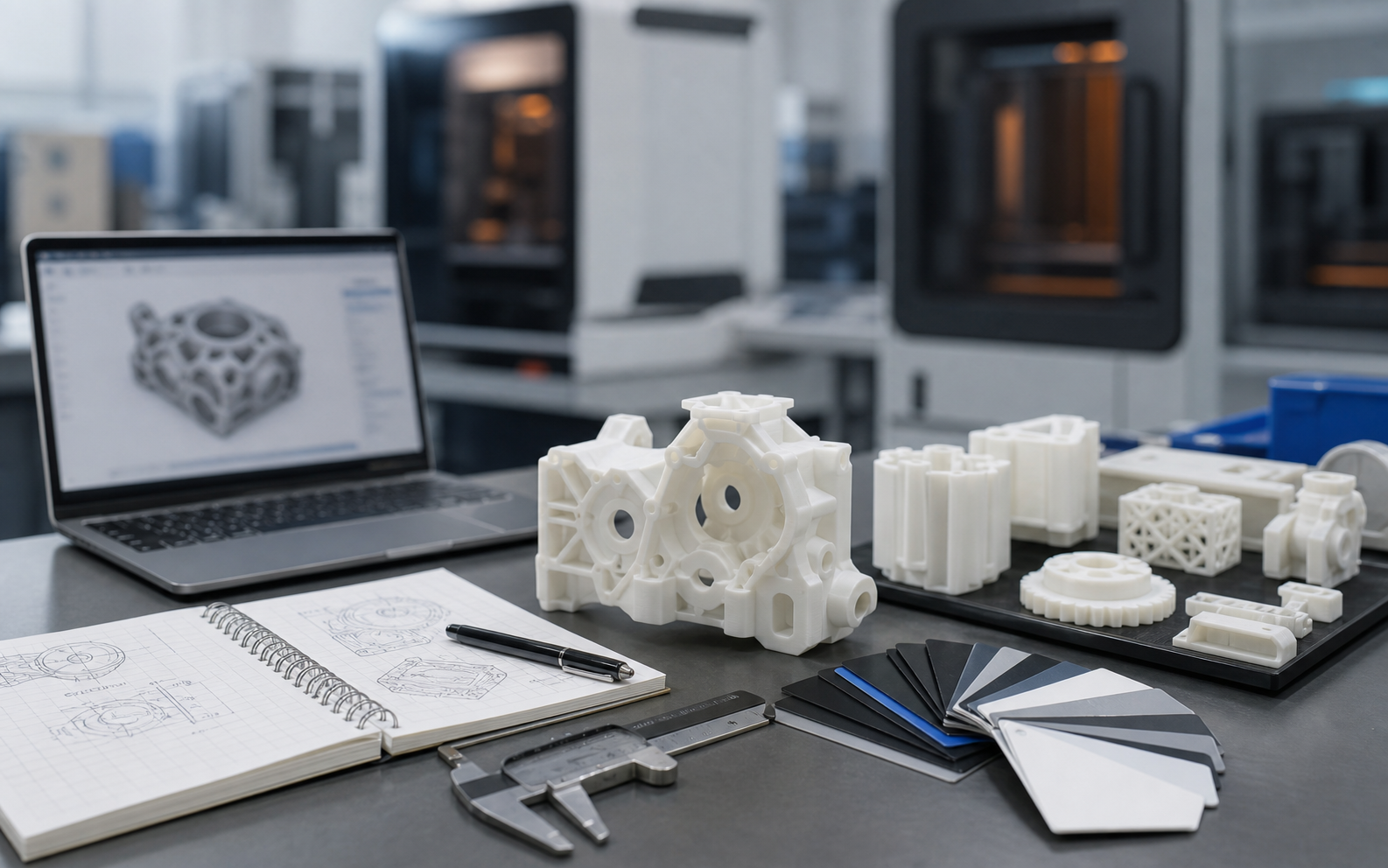
Introduction: High-performance materials promote SLA technology innovation
With the rapid development of light-curing 3D printing (SLA/DLP/LCD) technology, the improvement of material performance has become the core driving force for industry progress. Nylon PA12 (polyamide 12), as a high-performance engineering plastic, is becoming a high-end material choice in the field of SLA 3D printing due to its excellent mechanical properties, chemical stability and dimensional accuracy. According to the latest industry report in 2026, nylon PA12 accounts for 18% of the global industrial-grade SLA material market, with an annual growth rate of more than 25%. This article will provide an in-depth analysis of the application advantages, technical points and future development trends of nylon PA12 in SLA 3D printing.
Basic properties of nylon PA12 material
Nylon PA12 is a semi-crystalline thermoplastic whose molecular structure gives the material unique comprehensive properties. Compared with common PA6 or PA66, PA12 has lower moisture absorption (only 1.5% vs 3-10%), higher dimensional stability and better chemical corrosion resistance. In the SLA process, PA12 usually exists in the form of a liquid photosensitive resin, which is cured by UV light to form a three-dimensional entity with excellent mechanical properties.
From a physical performance perspective, SLA printed PA12 parts have a tensile strength of 45-55 MPa, an elongation at break of 30-40%, and a density of 1.01-1.02 g/cm³. Its glass transition temperature is about 50°C, its melting point is about 178°C, and its heat deformation temperature can reach 120°C (under 1.8 MPa load). These data demonstrate that PA12 maintains good mechanical properties while also possessing heat resistance suitable for a variety of industrial applications.
Curing mechanism and parameter optimization of PA12 in SLA process
SLA technology uses ultraviolet laser (wavelength 355nm or 405nm) to scan liquid photosensitive resin layer by layer, triggering a photopolymerization reaction and converting the resin from liquid to solid. For PA12 photosensitive resin, cure depth (Cure Depth, Cd) and critical exposure (Critical Exposure, Ec) are two key process parameters. According to the Jacobs equation: Cure depth Cd = Dp × ln(Ec/E), where Dp is the penetration depth and E is the exposure dose.
In the actual printing process, in order to achieve the best curing effect, the following parameters need to be accurately controlled:
- **Laser power**: It is recommended to set it between 150-250mW
- **Scan speed**: usually controlled at 2000-4000 mm/s
- **Layer thickness**: 0.05-0.1mm for best surface quality
- **Post-curing time**: UV post-curing for 60-120 minutes can increase mechanical strength by 30%
Performance comparison with traditional SLA materials (standard resin, ABS-like)
| Performance indicators | Standard SLA resin | ABS-like resin | PA12 SLA |
|---------|------------|-------------|----------|
| Tensile strength | 35-45 MPa | 40-50 MPa | 45-55 MPa |
| Elongation at break | 5-15% | 15-25% | 30-40% |
| Impact Strength | Low | Medium | High |
| Heat-resistant temperature | 50-60°C | 70-80°C | 120°C |
| Water absorption rate | 0.5-1% | 0.8-1.2% | 1.5% |
| Chemical Resistance | Poor | Moderate | Excellent |
| Price | Low | Medium | High |
Typical application cases: from prototype to end part
The successful application cases of nylon PA12 in SLA 3D printing can be found in many industries:
**Automotive Industry**: A German automobile manufacturer uses PA12 SLA technology to manufacture intake manifold prototypes. Compared with traditional CNC processing, the development cycle is shortened by 60% and the cost is reduced by 45%. The final parts passed a 200-hour engine bench test, proving that their heat resistance and mechanical strength fully meet the requirements.
**Medical Devices**: A medical device company prints surgical guides using PA12 SLA, with the material’s biocompatibility and sterilization resistance making it an ideal choice. After ethylene oxide (EO) sterilization, the size change of the parts is less than 0.1%, which fully complies with medical standards.
**Consumer Electronics**: A well-known headphone brand uses PA12 SLA technology to manufacture headphone shells. The material's high toughness and excellent surface quality enable the product to pass the 1.5-meter drop test and the 48-hour salt spray test.
Post-processing technology and quality control
SLA printed PA12 parts need to go through a series of post-processing processes to achieve optimal performance:
- **Cleaning**: Use isopropyl alcohol (IPA) or special cleaning fluid to remove uncured resin residue on the surface
- **UV post-curing**: Post-curing for 60-120 minutes in a UV curing box to increase cross-linking density
- **Thermal annealing treatment**: annealing in an 80°C oven for 2-4 hours to eliminate internal stress
- **Surface treatment**: Sandblasting, spraying or polishing as required
- Develop faster curing formula to increase printing speed by more than 50%
- Reduce material costs to 60-70% of current prices
- Achieve closed-loop recycling system and improve sustainability
- Expand new application fields, such as aerospace, energy equipment, etc.
The focus of quality control includes dimensional accuracy testing (CMM three-coordinate measurement), mechanical performance testing (tensile, impact, hardness) and appearance defect inspection. By establishing a complete quality control system, the consistency and reliability of PA12 SLA parts can be ensured.
Future development trends and challenges
Although nylon PA12 shows great potential in SLA 3D printing, it still faces some challenges. The first is the cost issue. The price of PA12 photosensitive resin is usually 3-5 times that of standard resin. The second is the printing speed. Due to the need to precisely control the curing parameters, the printing speed is relatively slow. Finally, there is the issue of recycling and reuse. PA12 after light curing is difficult to directly recycle, and a new chemical recycling process needs to be developed.
Looking to the future, with the advancement of material science and process optimization, PA12 SLA technology is expected to make breakthroughs in the following directions:
For companies that want to adopt PA12 SLA technology, it is recommended to start with small batch trial production, gradually accumulate process experience, and at the same time establish close cooperative relationships with material suppliers to jointly promote technological progress.
Submit a model, drawing, image or written notes. Engineers will review material, process, finishing and delivery based on actual use.