Basic principle of shape memory effect
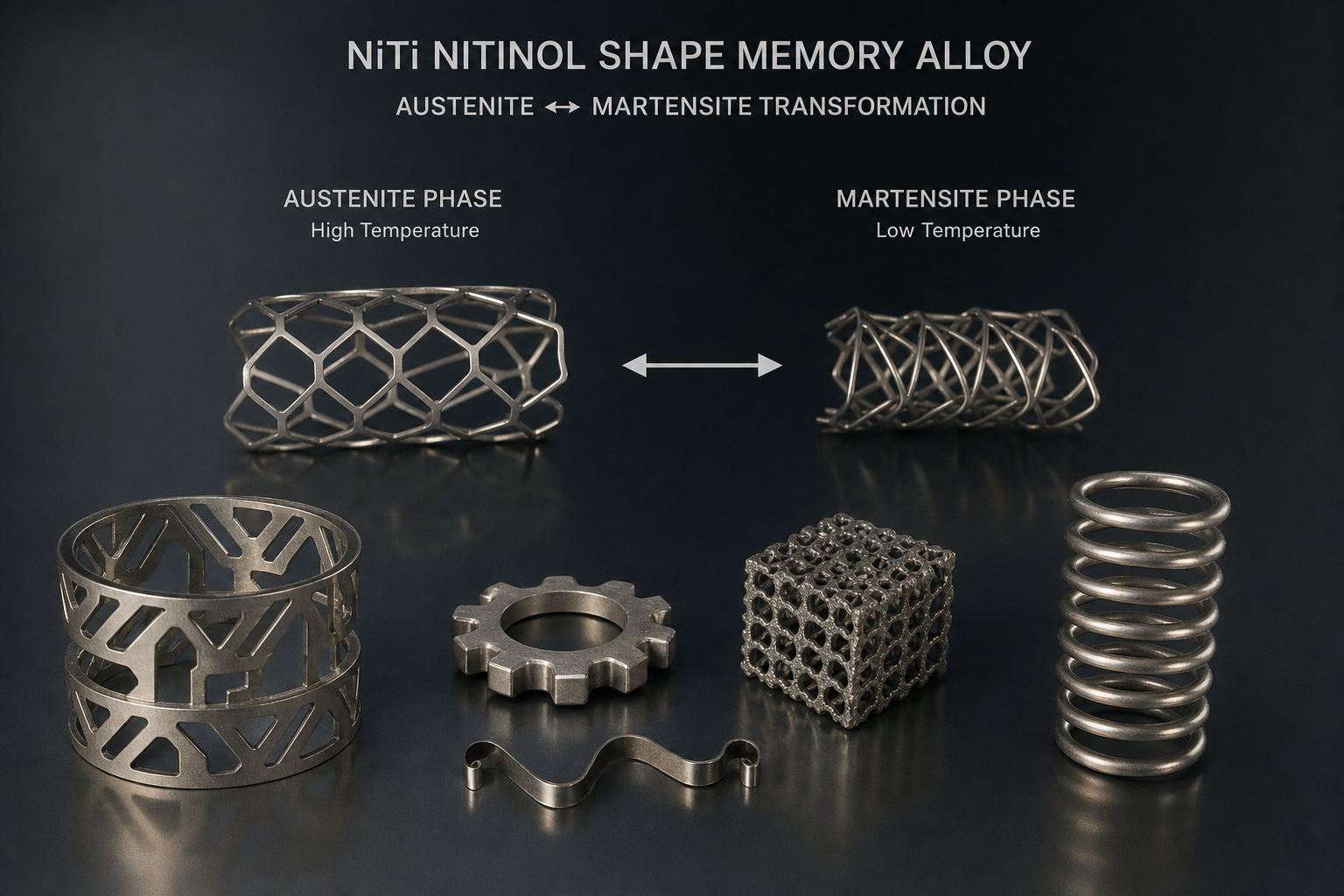
The shape memory effect of nickel-titanium alloy (NiTi, also known as Nitinol) originates from the thermoelastic martensitic phase transformation. In the high-temperature austenite phase, the material has a body-centered cubic structure; when cooled to the martensite phase, it transforms into a monoclinic structure and can change its shape through deformation. When reheated, the material returns to its original austenitic structure and preset shape. This reversible phase transformation process gives the material its unique intelligent response properties. Superelasticity is the result of stress-induced martensite transformation, which allows the material to withstand large deformations without plastic yielding and automatically return to its original shape after unloading.
Key points of laser powder bed fusion process
The 3D printing of NiTi alloy mainly uses laser powder bed fusion (LPBF) technology, but it faces challenges such as composition control, residual stress and phase transition temperature control. The difference in evaporation temperature of Ni and Ti elements leads to component segregation during the printing process, affecting the phase change temperature and memory performance. Laser power, scanning speed and scanning strategy need to be precisely optimized to control the melt pool temperature gradient and cooling rate to reduce the tendency of hot cracking. Preheating the powder bed to 150-200°C reduces residual stress and prevents parts from warping and cracking.
Microstructure and functional performance control
Printing parameters directly affect the microstructure and functional performance of NiTi parts. Higher energy density promotes the growth of columnar crystals, which is beneficial to the consistency of functional properties; lower energy density produces equiaxed crystal structures and more uniform mechanical properties. The heat treatment process is crucial to adjust the phase transition temperature and eliminate residual stress. Solid solution treatment makes the element distribution uniform, and aging treatment controls the phase change behavior through precipitation phases. Appropriate circuit training can stabilize hyperelasticity and shape memory effects and reduce functional fatigue.
Intelligent structural design and verification
The advantage of 3D printing is to realize complex geometric structures that are difficult to manufacture with traditional processes, providing a broad space for intelligent structural design. Lightweight designs such as honeycomb structure, grid structure and gradient pore structure, combined with shape memory functions, can achieve functions such as adaptive deformation, energy absorption and vibration control. Design verification requires a combination of finite element simulations and experimental testing to evaluate the deformation behavior of the structure under different temperature and load conditions. Fatigue life prediction is a key issue, and a life prediction model that considers functional fatigue needs to be established.
Application cases and development trends
NiTi shape memory alloy 3D printing shows application potential in many fields. In the aerospace field, the variable wing structure can adaptively adjust the aerodynamic shape according to the flight status. In the medical field, personalized implants and minimally invasive surgical instruments use shape memory properties to achieve intelligent deployment. In the automotive and robotics fields, NiTi smart structures are used for vibration reduction and energy harvesting. Future development directions include multi-material printing to achieve functional gradient structures, integration of in-situ monitoring and feedback control systems, and large-scale preparation of high-performance, low-cost powders.
Submit a model, drawing, image or written notes. Engineers will review material, process, finishing and delivery based on actual use.