
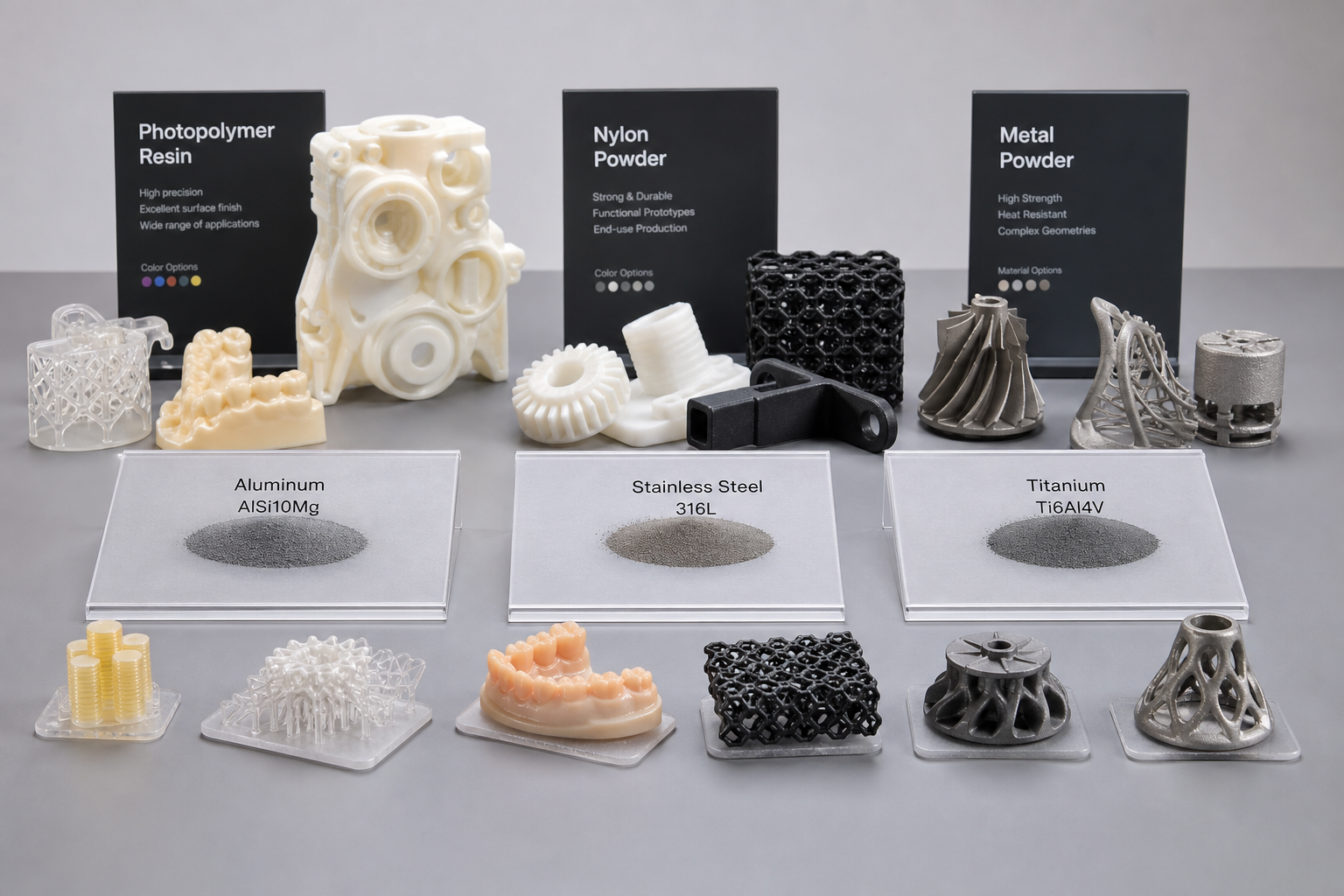
Technical principles of multi-material 3D printing
Multi-material 3D printing refers to the technology of using two or more materials to manufacture parts in the same printing process. The current process for realizing multi-material printing includes: multi-nozzle FDM, each nozzle is loaded with different materials and can be switched during the printing process. Multi-material SLA, the resin tank can be replaced during the printing process to realize the lamination of different resins. PolyJet/Material Jetting sprays different materials through multiple nozzles to achieve material mixing and gradient. Multi-material SLS, by pre-mixing different powders or changing the powder composition during the printing process. Each process has different multi-material capabilities, and the design strategy needs to be formulated based on the process characteristics.
Application scenarios of color partition design
Color partition design is to design different areas of parts into different colors to achieve identification, decoration or functional distinction. Typical applications include: product prototypes, using different colors to distinguish different parts of the product shell to visually demonstrate the design effect. Educational model with different anatomical structures or functional components labeled in different colors. For identification labels, text and symbols are printed in contrasting colors to improve recognition. Artistic creation, expressing design concepts through color changes. For industrial parts, use colors to distinguish components with different functions or indicate assembly relationships. The clarity of color boundaries and the bonding strength between materials of different colors need to be considered when designing.
Mechanical considerations of performance partition design
Performance partition design is to design different areas of the part with different mechanical properties to achieve functional optimization. Typical applications include: soft and hard combination parts, such as the structure of mobile phone case with soft glue on the edge and hard shell in the middle. Sealing connector, the main body is made of rigid material and the sealing surface is made of elastic material. Damping structure, the load-bearing part is made of high-strength material and the damping part is made of soft material. Wear-resistant composite parts, the friction surface is made of wear-resistant material and the matrix is made of tough material. When designing, attention should be paid to: material interface strength, and the bonding strength between different materials is often lower than that of the same material. Thermal expansion matching, differences in thermal expansion coefficients of different materials can cause internal stress. Due to load transfer, the interface may become a stress concentration point, requiring mechanical analysis.
Functionally graded material design
Functionally graded materials (FGM) refer to material structures whose material composition and properties continuously change in space. Multi-material printing enables gradual transitions from one material to another, avoiding stress concentrations at abrupt interfaces. The gradient function of the material composition needs to be specified during design, such as linear gradient, exponential gradient or custom gradient. The length of the gradient transition zone needs to take into account print resolution and material mixing capabilities. Gradient design can effectively solve the interface bonding problem and improve the mechanical properties of the overall structure. Application scenarios include: gradient stiffness structures, transition from rigid zone to flexible zone. Thermal stress relief structure, gradient thermal expansion coefficient reduces thermal stress. Functionally integrated parts, gradient transition eliminates material mutations.
Process constraints of multi-material design
Multi-material printing design needs to consider process constraints. Material compatibility, the chemical compatibility between different materials determines the interface bonding strength. Printing sequence, multi-nozzle FDM requires designing material switching points and transition strategies. Support materials. Supports for multi-material parts may require specific materials to be removed. Post-processing compatibility, different materials may respond differently to post-processing (sanding, spraying, disinfection, etc.). For cost considerations, multi-material printing is usually more expensive than single-material printing, and the cost-effectiveness needs to be evaluated. When designing, you need to communicate with the printing service provider to understand the specific process capabilities and limitations.
Submit a model, drawing, image or written notes. Engineers will review material, process, finishing and delivery based on actual use.