
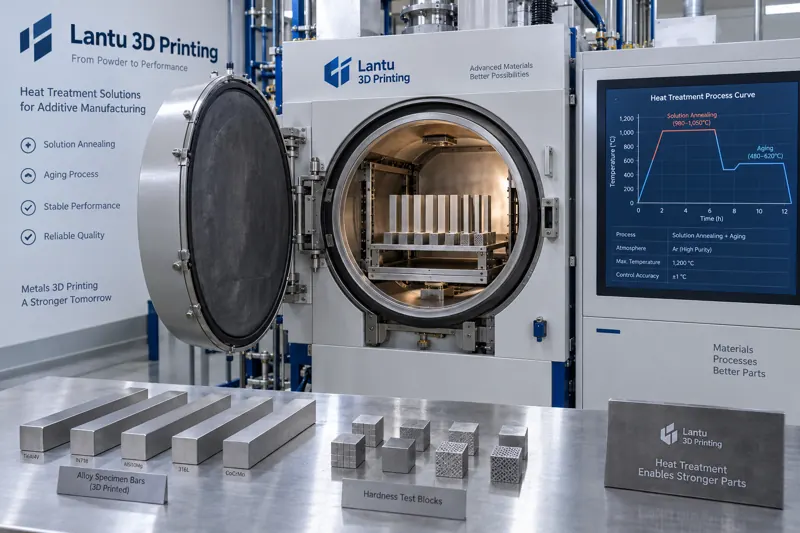
1. As-Printed Does Not Mean Ready to Use: The Starting Point of Heat Treatment
The as-printed microstructure of metal 3D printed parts is a rapidly solidified structure formed under extremely high cooling rates. In LPBF processes, the melt pool cooling rate is typically on the order of 10^3 to 10^6 K/s. This microstructure features high supersaturation, fine cellular grains, and significant residual stress, but its mechanical properties are often not optimal. For example, as-printed AlSi10Mg has a tensile strength of about 380-420 MPa and an elongation of only 3%-6%; as-printed Ti6Al4V consists of acicular martensite, with high strength but poor ductility; and as-printed Inconel 718 contains a large amount of brittle Laves phase and Nb segregation. Therefore, heat treatment is not optional, but a necessary process for transforming the as-printed microstructure into a deliverable performance state.
2. Solution Treatment: Restoring the Microstructure to a Strengthenable State
The purpose of solution treatment is to fully dissolve alloying elements into the matrix, eliminate segregation and non-equilibrium phases from the as-printed state, and provide a uniform chemical basis for subsequent aging precipitation. There are three key parameters: solution temperature, holding time, and cooling rate. Taking AlSi10Mg as an example, the solution temperature is usually 520-540°C, followed by water quenching after holding for 1-2 hours. If the temperature is too high, overburning may occur, including coarsening of primary silicon or even localized melting; if it is too low, eutectic silicon cannot be sufficiently spheroidized. The standard solution treatment for Inconel 718 is holding at 980°C ±10°C for 1 hour followed by air cooling, with the purpose of dissolving the Laves phase and redistributing Nb uniformly. If the temperature is below 950°C, retained Laves phase will significantly reduce stress-rupture strength. Cooling rate is also critical: water quenching retains the highest supersaturation but carries a greater risk of distortion, while air cooling and polymer quenching are compromise options.
3. Aging Treatment: The Temperature-Time Window for Precipitation Strengthening
Aging allows a supersaturated solid solution to precipitate dispersed strengthening phases by holding at a moderate temperature. Artificial aging of AlSi10Mg is generally performed at 160-180°C for 4-12 hours, precipitating the β'' (Mg2Si) phase and increasing yield strength from about 200 MPa in the as-printed state to 250-280 MPa. However, when the aging temperature exceeds 200°C or the holding time is too long, the material enters the over-aging region, where coarsening of precipitates causes strength to decline. Solution treatment plus aging (T6) and direct artificial aging (T5) are two common routes: T6 offers a higher strength ceiling but greater distortion and cost, while T5 provides better dimensional stability and a shorter cycle. Inconel 718 uses a double-aging process: holding at 720°C for 8 hours, furnace cooling to 620°C at 50°C/hour, and then holding for another 8 hours. This precipitates γ'' and γ' phases, enabling room-temperature yield strength above 1000 MPa.
4. Differences in Process Windows for Typical Alloys
The conventional route for Ti6Al4V is stress-relief annealing, such as holding at 600-800°C for 2 hours, or solution aging, such as holding at about 950°C for 1 hour followed by quenching and then holding at 540°C for 4 hours. The latter can achieve a balance of strength and ductility, with tensile strength reaching 1100-1200 MPa and elongation above 10%. The standard treatment for 18Ni300 maraging steel is solution treatment near 840°C followed by aging at 480-500°C for 6 hours. Strengthening relies on the precipitation of Ni3Mo and Ni3Ti intermetallic compounds, and hardness can reach HRC 50-54. 316L stainless steel is a non-precipitation-strengthened alloy and is usually only subjected to stress relief or solution treatment at 1050-1100°C to eliminate sensitization and residual stress. Aluminum alloys and nickel-based alloys are more sensitive to holding time, while titanium alloys and tool steels are more sensitive to cooling rate. Process windows must therefore be calibrated material by material and should not simply follow forged-part standards.
5. Dimensional Stability: A Problem Heat Treatment Must Also Solve
Heat treatment is both a performance process and a source of distortion. The residual stress inside LPBF parts can reach 50%-80% of the material's yield strength. Direct furnace heating can cause warping or even cracking due to stress relaxation. In engineering practice, stress relief is usually performed first, such as pre-annealing aluminum alloys at around 300°C, before entering the solution treatment step. Loading must account for support and placement: slender parts should be placed vertically with uniform hot-air flow channels reserved, and conformal-cooling mold components should retain process ribs at stress concentration areas, which are removed after heat treatment. Quench transfer time must be written into the process card. For aluminum alloys, the time from furnace exit to water entry is generally controlled within 15 seconds; otherwise, precipitates may nucleate during transfer, greatly reducing the aging-strengthening effect. Furnace temperature uniformity, typically required to be ±5°C to ±10°C, and thermocouple placement must also be recorded; otherwise, parts in different positions within the same furnace load may show batch-to-batch property variation.
6. Inspection and Release: Making Heat Treatment Results Verifiable
Release after heat treatment cannot rely only on furnace temperature curves. It is recommended to place standard companion specimens from the same batch and in the same orientation in the furnace, and to test tensile strength, yield strength, elongation, and hardness. For dimensions, critical datums should be measured using a coordinate measuring machine to confirm that distortion remains within the design allowance. When necessary, metallographic inspection should be performed to confirm precipitate morphology and grain boundary condition. All parameters, including loading diagrams, heating rate, holding time, cooling medium temperature, and transfer time, should be included in batch records to form a traceable chain. When hardness or strength deviates from the process window, furnace temperature uniformity and transfer time should be checked first, rather than simply extending aging time, because over-aging will only make the problem more hidden.
Conclusion
Solution treatment and aging are key steps in turning metal 3D printed parts from formed components into engineering components. Solution treatment addresses microstructural uniformity, aging addresses strength, and stress relief plus loading design addresses dimensional stability. In engineering practice, these three aspects should be managed as one complete process chain. Companion specimens and batch records should be used to make results verifiable and traceable, rather than relying on empirical parameters.
Submit a model, drawing, image or written notes. Engineers will review material, process, finishing and delivery based on actual use.