Why Powder Management Determines Consistency in SLM Printing
In metal 3D printing, especially in SLM/LPBF processes, powder is not just a "consumable". It is the core feedstock that directly governs part quality. Particle size distribution, oxygen content, flowability, reuse count, and contamination level all affect powder spreading uniformity, melt pool stability, porosity, and final mechanical performance. For common materials such as Ti6Al4V, 316L, IN718, and AlSi10Mg, unstable powder condition can cause part density to drop from 99.7% to below 99.2%, while fatigue performance differences become even more pronounced. In practice, most failures do not come from "incorrect process parameters" but from moisture, oxides, spatter particles, or foreign materials entering the powder during storage, transfer, recovery, and sieving, leading to large performance scatter across an entire batch of parts. Therefore, establishing a powder management standard from incoming inspection to scrap disposal is the foundation for batch delivery and traceable manufacturing.
- The goal of powder management is not merely to "make it printable," but to ensure stable density, microstructure, and properties for every build batch.
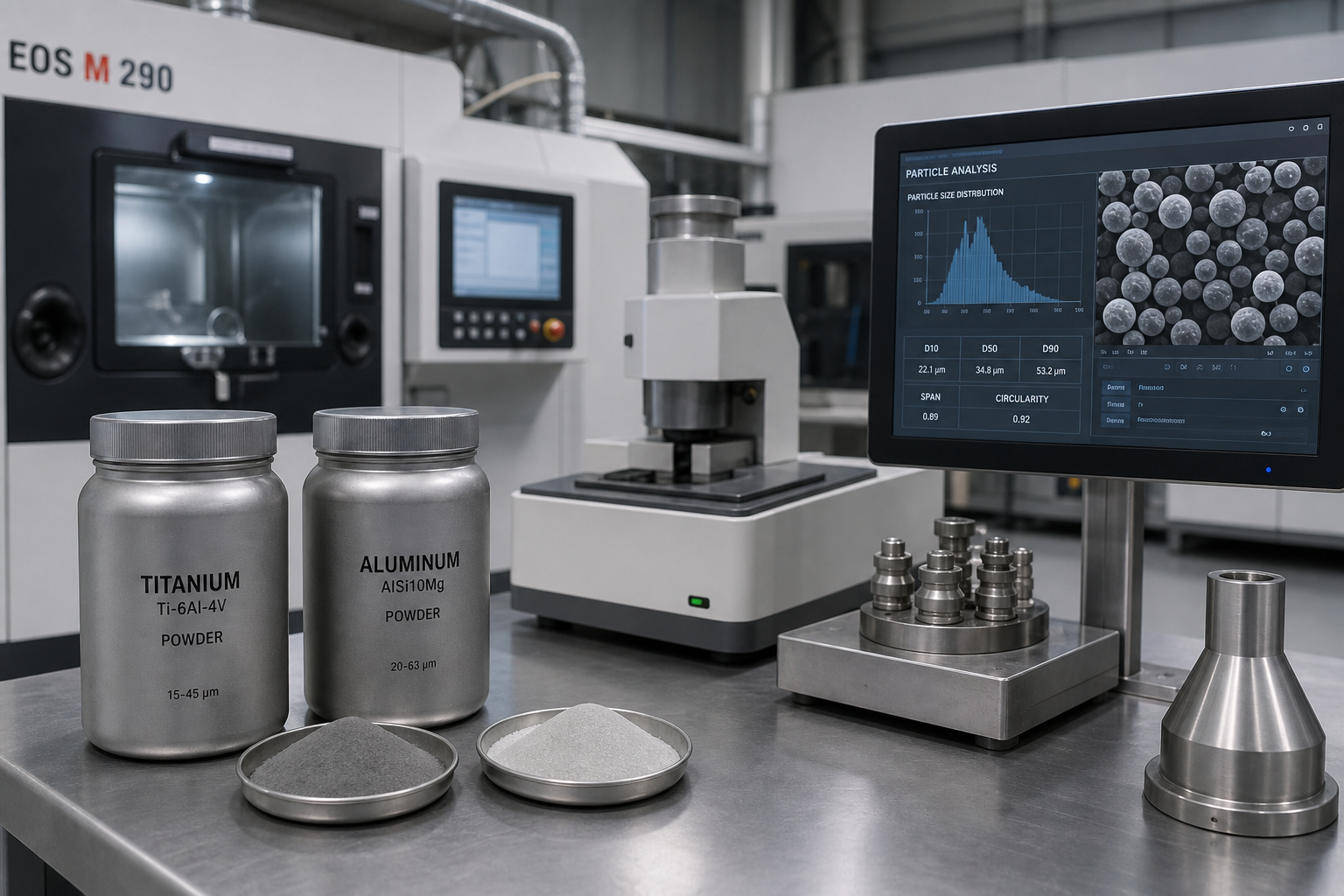
- Common SLM powder size ranges are 15–45 μm or 20–63 μm; out-of-spec particles will affect spreading behavior and laser absorption consistency.
- If reclaimed powder is not governed by an independent acceptance criterion, oxides and fines will typically accumulate significantly after 3–8 reuse cycles.
Storage Conditions: Temperature, Humidity, Sealing, and Inert Atmosphere Must All Be Controlled
For metal powder storage, the environment must be controlled first, then the container. For highly reactive materials such as titanium alloys and aluminum alloys, it is recommended to keep the warehouse temperature at 18–25°C and relative humidity at 20%–40%, while avoiding frequent temperature swings that can cause condensation. Powder drums or original manufacturer containers should be managed with a combination of sealed lids, inner liner bags, and desiccants. If a container has been opened and the powder is not used within 8 hours, it is recommended to return it to an inert-gas cabinet or dry storage cabinet. For Ti64 powder, many plants set the oxygen threshold below 0.13 wt%; in aerospace and medical applications, even stricter requirements may call for new powder oxygen content no higher than 0.10 wt%, because increased oxygen reduces ductility in printed parts, raising hardness but degrading toughness. For stainless steels and nickel-based alloys, sensitivity to oxygen is lower, but moisture uptake and surface oxidation still affect flowability and layer-thickness stability during spreading.
Storage areas should also be kept separate from cleaning agents, cutting fluids, oil mist, and welding fumes. Once powder adsorbs oil contamination, it is difficult to fully remove even after sieving. A "one material, one cabinet, one label" system is recommended, with each container clearly identified by material grade, particle size range, batch number, receipt date, opening date, remaining quantity, and cumulative reuse count. For high-value powders, online dew point monitoring may also be installed. The recommended dew point is below -20°C, and an ideal target is around -30°C, to suppress long-term moisture uptake.
- Recommended temperature: 18–25°C; recommended relative humidity: 20%–40%; for highly reactive materials, use a dry cabinet or inert-gas storage whenever possible.
- After opening, the powder should be returned to storage within the specified time to avoid prolonged exposure to air and rising oxygen/moisture content.
- Storage containers must be traceable. Labels should at minimum include material, batch number, particle size, opening time, reuse count, and responsible operator.
Powder Reclamation Process: Closed-Loop Control from Build Chamber to Reusable Powder
Reclamation is not simply "pouring the powder back in"; it is a closed-loop process designed to prevent contamination from spreading. After printing, the powder inside the build chamber should be allowed to cool naturally to below 40°C before recovery, so that hot powder does not absorb moisture or agglomerate during transfer. A dedicated recovery system is recommended to collect powder separately from the build zone, recoater area, and overflow hopper, preventing powders from different sources from mixing. For equipment that supports controlled atmospheres, recovery should be performed under inert gas protection whenever possible to reduce high-temperature oxidation. After recovery, magnetic separation or foreign-object inspection should be carried out first, followed by sieving. Common sieve sizes include 100 mesh, 150 mesh, or 325 mesh, depending on the powder size and process window; for 15–45 μm powder, a typical setup is an upper sieve limit of 45–63 μm and a lower control limit of 20–25 μm to remove satellites, sintered agglomerates, and spatter particles.
After sieving, the powder must also be managed through "new powder/reclaimed powder" blending control. Many companies use a top-up strategy, for example replenishing each batch with 70%–80% reclaimed powder and 20%–30% new powder to maintain a stable particle size distribution and flowability. It should be noted that the replenishment ratio is not fixed and depends on the material, machine, and oxygen-control level. For oxygen-sensitive materials such as titanium alloys, if oxygen content rises close to the limit, it is better to reduce the reuse ratio than to extend powder life blindly. In one aerospace bracket project, build density remained acceptable after six reuse cycles, but elongation at break dropped from 10.8% to 8.9%. Traceability showed that the fines fraction had increased significantly and cumulative oxygen content had risen by about 0.015 wt%. The process was eventually stabilized by mandating a 15% new-powder addition after every three reuse cycles.
- Powder must be cooled before recovery to avoid agglomeration and condensation.
- Recovery must be managed by zone, and powders of different materials or batches must never be mixed.
- After sieving, new powder should be added at a fixed ratio, which should be adjusted dynamically according to material type and oxygen-control level.
Sieving and Contamination Removal: The Key Process for Spreading Uniformity
The purpose of sieving is not only to remove oversized particles, but more importantly to restore the powder size distribution and flow state. SLM is typically sensitive to a layer thickness of 20–60 μm. If the powder contains agglomerates larger than the upper size limit, they can cause streaking, powder buildup, and local powder starvation as the recoater passes; if there are too many fines, the specific surface area increases, accelerating oxygen and moisture uptake while reducing powder-bed permeability. In practice, the D10, D50, and D90 values of reclaimed powder should remain within acceptable deviation from the new powder. For example, if a batch of 316L powder has a new-powder D50 of 31 μm, and after repeated use the D50 rises to 35 μm while D90 exceeds 52 μm, spreading stability often begins to deteriorate. For titanium alloy powders, satellite fraction, hollow particle fraction, and sintered adhered particles must be monitored closely, because these defective particles can form irregular melt pools under the laser, increasing spatter and lack-of-fusion risk.
Contamination-removal methods can be divided into mechanical sieving, air classification, and magnetic/non-magnetic separation. Mechanical sieving is suitable for routine batch management, while air classification is better for tighter control of fines and low-density oxides. If the powder carries metal chips from equipment wear, they must be removed through magnetic separation and microscopic inspection. For aluminum alloy powder, special attention should be paid to oxide-film thickening and powder agglomeration; for nickel-based superalloys, high-temperature spatter particles mixed into the powder can cause local inclusions. Some plants add optical sorting or image-recognition systems to remove anomalous morphology particles a second time, thereby reducing the risk of missed defects during manual sampling.
- The core of sieving is not just mesh size, but restoring D10/D50/D90 and the fines fraction.
- If streaking, powder buildup, or discontinuous spreading occurs, check agglomerates and out-of-spec particles first rather than adjusting laser parameters immediately.
- Magnetic separation, air classification, and image recognition can be combined for high-requirement materials.
Batch Traceability Management: New Powder, Reclaimed Powder, and Build Parts Must Be One-to-One Mapped
Without traceability, powder management cannot form a closed loop. The standard practice is to assign a unique code to every new powder container, every recovery event, every sieving cycle, and every print job, creating a chain that links "material batch number—machine ID—parameter set—part serial number." Traceability information should at minimum cover the original supplier COA, incoming inspection results, opening record, reuse count, blending ratio, sieve specification, operator, print date, and post-processing batch. For high-reliability industries, it is recommended to establish an MES or electronic batch record system that links powder lifecycle data with part-quality data, such as archiving CT density, metallographic porosity, tensile strength, fatigue life, and powder test results together. In this way, if a batch of parts shows abnormality, the corresponding powder lot can be identified within 24 hours rather than spending time checking each storage container one by one.
Traceability management also involves scrap criteria. Not all reclaimed powder should be recycled indefinitely. Companies typically set a maximum reuse count, such as 3–5 cycles for titanium alloys, 5–8 cycles for 316L, and 4–6 cycles for IN718. After that, even if test results still barely meet requirements, the powder should be downgraded or scrapped. The essence of this strategy is risk control, not squeezing every last bit of material life. For medical implants, aerospace load-bearing parts, and high-temperature rotating components, the scrap threshold is often more conservative than for general industrial parts. After a custom medical implant supplier introduced a traceability system, the response time for batch anomalies was reduced from two days to four hours, and precise identification of the problematic powder lot significantly reduced monthly scrap and revalidation costs.
- The traceability chain should at least include: original powder batch number, reuse count, sieving parameters, blending ratio, print job number, and post-processing batch.
- For high-reliability applications, an MES or electronic batch record system is recommended to avoid breaks in manual records.
- A clear maximum reuse count and downgrade/scrap rule should be defined; unlimited recycling is not acceptable.
Key Quality Metrics: Oxygen Content, Flowability, Density, and Morphology Are All Essential
Powder quality control cannot rely on appearance alone. Routine testing should at least cover chemical composition, oxygen/nitrogen/hydrogen content, particle size distribution, flowability, apparent density, tap density, and morphology. Taking Ti6Al4V as an example, new powder oxygen content is commonly controlled below 0.10 wt%, while reclaimed powder above 0.13 wt% usually requires attention; nitrogen content should also remain stable within the material specification, because elevated nitrogen can affect brittleness. Flowability can be evaluated using a Hall flow test or Hall funnel, with a common benchmark being a 50 g flow time of around 20 seconds or less. If flow time is noticeably slower, it often indicates excessive fines, moisture uptake, or degraded particle shape. Apparent density and tap density reflect particle packing behavior,
Submit a model, drawing, image or written notes. Engineers will review material, process, finishing and delivery based on actual use.