
Introduction: Why Internal Defects in Additively Manufactured Parts Must Be “Healed”
Metal 3D printing (SLM/LPBF) forms parts through layer-by-layer melting and solidification. Even when process parameters are optimized, spherical gas pores, lack-of-fusion voids, and microcracks may remain inside the part, with porosity often ranging from 0.2% to 1%. Under cyclic loading, these micron-scale defects become fatigue crack initiation sites, reducing fatigue strength to only 30%–50% of that of forged parts. For critical load-bearing components in aerospace, energy, medical, and other demanding industries, printing alone is rarely sufficient to completely eliminate internal defects. A secondary “healing” post-processing method is required to improve internal quality. Hot Isostatic Pressing (HIP) is currently the most mature process for densification and defect healing.
1. Process Principle of Hot Isostatic Pressing
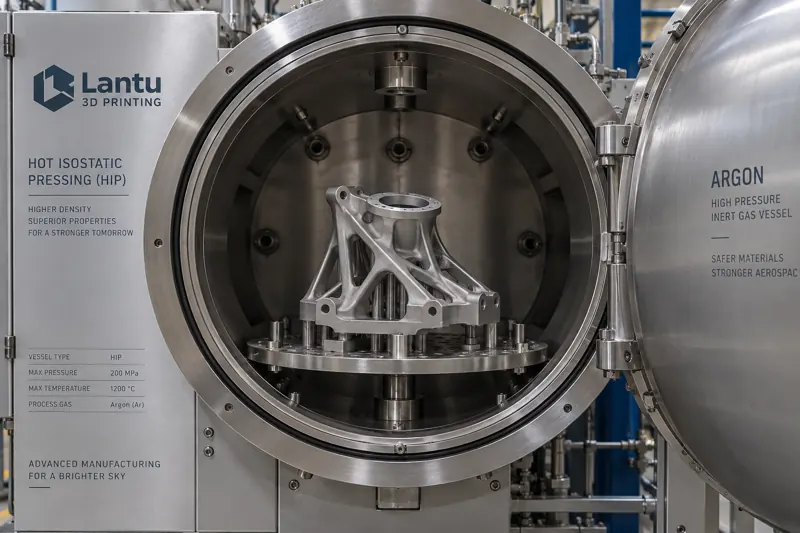
HIP places the part inside a sealed high-pressure vessel and simultaneously applies high temperature and isostatic pressure in an inert argon (Ar) atmosphere. Argon acts as the pressure-transfer medium, uniformly compressing the workpiece from all directions. At temperatures above the material’s yield range but below its melting point, internal pores are compacted and closed through plastic creep and diffusion mechanisms, while microcracks are “welded” shut. Unlike uniaxial forging, isostatic pressure does not introduce directional deformation, so the part’s overall geometry is largely maintained. This makes HIP especially suitable for the overall densification of components with complex internal channels and thin-walled structures.
2. Why Additively Manufactured Parts Particularly Need HIP
In powder bed fusion, layers are built one by one. Rapid solidification of the melt pool can trap gas before it escapes, forming pores. Low-energy-density regions can lead to lack of fusion, while thermal stress concentration may induce microcracks. These defects are clearly visible under X-ray industrial CT, but they cannot be removed by surface post-processing methods such as sandblasting or polishing because they are buried deep inside the part. HIP specifically targets these volumetric defects, reducing porosity from around 0.5% to below 0.1%, or even achieving full density, thereby improving the fatigue limit by 2–3 times.
3. Key Process Window: Temperature, Pressure, and Time
The core HIP parameters depend on the material. For titanium alloy Ti6Al4V, typical conditions are 920±20°C, 100–150 MPa, and 2–4 hours of holding time. Nickel-based superalloy Inconel 718 generally requires 1160–1200°C, 100–150 MPa, and 3–4 hours to close hot cracks. For 316L stainless steel, typical conditions are approximately 1040–1100°C and 100–200 MPa. For aluminum alloy AlSi10Mg, conventional HIP is usually not recommended due to over-aging and softening, or it must be controlled within a low-temperature range of 500–530°C with strength loss carefully evaluated. Heating and pressurization profiles must be matched to the material’s thermal expansion behavior to avoid thermal shock and the formation of new cracks.
4. Implementation Points and Common Misconceptions
First, porous parts or components with internal cavities require encapsulation and vacuum evacuation to prevent high-pressure argon from penetrating cavities and causing bulging or deformation. Second, supports and adhered powder should be removed as much as possible before HIP to reduce oxide inclusions. Third, high temperatures may cause slight creep and dimensional changes, so critical mating surfaces should include machining allowance and be finish-machined after HIP. Finally, HIP is not a universal cure. Its effectiveness is limited for excessively large lack-of-fusion defects or surface-connected open defects, which should be controlled as early as possible during the printing process.
5. Quality Verification: From Density to Fatigue Release
Post-HIP acceptance requires quantitative verification. Density should be measured using the Archimedes method or image analysis and should exceed 99.5%. Industrial CT should be used to confirm that original pores and microcracks have been closed and that no new defects have formed. For load-bearing parts, tensile and high-cycle fatigue (HCF) testing should be added to compare the improvement in fatigue strength before and after treatment. It is recommended to establish a closed-loop data archive covering “printing—HIP—CT—mechanical testing,” upgrading post-processing from experience-based operation to a reproducible process specification.
Conclusion
Hot isostatic pressing is a critical post-processing step for enabling metal 3D printed parts to be used in key load-bearing applications. It transforms printing-related residual pores, lack-of-fusion defects, and microcracks into a dense and reliable metallic structure, significantly improving fatigue life and batch consistency. In engineering implementation, temperature and pressure windows should be matched to the material, encapsulation and machining allowance should be properly designed, and closed-loop validation should be performed using industrial CT and fatigue data so that the internal quality of additively manufactured parts becomes truly visible and controllable.
Submit a model, drawing, image or written notes. Engineers will review material, process, finishing and delivery based on actual use.