
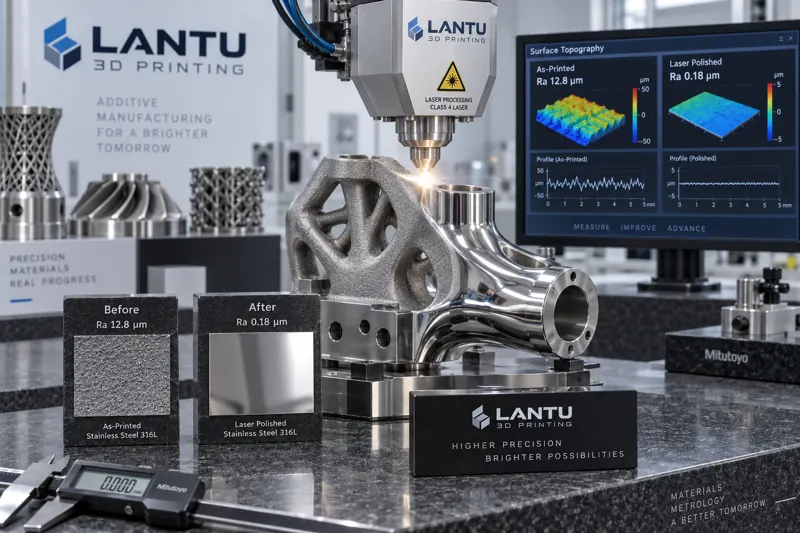
Introduction: Why Metal Additive Parts Need Laser Polishing
Metal 3D printing (SLM, LPBF) enables the production of complex conformal cooling channels, lattice structures, and integrated components through its design freedom. However, layer-by-layer melting leaves layer lines, adhered unmelted powder, and balling effects, so surface roughness often remains at Ra 6-15 μm—far rougher than machined surfaces at Ra 0.4-1.6 μm. In applications such as fluid sealing, mirror-finish injection molds, osseointegration for medical implants, and optical brackets, as-printed surfaces can significantly increase friction, trap contaminants, and initiate fatigue cracks. Conventional sandblasting, manual grinding, and abrasive flow machining are often ineffective for deep narrow channels, internal cavities, and freeform surfaces. With its non-contact, programmable, and highly accessible characteristics, laser polishing has become a key surface finishing process for metal additive manufacturing post-processing.
1. Mechanism of Laser Polishing
Laser polishing is essentially microscopic leveling through surface remelting and resolidification: a high-energy-density laser melts the top tens of microns within an extremely short interaction time. Driven by surface tension and capillary forces, the molten pool flows into low areas and fills valleys, forming a smoother solidified layer after rapid cooling. Depending on energy input, laser polishing can be divided into continuous-wave laser heat-conduction polishing and pulsed laser shock polishing. The former reduces roughness through redistribution of the temperature field, while the latter relies on peak pulse power for selective ablation. The key is to keep the melt pool alive long enough to achieve leveling, but short enough to avoid new oxidation or thermal distortion.
2. Core Process Parameters and Process Window
The effectiveness of laser polishing is determined by a set of coupled parameters: laser power (typically 50-400 W), scanning speed (500-4000 mm/s), spot overlap ratio (40%-90%), pulse frequency (kHz range), defocus amount, and number of scan passes. Experience shows that for SLM 316L stainless steel parts, using 150 W power, 1200 mm/s speed, 70% overlap, and two bidirectional scan passes can reduce Ra from 9.2 μm to 1.1 μm, a reduction of about 88%. Aluminum alloys require higher power density due to high reflectivity and high thermal conductivity, along with inert gas shielding to prevent oxidation and darkening. Titanium alloys require strict heat input control to suppress phase transformation and oxygen ingress that may form a brittle surface layer.
3. Selection Compared with Other Finishing Processes
Laser polishing complements rather than replaces existing processes: sandblasting removes adhered powder quickly but can increase subsurface roughness; manual or robotic grinding is suitable for large external flat areas but struggles to reach internal channels; abrasive flow machining (AFM) is effective for complex internal cavities but leaves a uniform matte surface; chemical/electrochemical polishing depends on isotropic material dissolution and is sensitive to alloy composition. The greatest value of laser polishing lies in accessibility—through fiber delivery and galvanometer beam steering, the laser beam can enter conformal cooling channels only a few millimeters in diameter, areas that mechanical tools cannot reach. In engineering practice, a two-stage process is often used: rough polishing to remove layer lines followed by fine polishing to reduce roughness.
4. Typical Applications and Accessibility Advantages
In injection mold inserts with conformal cooling channels, laser polishing can reduce the internal channel wall roughness from Ra 8 μm to below 1.5 μm, lowering demolding resistance, improving cooling uniformity, and shortening cycle time by about 6%-12%. For medical titanium alloy implants, laser polishing can increase bone contact area and reduce bacterial adhesion. In aerospace fuel nozzle bores and hydraulic valve body channels, laser polishing removes layer-line-induced turbulence and reduces the risk of particle shedding. For additive structures with undercuts, deep cavities, and fine features, the programmable accessibility of laser polishing is the fundamental reason it differs from all contact-based processes.
5. Implementation Essentials and Quality Verification
Four points are critical when implementing laser polishing. First, remove powder before polishing, because residual unmelted powder can be entrapped in the melt pool and form inclusions. Second, establish parameter cards based on the part material and geometry, and calibrate with test coupons before processing actual parts. Third, control heat accumulation; for complex parts, use segmented scanning and air cooling to prevent distortion. Fourth, process under inert gas shielding, typically argon, to prevent oxidation and discoloration of titanium and aluminum parts. Quality verification mainly uses white-light interferometry or contact profilometry to measure Ra and Rz, supplemented by SEM observation to confirm whether the remelted layer is dense and free of microcracks. When necessary, XRD can be used to verify that the surface phase structure has not deteriorated. For sealing and fluid components, flow rate and pressure drop should also be retested to confirm that finishing has not changed the effective channel cross-section.
Conclusion
Laser polishing connects the “design freedom” of metal 3D printing with “functional surfaces.” It does not alter the overall part geometry, but reshapes the morphology and quality of only the top tens of microns—directly affecting sealing, fatigue performance, biocompatibility, and appearance. Only by mastering the power-speed-overlap process window, distinguishing its application boundaries from sandblasting, abrasive flow machining, and chemical polishing, and accepting parts based on both roughness and microstructure can additive manufactured parts truly move from “printable” to “usable.”
Submit a model, drawing, image or written notes. Engineers will review material, process, finishing and delivery based on actual use.