
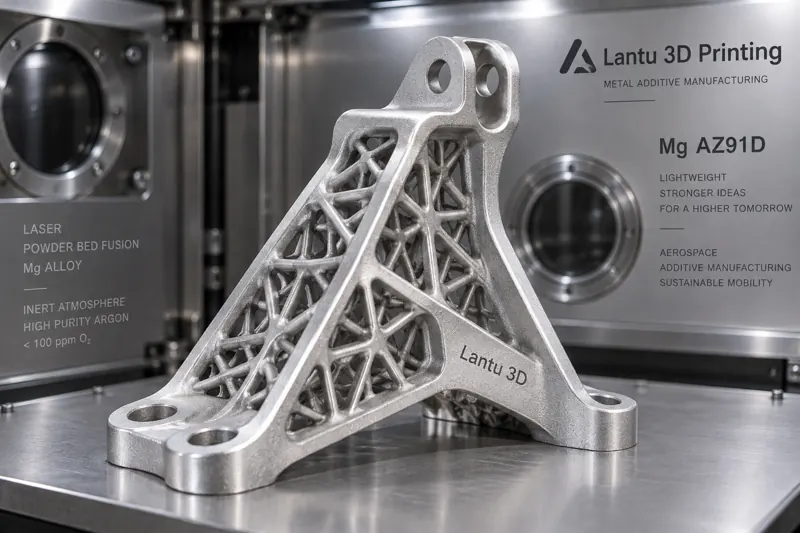
Introduction: Why Magnesium Alloy Additive Manufacturing Deserves Attention
Magnesium alloys are the lowest-density structural materials among engineering metals (1.74–1.83 g/cm³), with specific strength approaching that of titanium alloys. They have clear demand in aerospace brackets, new energy vehicles, and biodegradable medical implants. However, magnesium is highly chemically active. In conventional casting, it is prone to oxidation and combustion, and finished parts often exhibit porous microstructures. Laser powder bed fusion (LPBF/SLM) forms parts layer by layer through high energy density and rapid melting/solidification, enabling topologically optimized lightweight magnesium alloy structures that are difficult or impossible to produce with conventional processes—provided that two major challenges are solved: powder oxidation and a narrow processing window.
1. Application Value and Core Challenges
Taking alloys such as AZ91D, WE43, and ZK60 as examples, additively manufactured magnesium alloy parts can achieve 30%–50% weight reduction while retaining sufficient stiffness. The real bottlenecks for mass production are twofold. First, magnesium powder oxidizes more readily than aluminum or titanium powder; increased oxygen content directly degrades density and corrosion resistance. Second, magnesium has a low boiling point (about 1090°C) and high vapor pressure, making it highly susceptible to spatter and combustion under laser irradiation. Its processing window is therefore narrower than that of titanium alloys. This means equipment, atmosphere, and parameters must be designed as an integrated system rather than by simply applying generic metal powder processes.
2. Powder Oxidation and Protective Atmosphere Control
Oxidation of magnesium powder in air begins as early as the powder production stage. Inert gas atomization under argon protection is recommended, with oxygen content controlled below 800 ppm and the oxygen increase during the printing cycle limited to within 200 ppm. Oxygen concentration in the build chamber should be maintained below 100 ppm, ideally 50 ppm, with a dew point below −40°C. Powder feeding and recycled powder should undergo sieving and vacuum drying to prevent moisture-induced boiling in the laser melt pool. In practice, reducing chamber oxygen concentration from 500 ppm to 50 ppm can increase the relative density of AZ91D from about 96% to more than 99%.
3. Processing Window and Density Optimization
Magnesium alloys have high thermal conductivity and rapid heat dissipation, requiring higher volumetric energy density than titanium powder of the same particle size. For 30–45 μm powder with a 30 μm layer thickness, the volumetric energy density can be set to 90–140 J/mm³, with laser power of 150–250 W, scanning speed of 600–1000 mm/s, hatch spacing of 0.08–0.12 mm, and chessboard or stripe scanning combined with a 60°–67° interlayer rotation to reduce heat accumulation. Excessive energy density can cause magnesium vapor jetting and porosity, while insufficient energy leads to lack of fusion. Through closed-loop calibration using melt pool morphology and X-ray CT, porosity can be stably controlled below 0.5%.
4. Flame-Retardant Processing and Defect Suppression
To address spatter and combustion risks, three categories of mitigation methods can be used: adding small amounts of active/inert mixed gases to the shielding atmosphere, such as fluorine-containing gas or trace SF6 in argon, to passivate the melt pool surface; using short-pulse, low-duty-cycle laser modulation to reduce local heat input; and reducing line energy in thin-wall and overhanging regions while applying island-type supports. If balling occurs, priority should be given to increasing scanning speed or reducing power and tightening overlap rate, rather than blindly increasing laser power. For post-processing, hot isostatic pressing (HIP, approximately 400–450°C and 100–150 MPa) is recommended to further eliminate micropores and stabilize dimensions.
5. Typical Application Scenarios
Current mature applications are concentrated in three areas: lightweight aerospace brackets and satellite structural components, powertrain and chassis lightweight parts for new energy vehicles, and biodegradable bone implants made from rare-earth magnesium alloys such as WE43. In medical applications, attention must be paid to matching the magnesium ion release rate with mechanical performance. Surface modification, such as micro-arc oxidation or coatings, is usually required to regulate the degradation cycle.
Conclusion
The essence of LPBF additive manufacturing for magnesium alloys is to turn a highly reactive metal into a controllable structural material through an ultra-clean atmosphere, a precise energy window, and flame-retardant processing. For engineering teams, the most reliable path toward small-batch production is to first establish online oxygen/dew-point monitoring and powder recycling management, then build a closed parameter loop around density and porosity.
Submit a model, drawing, image or written notes. Engineers will review material, process, finishing and delivery based on actual use.