
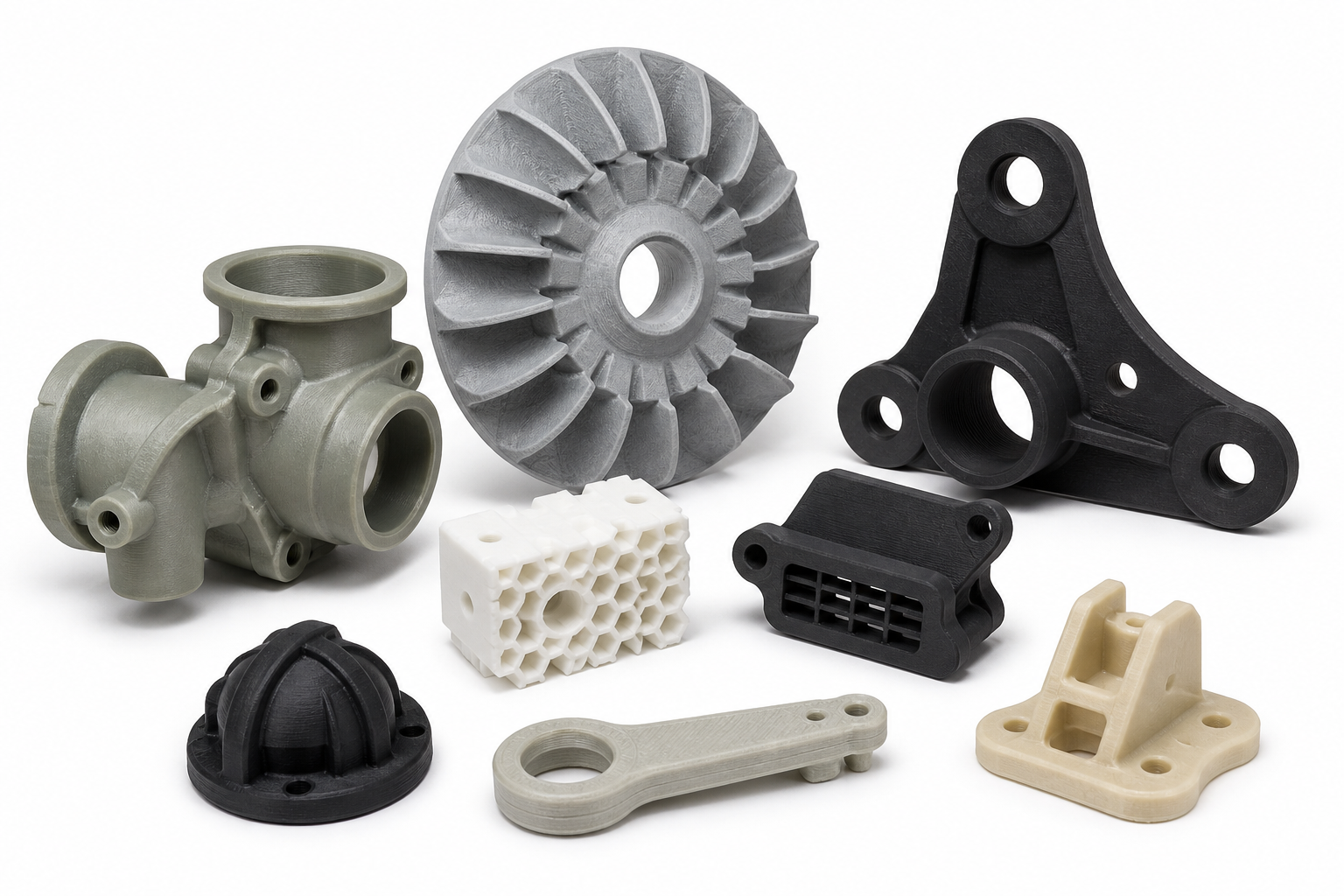
The unique advantages of the lattice structure
The lattice structure is a porous structure composed of regularly arranged rod units or surface units, and is widely used in nature and engineering technology. Compared with traditional solid structures, lattice structures have unique advantages such as high specific strength, high specific stiffness, strong energy absorption capacity, and high heat exchange efficiency. The maturity of 3D printing technology makes it possible to manufacture complex lattice structures, opening up a new space for lightweight design. The lightweight demand in the aerospace field drives the rapid development of lattice structure research and application. On the premise of meeting the load-bearing requirements, 20%-50% weight reduction can be achieved by replacing solid materials with lattice filling while maintaining the mechanical properties of the structure.
Principle of topology optimization algorithm
Topology optimization is a mathematical optimization method that automatically finds the optimal material distribution scheme under a given design domain, load conditions and constraints. Commonly used topology optimization algorithms include density method, level set method, evolutionary structure optimization method, etc. The density method discretizes the design domain into finite units, assigns density variables to each unit, and adjusts the density distribution through an optimization algorithm. Materials are retained in areas where the density approaches 1, and materials are removed in areas where the density approaches 0. The level set method tracks structural boundary changes through the interface motion equation to achieve simultaneous optimization of shape and topology. The evolutionary structure optimization method determines whether materials should be retained based on stress or strain energy density, and gradually removes inefficient materials. These algorithms can be combined with lattice structure design to achieve efficient and lightweight design.
Lattice types and selection strategies
Lattice structures can be divided into three categories according to unit shapes: beam lattice, plate lattice and shell lattice. The beam lattice is composed of rod units, with simple structure and flexible design. Common types include Kelvin lattice, diamond lattice, eight-position truss, etc. Plate lattices are composed of area elements, which are stronger and stiffer, but also more complex to design. The shell lattice is composed of curved shell elements and has excellent load-bearing properties and energy absorption capabilities. Choosing a lattice type requires comprehensive consideration of load-bearing requirements, manufacturing processes, and cost factors. Beam lattice is suitable for most 3D printing processes, plate lattice requires higher manufacturing accuracy, and shell lattice requires support structure to assist manufacturing. Lattice unit size is usually in the range of 2-10mm, determined based on part size and load-bearing requirements.
Performance analysis and verification
The performance analysis of the lattice structure is carried out using the finite element method. The homogenization method equates the crystal lattice to a continuous medium material, calculates the equivalent elastic modulus and strength, and is suitable for macrostructure analysis. The direct modeling method establishes a detailed finite element model of the lattice, which can accurately analyze local stress distribution and failure modes. Experimental verification is a necessary step to ensure design reliability. Tension, compression, and bending tests on standard specimens obtain mechanical property data of lattice materials. Fatigue performance testing evaluates the durability of lattice structures. Impact tests verify energy absorption capabilities. Compare data and analyze the differences between simulation predictions and actual measurement results, and correct the material model and design parameters.
Manufacturing process and quality control
The 3D printing manufacturing of lattice structures has high requirements on process parameters. Laser power and scanning speed need to be precisely controlled to ensure the dimensional accuracy and surface quality of the rod unit or surface unit. Support structure design is a key link. Complex lattice structures may require internal supports, but support removal is difficult and affects surface quality. The self-supporting angle needs to be considered during design to reduce or avoid the need for internal support. Thermal deformation control is very important. The lattice structure has a large surface area and fast heat dissipation, but it is also prone to warping due to temperature gradients. Material selection affects the lattice performance. Metal materials such as titanium alloy and aluminum alloy are suitable for load-bearing structures, while polymer materials such as nylon are suitable for general structural parts. Post-processing includes support removal, surface polishing, heat treatment and other processes.
Submit a model, drawing, image or written notes. Engineers will review material, process, finishing and delivery based on actual use.