
Introduction: The Practical Challenges of Forming Large Metal Components
When part dimensions exceed the build chamber of powder bed systems (typically on the order of 250×250×300 mm), or when a single part’s weight, density, and mechanical property requirements are difficult for powder bed processes to balance, additive manufacturing needs another route. Components such as aerospace engine casings, marine crankshafts, large mold inserts, and valve bodies for energy equipment often require meter-scale dimensions or net formed weights of tens of kilograms, which traditional SLM can hardly complete in one build. Directed energy deposition (DED) and wire arc additive manufacturing (WAAM) were created precisely for such large-size, high-deposition-rate, repairable scenarios, complementing rather than replacing powder bed processes.
1. What Are Directed Energy Deposition and WAAM?
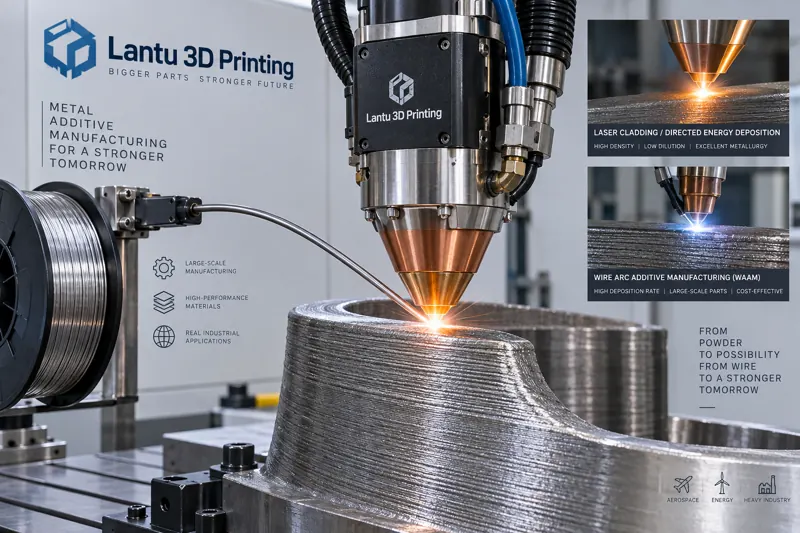
Directed Energy Deposition (DED) is a general category of processes in which a focused heat source is used while metal powder or wire is fed simultaneously, cladding and building up material layer by layer on the substrate surface. Among them, laser cladding uses a laser as the heat source with powder or wire feed, offering a fine spot size and low dilution rate; electron beam freeform fabrication (EBF) is used in vacuum environments; while WAAM (Wire Arc Additive Manufacturing) uses an electric arc as the heat source and welding wire as the material, achieving deposition rates of several kilograms per hour. All three belong to the principle of “synchronous material feeding and layer-by-layer buildup,” differing in heat source, material form, and the trade-off between precision and cost.
2. Process Principles: Two Routes, Powder-Based and Wire-Based
Powder-based DED uses carrier gas to precisely deliver metal powder into the melt pool, with powder utilization of approximately 40%–60%, making it suitable for complex gradients and precise forming. Wire-based processes (including WAAM) can achieve material utilization of 85%–95%, with low cost and high efficiency, but they have greater surface roughness and require more post-processing. As the heat source scans, the melt pool rapidly solidifies on the substrate, and the metallurgical bonding strength between layers depends on heat input and overlap ratio. Controlling layer thickness (commonly 0.5–2.0 mm), scanning speed (300–1200 mm/min), and feed rate is the foundation for stable forming.
3. Core Process Parameters and Quality Window
The key parameters that determine DED/WAAM quality include deposition rate, dilution rate, heat input (kJ/mm), interlayer temperature, and overlap ratio. Excessive dilution will dilute the composition of the cladding layer and reduce corrosion resistance; insufficient dilution will result in poor bonding. For reactive metals such as titanium alloys and nickel-based superalloys, inert gas shielding (argon, with a dew point below -40°C) or a local gas curtain is required to prevent oxidation and nitridation. Anisotropy is an inherent characteristic of this class of processes—the differences in strength and elongation between the build direction (Z) and the horizontal direction can reach 15%–30%, requiring compensation through part orientation and subsequent heat treatment.
4. Typical Application Scenarios
The first is repair and remanufacturing: cladding the worn local areas of expensive rotors, blades, and molds with matching material to restore dimensions and performance, with material costs only a fraction of those for a new part. The second is gradient materials: continuously transitioning compositions within the same component, such as from nickel-based to cobalt-based alloys, to achieve functional gradients. The third is large near-net-shape forming: using WAAM to rapidly build meter-scale blanks and then finishing them with CNC machining, significantly reducing forging and material removal. These scenarios share the characteristics of “large size, small batch, and high value,” which is exactly the engineering range covered by lantu3D’s capabilities from design to physical delivery.
5. Complementarity with Powder Bed Processes and Post-Processing
The precision (IT10–IT12 grade) and surface quality (Ra from more than ten to several dozen micrometers) of DED/WAAM are lower than those of SLM, so they are often combined with subtractive machining to form hybrid additive-subtractive manufacturing: first use DED for near-net forming, then CNC finish-machine the critical surfaces. Key post-processing steps include stress-relief annealing to reduce residual stresses between layers, hot isostatic pressing (HIP) when necessary to eliminate internal porosity, and ultrasonic or industrial CT sampling inspection. For reactive metal components, fluorescent penetrant testing or radiographic testing should also be performed to confirm the absence of lack-of-fusion defects. Only by integrating process selection, post-processing, and inspection into the same delivery chain can large components be assured for release.
Conclusion
Large-format metal additive manufacturing is not a replacement for powder bed technology, but an extension of its capabilities. Laser cladding and WAAM, with their high deposition rates, repairability, and gradient forming capability, fill the gaps left by SLM in large-size and high-value repair scenarios. Which route to choose depends on the balance among size, material, precision, and cost. Only by understanding dilution rate, heat input, and anisotropy can large components not only be “built successfully,” but also “used with confidence.”
Submit a model, drawing, image or written notes. Engineers will review material, process, finishing and delivery based on actual use.