The Core Value of Integrated Design
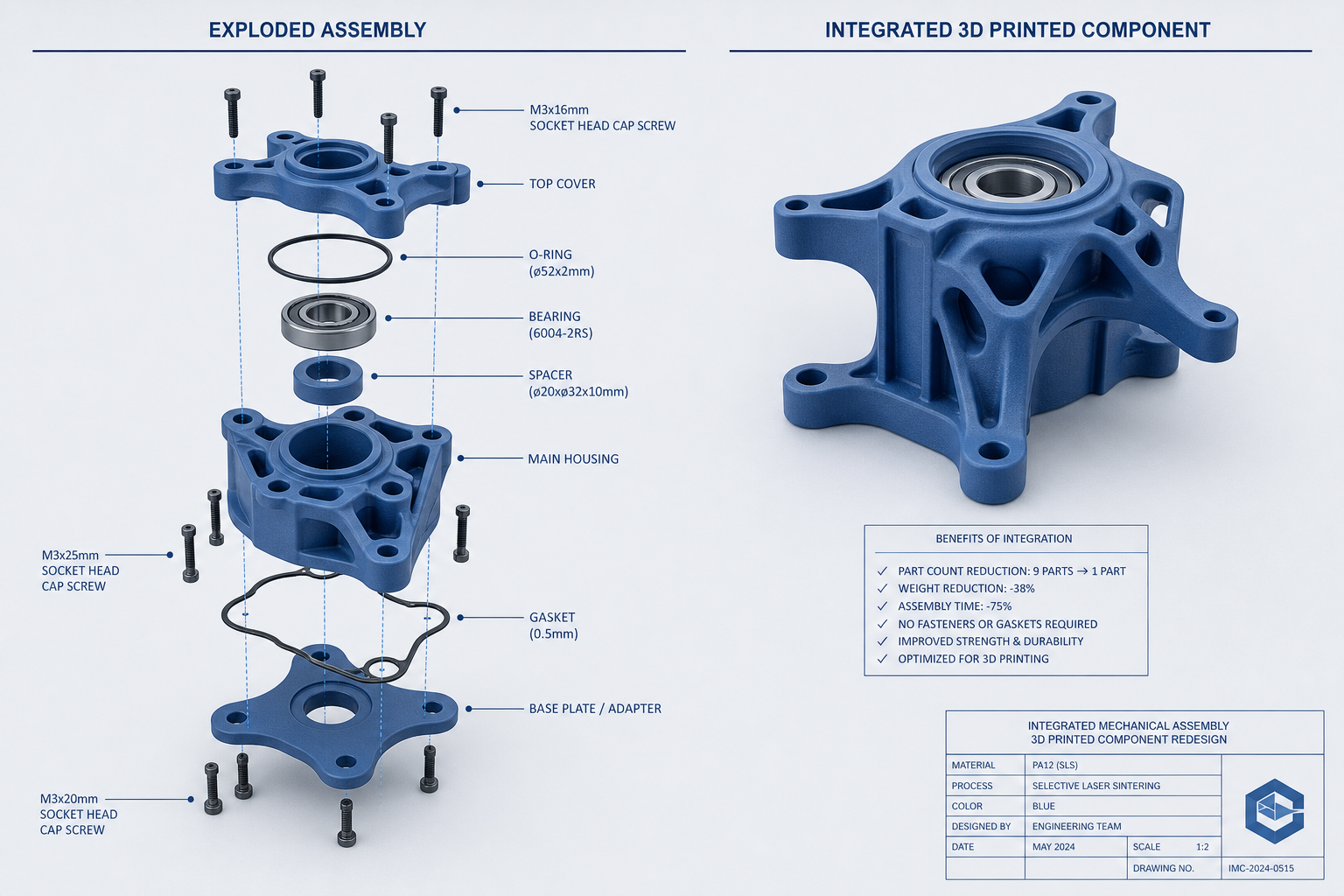
One of the most unique advantages of 3D printing is its ability to produce complex geometries that traditional manufacturing processes cannot achieve, creating unprecedented possibilities for part integration design. By combining multiple conventional manufacturing parts into a single printed component, companies can significantly reduce assembly complexity, decrease failure points, improve system reliability, and shorten supply chains and delivery cycles. In traditional manufacturing, due to process limitations, complex products must be broken down into multiple manufacturable parts and then assembled with fasteners, welding, or bonding. Each connection point is a potential source of failure, as well as an additional manufacturing and quality control cost. Integrated design fundamentally improves product reliability and performance consistency by eliminating these connection points.
Design Methodology for Part Consolidation
When implementing part consolidation, designers need to follow a systematic methodology. First, perform a functional decomposition analysis to identify which parts can be consolidated while maintaining functional integrity. Typical candidates for consolidation include moving parts with fixed relative positions, multiple ribs that carry the same load, and multiple shell parts that form enclosed flow channels. Consolidated designs must also account for manufacturability constraints. For example, the consolidated part must still be removable from the build platform, internal cavities must allow support material to be removed, and the size of the consolidated part cannot exceed the printer's build volume. Designers should find a balance between the benefits of consolidation and manufacturing feasibility.
Integrated Design of Moving Mechanisms
3D printing makes the integrated design of moving mechanisms possible, with the most typical examples being integral hinges, snap-fit joints, and articulated joints. These structures traditionally require multiple parts to be assembled, but in 3D printing they can be directly printed as movable monolithic structures. Key design parameters include hinge clearance, the elastic deformation range of snap-fits, and the preload control of articulated joints. When designing integrated motion mechanisms, print orientation is crucial. For hinge structures, the hinge axis is usually oriented perpendicular to the printing direction to achieve the best interlayer bonding and surface quality. Adding appropriate fillets and transition surfaces can effectively reduce stress concentration and improve the fatigue life of snap-fit features.
Integrated Optimization of Flow Channels and Cooling Systems
3D printing has a unique advantage in manufacturing complex internal flow channels, which makes integrated design of fluid systems possible. In traditional manufacturing, complex flow channels are usually realized by machining separate parts and then assembling them, which leads to sealing difficulties and high flow resistance. 3D printing can produce smooth flow channels of arbitrary shapes, optimizing fluid dynamics performance. When designing integrated flow channel systems, the following principles should be followed: the cross-section of the channel should preferably be circular or teardrop-shaped to reduce flow resistance; the roughness of the inner wall affects fluid performance and should be controlled through appropriate printing parameters and post-processing; and support structures inside the channels must be completely removable, with drainage and vent holes designed when necessary.
Integrated Manufacturing of Electronics and Structures
Integrating electronic components into 3D printed structures is a frontier direction in integrated design. By embedding wires, circuits, and sensors during the printing process, intelligent structures with sensing and response capabilities can be manufactured. Key technologies for achieving electronic-structural integration include printing conductive materials, encapsulation design for embedded electronic components, and electromagnetic compatibility design for signal transmission paths. During the design stage, space for installing electronic components and wire channels must be reserved, while heat dissipation and protection requirements are also considered. For electronic components that need to be installed afterward, guide structures and snap-fit fixtures should be designed to reduce the complexity of subsequent assembly.
Economic Analysis of Integrated Design
Although integrated design can bring many technical and performance advantages, its economics must be carefully evaluated. Integrated parts usually take longer to print, consume more material, and may have a higher unit cost than traditional separately manufactured parts. Economic analysis should comprehensively consider part cost, assembly cost, quality inspection cost, inventory management cost, and after-sales costs reduced by improved reliability. For small-batch or customized production, the economic advantages of integrated design are more obvious because traditional separate-part manufacturing requires individual molds or programming for each part, whereas the digital nature of 3D printing eliminates additional mold costs for integrated parts. For mass production, it is necessary to evaluate whether integrated design can create sufficient added value through performance improvements.
Submit a model, drawing, image or written notes. Engineers will review material, process, finishing and delivery based on actual use.