
Introduction: The Overlooked “Gas Bill”
In the cost structure of a metal laser powder bed fusion (LPBF) shop, electricity, powder, and equipment depreciation are typically accounted for item by item. Inert gas consumption, however, is often bundled into manufacturing overhead under the label of “auxiliary material.” On a mid-size four-laser LPBF machine, shielding-gas flow during continuous printing is typically 20–40 L/min, while instantaneous flow during purging can reach 100–200 L/min. Assuming a 30-hour build cycle and an average flow rate of 30 L/min, continuous gas flow alone consumes approximately 54 m³ per build. Including purging, powder handling, sieving, and glovebox gas replenishment, total gas consumption per build commonly falls in the range of 80–150 m³. Based on delivered liquid-argon vaporization costs of RMB 8–15/m³, gas costs per build can reach RMB 1,000–2,200—already comparable with the amount required to replenish one build’s metal powder. Yet in most quotations, gas is either averaged into the equipment hourly rate or omitted entirely. As production volumes grow from single-digit quantities to hundreds of parts, gas consumption shifts from a “negligible auxiliary item” to an independent cost category that can be measured, optimized, and priced.
1. Breaking Down Consumption: Distinguish Useful Gas from Lost Gas
Effective control begins by dividing total consumption into four attributable components. Build shielding gas: the continuous flow required to keep oxygen concentration in the build chamber below the specified threshold, directly related to chamber volume, sealing performance, and target oxygen level; purge and displacement gas: the gas required to displace oxygen-containing air in the chamber to the target level before and after chamber opening, typically estimated by the number of volume exchanges, generally 3–5 times the chamber volume; powder-handling gas: gas consumed in sieving, drying, transfer, and glovebox replenishment, which is easily omitted from records; and unplanned losses: pipeline leaks, minor seepage at fittings, internal valve leakage, and accidental venting. The last two categories are the ones most readily reduced through engineering measures, especially the fourth. Field experience shows that untested gas piping can account for 10%–25% of total consumption in unplanned losses. Therefore, simply dividing the main meter reading by output to obtain per-part gas use produces an average that conceals the underlying structure. Optimization has a target only after consumption is measured by category.
2. Purity and Oxygen Content: Higher Is Not Always Better—Clear Criteria Are Required
Inert-gas quality indicators include purity (such as 99.999%), oxygen content at the ppm level, moisture content expressed as dew point—typically ≤ −40 °C or even −60 °C—and particulate contamination. Many shops simply purchase the highest available grade, but the appropriate engineering approach is to define acceptance criteria according to material sensitivity. Ti6Al4V titanium alloy is highly sensitive to oxygen and nitrogen interstitial solid solution; chamber oxygen concentration generally needs to be controlled below 1,000 ppm (0.1%), while some aerospace parts require 500 ppm or lower. Aluminum alloys are likewise oxygen-sensitive, although hydrogen porosity and oxide films are often the more significant concerns. 316L stainless steel has relatively broader tolerance, and acceptable density can generally still be achieved within an oxygen range of 2,000–5,000 ppm. Moisture is equally critical: water vapor decomposes in the high-temperature melt pool and releases hydrogen, a direct source of hydrogen porosity. Powder moisture content and gas dew point must therefore be controlled together.
At the implementation level, three hard criteria are needed. First, incoming acceptance criteria: every batch of cylinders or bulk tanker deliveries should include purity and dew-point certificates, and failed spot checks should result in rejection. Second, in-chamber process criteria: oxygen sensor readings must be included in process records, with defined thresholds for stopping the process when limits are exceeded and specified response times. Third, traceability criteria: oxygen sensors themselves must be calibrated regularly with certified reference gas; otherwise, a displayed reading of 800 ppm may actually be 1,800 ppm. Higher purity is not necessarily more economical, but the criteria must be verifiable and traceable.
3. Piping and Sealing: Turn Leakage into a Quantifiable Number
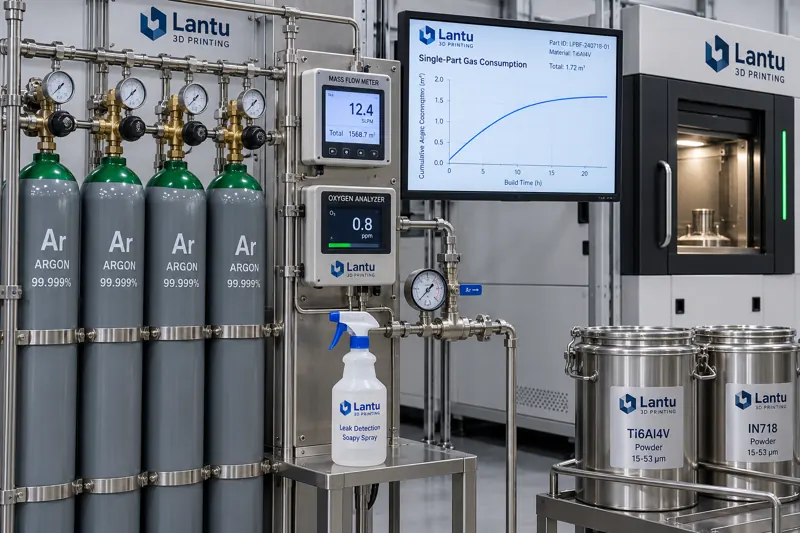
Nearly all gas-system losses occur at interfaces and dynamic seals: compression fittings, hoses, solenoid valves, filter regulators, chamber-door seals, and glovebox transfer chambers. Leak testing does not require expensive equipment. One practical method is a pressure-hold test: close downstream points of use, pressurize the line to 1.1 times its operating pressure without exceeding the rated pressure of any component, record the pressure drop over 30 minutes, and convert it into a leakage rate. For hose sections, apply leak-detection foam point by point. A more engineering-oriented approach is to install flowmeters and pressure logging and establish a “standby baseline flow.” When the machine is not printing and no powder is being processed, theoretical flow should be close to zero. If baseline flow continuously exceeds the threshold, leakage is present.
Seal replacement should also be included in a scheduled maintenance plan rather than performed only after failure. Chamber-door seals are typical wear components; once compression set occurs, they can continuously seep gas. Mandatory replacement based on operating hours, such as every 2,000 hours, or measured seal-compression values is recommended. One often-overlooked detail is that frequent chamber opening consumes more gas than long continuous builds, because each opening requires another purge cycle. Therefore, consolidating orders using the same material and similar build height into the same build is itself one of the most effective gas-saving measures and requires no equipment investment.
4. Per-Part Gas Consumption Accounting and Recovery Options
To turn gas into a controllable cost, establish the metric of “gas consumption per part (m³/part).” A recommended standardized calculation is: gas consumption per part = (total gas consumption during the period − non-production gas use) ÷ number of conforming delivered parts during the period. The denominator should be conforming parts rather than printed parts in order to reflect the real cost of rework and scrap. For the same machine, stratified analysis by material, build packing density, and build height often reveals that builds with low packing density have per-part gas consumption several times higher. This directly supports scheduling rules aimed at maximizing build utilization.
Recovery and reuse are the second step. LPBF exhaust gas is essentially inert gas containing small amounts of dust and trace oxygen and moisture; after dust removal, deoxidation, and drying, it can theoretically be recirculated. However, the limitations must be assessed honestly: the investment, energy consumption, and maintenance costs of a recovery system must be evaluated against gas-cost savings to determine payback time. For aerospace titanium components with extremely stringent oxygen requirements, most companies still choose once-through gas use with fresh gas to ensure consistency. A more practical intermediate approach is tiered gas utilization: use high-purity fresh gas in the build chamber, while using recovered or lower-grade gas for powder handling, sieving, and gloveboxes. This reduces overall consumption while protecting quality in critical processes.
5. Implementation Checklist and Common Misconceptions
An immediately actionable checklist includes: install gas flowmeters and totalizers on each machine to enable consumption measurement by category; establish standby baseline-flow thresholds and monthly leak-test records; define and document incoming acceptance and in-chamber process criteria for oxygen content and dew point; incorporate seal replacement into preventive-maintenance schedules; calculate per-part gas consumption by material and build packing density and include it in quotation costing sheets; and prioritize combining builds of the same material to reduce chamber-opening frequency. There are three common misconceptions. First, monitoring only the main meter without itemized measurement allows leaks to remain invisible over the long term. Second, treating gas purity grade as quality insurance overlooks sensor calibration, which is the real risk point. Third, broadly allocating gas cost into an hourly rate makes quotations insensitive to volume changes. Per-part gas consumption is inherently different for low-volume and high-volume production, and averaged pricing can quietly lose money on high-volume orders.
Conclusion
Inert gas is not merely an “auxiliary material”; it is a measurable, attributable, and optimizable production input in metal additive manufacturing. Break consumption into shielding gas, purging gas, powder-handling gas, and unplanned losses; use three criteria for purity and oxygen content to define quality boundaries; quantify leaks through pressure-hold testing and standby baseline flow; and connect the results to scheduling and quotations through per-part gas consumption. Once this chain is established, gas changes from an opaque bill into a set of manageable engineering parameters. For on-demand manufacturing dominated by low-volume, high-mix production, this level of cost granularity is an essential step in progressing from simply being able to print to delivering consistently and with accountable economics.
Submit a model, drawing, image or written notes. Engineers will review material, process, finishing and delivery based on actual use.