Diverse needs for end effectors
The end effector of industrial robots is a key component in direct contact between the robot system and the workpiece, and its performance directly affects production efficiency and product quality. The production scenarios of different industries and products have huge differences in the form and function requirements of end effectors. Automobile manufacturing requires large-scale gripping fixtures, electronic assembly requires precision suction cups or micro-grippers, food packaging requires flexible grippers that meet hygienic standards, and pharmaceutical production requires sterile-grade special tools. Traditional processing methods have long production cycles and high costs, making it difficult to meet the rapidly changing market demand. The introduction of 3D printing technology has completely changed this situation. Companies can obtain customized end effectors within 3-5 days, and the response speed has increased by more than 80%.
Core elements of customized design
The customized design of the end effector requires comprehensive consideration of many factors. The first is functional adaptation. The gripping method is designed according to the shape, size, weight, material and other characteristics of the workpiece to ensure stable and reliable clamping. Secondly, there are accuracy requirements. Positioning accuracy and repeatability directly affect product quality, so appropriate printing processes and materials need to be selected. The third is durability performance. The end effector needs to withstand tens of thousands or even hundreds of thousands of cycles. Material selection and structural design must meet the life requirements. The fourth is the convenience of integration. The end effector needs to be connected to standard interfaces such as the robot flange, sensor, and gas system, and compatibility needs to be fully considered during design. The fifth is cost control, optimizing design and reducing material and manufacturing costs while meeting performance requirements.
The advantages of 3D printing technology
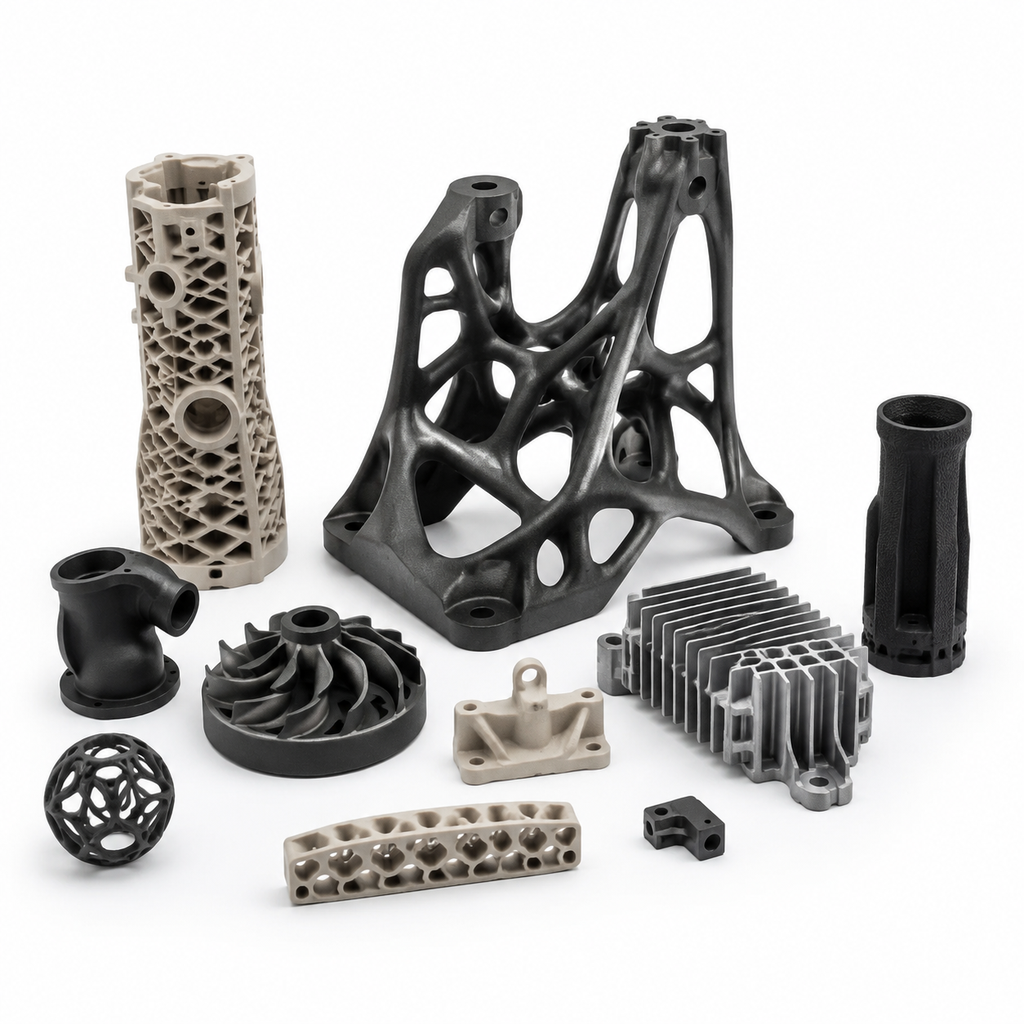
3D printing technology has shown significant advantages in the production of end effectors. The degree of design freedom is high, and complex structures, internal flow channels, and embedded mounting holes that are difficult to achieve with traditional processing can be easily realized, providing a broad space for innovative design. The production cycle is short, it only takes 3-7 days from design completion to delivery, which greatly shortens the equipment debugging cycle. The cost-effectiveness is good. The cost of single-piece small-batch production is much lower than that of traditional mold processing. The advantages of small-batch customized production are particularly prominent. The material selection is rich, and different materials such as high toughness, wear resistance, anti-static, and high temperature resistance can be selected according to functional requirements to meet various application scenarios. With rapid iteration capabilities, design optimization and improvements can be quickly reflected in products, continuously improving end effector performance.
Application cases and effect analysis
An auto parts manufacturer uses 3D printing technology to manufacture robot grippers. The original traditional processing method takes 4 weeks and costs about 8,000 yuan per piece. After using SLS nylon material for 3D printing, the production cycle is shortened to 5 days and the cost is reduced to 2,500 yuan/piece, a decrease of 68%. More importantly, the design team can quickly optimize the gripper structure based on the actual conditions at the production site, improving gripping stability by 15%, shortening the production cycle by 2 seconds, and increasing annual production capacity by more than 10%. An electronics manufacturing company needs to frequently change product models. After using 3D printed customized end effectors, the new product introduction cycle was shortened from the original 6 weeks to 2 weeks, equipment downtime was reduced by 70%, and the production line switching efficiency was greatly improved.
Technological development trends
Customized production of end effectors is developing in an intelligent direction. The parametric design platform allows engineers to quickly generate end-effector design plans based on workpiece characteristics, increasing design efficiency by more than 5 times. Embedded sensor technology integrates force, vision, touch and other sensing capabilities into the end effector to achieve intelligent grasping and operation. The application of new materials continues to expand, 3D printing technology for high-performance engineering plastics, carbon fiber composite materials, and metal materials is becoming increasingly mature, and the performance and service life of end effectors continue to improve. The modular design concept is combined with 3D printing technology to achieve rapid combination and flexible configuration of end effectors to meet the needs of multi-variety and small batch production. In the future, intelligent sensing, adaptive control, and human-machine collaboration will become important directions for the development of end effectors.
Submit a model, drawing, image or written notes. Engineers will review material, process, finishing and delivery based on actual use.