
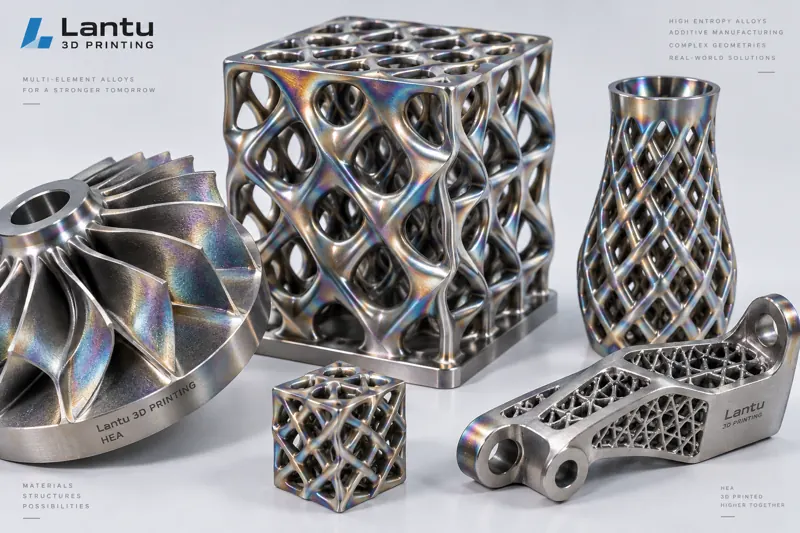
Introduction: Why High-Entropy Alloys Are Well Suited to 3D Printing
Conventional alloys are usually based on one or two principal elements, and further performance improvement is often limited by solid solubility and phase stability. High-entropy alloys (HEAs) consist of five or more principal elements in near-equimolar proportions. Through the high-entropy effect, sluggish diffusion effect, lattice distortion effect, and cocktail effect, they can deliver high strength, high hardness, excellent wear resistance, and corrosion resistance. Some systems also show strong high-temperature performance and potential radiation resistance. In applications such as aerospace hot-end components, tooling, wear-resistant coatings, and nuclear equipment, HEAs are regarded as next-generation structural materials.
However, the multi-principal element nature of HEAs makes them prone to compositional segregation and brittle phase precipitation during solidification. Traditional casting and forging processes often struggle to achieve both material uniformity and geometric freedom. Laser powder bed fusion (LPBF), with its rapid melting and solidification and layer-by-layer build process, can suppress macrosegregation and enable near-net-shape manufacturing of complex geometries. As a result, it has become an important route for producing HEA parts. At the same time, LPBF introduces new engineering challenges, including cracking caused by high thermal gradients, lack-of-fusion pores, and residual stress in the as-built state.
1. Powder Preparation: Composition Uniformity Is the Foundation
For LPBF, part quality begins with the powder. HEA powders are commonly produced by gas atomization (GA) or plasma rotating electrode processing (PREP). Each principal element should be highly uniform within individual particles to avoid dendritic segregation enriched in specific elements in the pre-alloyed powder. In practical engineering, powder oxygen content should generally be controlled below 800 ppm, with even lower limits required for some highly reactive systems. The proportion of satellite particles and hollow powder should also be included in incoming material inspection.
A particle size distribution of 15-45 μm is typically recommended. This range supports stable powder spreading while maintaining efficient energy coupling in the melt pool. For classic equimolar systems such as CoCrFeMnNi, powder sphericity and flowability are key indicators of batch consistency. For refractory high-entropy alloys (RHEAs) containing elements such as W, Mo, Nb, or Ta, greater attention should be paid to brittle powder fracture and spreading defects caused by an overly broad particle size distribution.
2. Laser Energy Density: Defining a Printable Process Window
The core LPBF process variable is volumetric energy density, E = P / (v · h · t), where P is laser power, v is scan speed, h is hatch spacing, and t is layer thickness. For HEAs, the available energy window is often narrower than that of single-metal systems. Insufficient energy leads to lack of fusion and poor interlayer bonding, while excessive energy can cause elemental evaporation, especially for volatile elements such as Mn and Cr, as well as balling and keyhole instability.
For medium- and high-entropy systems represented by CoCrFeMnNi, common process ranges include laser power of 200-370 W, scan speed of 600-1100 mm/s, layer thickness of 30 μm, and hatch spacing of 0.09-0.12 mm. This corresponds to a volumetric energy density of roughly 55-110 J/mm³. For refractory high-entropy alloys, higher melting points and lower thermal conductivity require higher laser power and lower scan speed to compensate for insufficient heat input, but thermal cracking must be carefully controlled.
3. Scan Strategy: Controlling Thermal Stress and Cracking
The hot-cracking sensitivity of HEAs mainly comes from steep thermal gradients and solidification shrinkage under rapid solidification. In engineering practice, island scanning and bidirectional rotational scanning, with each layer rotated by 67° or 90°, are often used to interrupt the heat flow direction and reduce accumulated stress. Scan vector length is also important. Long continuous scan vectors can amplify stress concentration, while island scanning shortens these vectors and can significantly reduce cracking.
Substrate preheating, for example to 80-200°C, is an effective way to suppress cracking. It reduces the temperature difference between the melt pool and the substrate and lowers the cooling rate. For crack-sensitive RHEA systems, substrate preheating combined with relatively low laser line energy is often more effective than simply increasing laser power. In addition, the shielding atmosphere must maintain extremely low oxygen partial pressure, typically using high-purity argon or nitrogen with oxygen content below 100 ppm, to prevent alloy oxidation and gas porosity.
4. Post-Processing: Stress Relief and Microstructure Control
As-built HEA parts usually contain high residual stress and non-uniform dendritic microstructures. A stepped stress-relief annealing process is recommended: first hold at a relatively low temperature, such as 600-700°C, to remove most residual stress, then perform homogenization or solution treatment depending on the target microstructure. For FCC systems such as CoCrFeMnNi, homogenization annealing can further reduce microsegregation and stabilize the single-phase solid solution.
If higher strength is required, cold working and recrystallization may be applied after homogenization, or precipitation-strengthening phases may be introduced. It is important to emphasize that heat treatment must be tailored to the specific alloy composition. The phase stability of HEAs is highly temperature-sensitive, and improper annealing may trigger brittle intermetallic compounds such as σ phase or Laves phase, reducing toughness instead of improving performance.
5. Quality Inspection and Process Closed Loop
HEA components should be controlled through a full-chain inspection system from powder to finished part. Powder batches should be tested for particle size distribution, flowability, and oxygen content. During printing, melt pool temperature and spatter should be monitored. After forming, X-ray CT should be used to detect internal pores and lack-of-fusion defects, while metallography and EBSD can evaluate grain orientation and segregation. Microhardness and tensile testing should be used to verify mechanical properties.
If CT inspection finds porosity above 0.5% or linear defects, the energy density parameters and powder spreading condition should be traced back. DOE experiments can then be used to recalibrate the process window. Feeding inspection data back into the parameter database to form a closed loop of powder, process, microstructure, and performance is essential for moving HEA parts from prototype trials to stable batch production.
Conclusion
LPBF manufacturing of high-entropy alloys is an engineering balance among compositional uniformity, energy window control, thermal stress management, and post-processing. By maintaining strict powder quality, using energy density as a guide to define the process window, suppressing cracks through island scanning and substrate preheating, adjusting microstructure through heat treatment, and building a closed loop with full-process inspection, multi-principal element alloys can move beyond the laboratory and become manufacturable industrial components.
Submit a model, drawing, image or written notes. Engineers will review material, process, finishing and delivery based on actual use.