
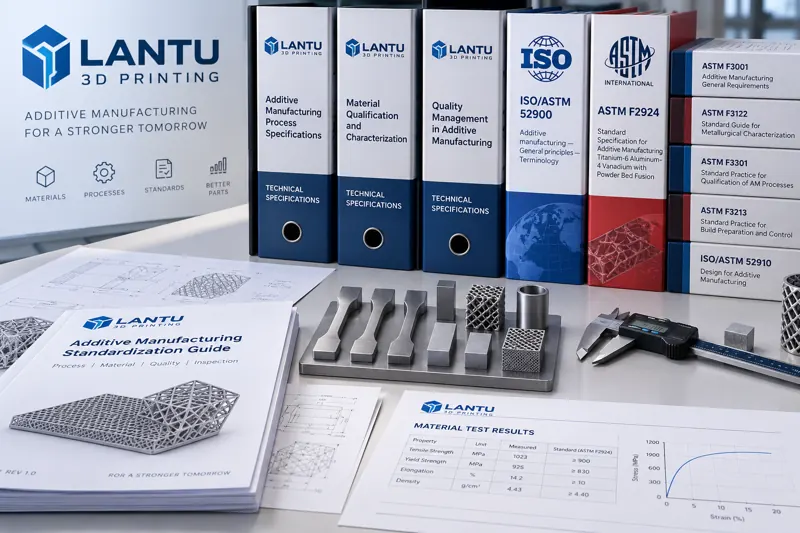
Introduction: Standards Are Not Certificates, but Pricing Power for Technical Influence
Many 3D printing enterprises regard participation in standard development as an honorary plaque to hang on the wall. In reality, every technical provision in a standard will ultimately become an acceptance criterion in procurement documents, a decision threshold in test reports, and a default requirement in customer selection. Whoever writes process parameters into a standard saves explanation costs in market competition for years to come. Group standards (usually numbered with the prefix T/) are the most responsive and broadly participatory level in China’s standard system, and are becoming a practical channel for small and medium-sized 3D printing enterprises to transform internal process specifications into industry influence.
I. The Actual Position of Group Standards in the Standards System
China’s standards system consists of five levels: national standards, industry standards, local standards, group standards, and enterprise standards. Group standards are independently developed by social organizations such as academic societies, associations, and industry alliances for voluntary adoption by the public. Their development cycle is generally 6 to 12 months, much shorter than the 2 to 3 years typically required for national standards. For additive manufacturing processes that iterate on a quarterly basis, this time difference is decisive.
At the international level, corresponding standards include the ISO/ASTM 52900 series, such as ISO/ASTM 52901 for procurement requirements and 52904 for powder bed fusion processes. Domestic group standards often serve to translate international frameworks into executable provisions. Therefore, participating organizations must understand the international terminology system while also being able to provide quantitative indicators aligned with the realities of domestic production lines.
II. Prerequisites for Participation: Data Comes Before Influence
Working groups drafting group standards do not accept opinions; they accept data. Before applying to participate, an enterprise generally needs to have completed data-driven accumulation of its internal process specifications, including at least the following three areas.
1. Traceable records for material batches. Each batch of metal powder must have inspection records for oxygen content, particle size distribution (D10/D50/D90), apparent density, and Hall flow rate; polymer powders should have records for melt flow rate and moisture content.
2. Quantified boundaries of the process window. For laser powder bed fusion (LPBF), the energy-density window formed by laser power, scanning speed, hatch spacing, and powder layer thickness should be supported by orthogonal test or DOE data, with a stable range identified in which density reaches 99.5% or above.
3. Consistency data for post-processing and inspection. This includes heat treatment schedules—the temperature, holding time, and cooling rate for stress-relief annealing—the measured distribution of surface roughness Ra after surface treatment, and CMM measurement reports for critical dimensions.
Without such data, even an enterprise that joins a working group can only serve as a named participant and will be unable to influence the substantive content of technical provisions.
III. From Initiation to Publication: The Actual Workload Across Five Stages
The development process for group standards generally includes five stages: proposal and initiation, drafting, public consultation, technical review, approval and publication, and review. The main contribution from participating organizations is concentrated in the second stage.
The drafting stage usually lasts 3 to 6 months and requires participating organizations to draft specific sections and support validation testing. Validation tests often require the same process specification to be reproduced on equipment at two or more different organizations to demonstrate the general applicability of the provision. This is a cost item many enterprises underestimate: samples and testing for a single cross-organization validation may cost tens of thousands of yuan.
The public consultation stage may generate dozens of comments from downstream users, testing institutions, and peer enterprises. The working group must address each comment and disclose its adoption status. During the technical review stage, standardization experts conduct compliance reviews of text formatting, referenced documents, and terminology consistency.
Publication does not mean the work is complete. A review is generally conducted every 2 to 3 years to determine whether the standard remains valid, should be revised, or should be withdrawn.
IV. How to Draft Technical Provisions That Are More Likely to Be Adopted
Two types of provisions are most likely to be rejected during drafting: unverifiable subjective descriptions and excessively demanding requirements detached from industrial realities. Adoptable provisions generally have three characteristics.
Measurability. Use a specific value, such as tensile strength of no less than a given MPa value, instead of “good mechanical properties”; use a dimensional deviation of no more than ±0.2 mm instead of “high dimensional accuracy.”
Statistical basis. Indicator values should be based on measured data from at least three batches, with no fewer than five specimens per batch, and should specify the sampling direction and test standard, such as GB/T 228.1 for room-temperature tensile testing. Additive manufacturing has anisotropy, so the sampling direction must be clearly defined.
Reasonable margin. Standards are intended for the industry average, not the performance limits of leading enterprises. Directly turning a company’s best data into a threshold will make the standard difficult to promote and may ultimately cause it to be shelved.
V. Coordination Between Standards, Patents, and Testing
Participating enterprises need to pay particular attention to standard-essential patents (SEPs). If a technology written into a standard has already been patented by the enterprise itself or another party, it must be disclosed in accordance with the patent policy of the relevant organization, and licensed either free of charge or under fair, reasonable, and non-discriminatory (FRAND) terms. Concealing patents and causing disputes after implementation of the standard exposes participating organizations to substantial risk.
On the other hand, standard provisions must ultimately be implemented through testing capabilities. While participating in standard development, enterprises often need to build or jointly establish the corresponding testing methods, including mechanical property testing, industrial CT inspection for internal defects, and chemical composition analysis. Standards and testing capabilities support each other; neither can be absent.
VI. Input-Output Assessment for Small and Medium-Sized Enterprises
Objectively speaking, participating in group standard development is not a low-investment undertaking. In addition to direct costs, a key technical employee may contribute more than 200 working hours over 6 to 12 months. Whether to participate should therefore be assessed through three questions: Does the standard’s topic cover a core process in your principal business? Do you already have the data foundation described in Section II? After publication, will your target customers genuinely cite the standard in tendering, bidding, or supplier audits? Only when all three answers are affirmative does the leverage effect of participation become valid.
The practical benefits mainly appear in three areas. First, once technical provisions align with the enterprise’s own process route, competitors must make additional modifications to comply, creating an implicit barrier. Second, being listed as a standard drafting organization can generate quantifiable additional points in tendering and bidding. Third, the participation process itself compels the standardization of internal process documentation, and this byproduct is often more valuable than the certificate itself.
VII. Common Misconceptions
Misconception 1: Treating participation as advertising placement. Organizations that only contribute money without participating in drafting generally appear only in the acknowledgments and have no influence over the provisions.
Misconception 2: Pursuing quantity while ignoring relevance. Participating simultaneously in five or six standards unrelated to the main business disperses technical resources and dilutes the enterprise’s professional image.
Misconception 3: Ignoring standard review and revision. If an enterprise does not continuously track a standard after publication and continues organizing production according to an old version after provisions have been revised, it may instead create compliance risks.
Conclusion
For 3D printing enterprises, participating in group standard development is essentially a systematic project of externalizing internal process specifications. Its threshold lies not in cost, but in the depth of accumulated data; its reward lies not in a plaque, but in the technical influence of needing less explanation and receiving more default recognition over the coming years. For enterprises that have already completed process data accumulation, deeply participating in a group standard that is highly relevant to their core process and genuinely cited by downstream customers is currently a cost-effective way to monetize their capabilities.
Submit a model, drawing, image or written notes. Engineers will review material, process, finishing and delivery based on actual use.