Introduction: If complaints rely only on sales to soothe customers, the problem will recur; if they rely only on technical explanations, the customer experience will suffer
From Complaint to Improvement: A Professionalized Design for Handling 3D Printing Customer Complaints is not a single technical issue, but a systems engineering task spanning customer requirements, model data, process selection, production scheduling and delivery, and after-sales review. For a full-life-cycle management platform such as lantu3D, which covers everything from blueprint/design to physical delivery, the key is not "can it be printed?" but whether uncertain requirements can be turned into a manufacturing process that is planned, traceable, and deliverable. A common misconception in the industry is to focus only on equipment parameters while ignoring order batches, validation checkpoints, quality records, and cross-department information flow, which ultimately leads to rework, delays, or cost overruns. This article focuses on a 3D printing customer complaint handling mechanism and, in the context of small-batch manufacturing, offers an actionable framework.
1. Classify first, then handle
Common sources of 3D printing complaints include deviations in requirement interpretation, model design defects, improper material selection, production quality problems, post-processing defects, and shipping damage. The first step is not to argue over responsibility, but to collect photos, order numbers, model versions, usage scenarios, and customer expectations. Only after classifying the problem can you decide whether to reprint, repair, redesign, switch materials, or explain the usage limitations.
2. Establish response deadlines and an evidence checklist
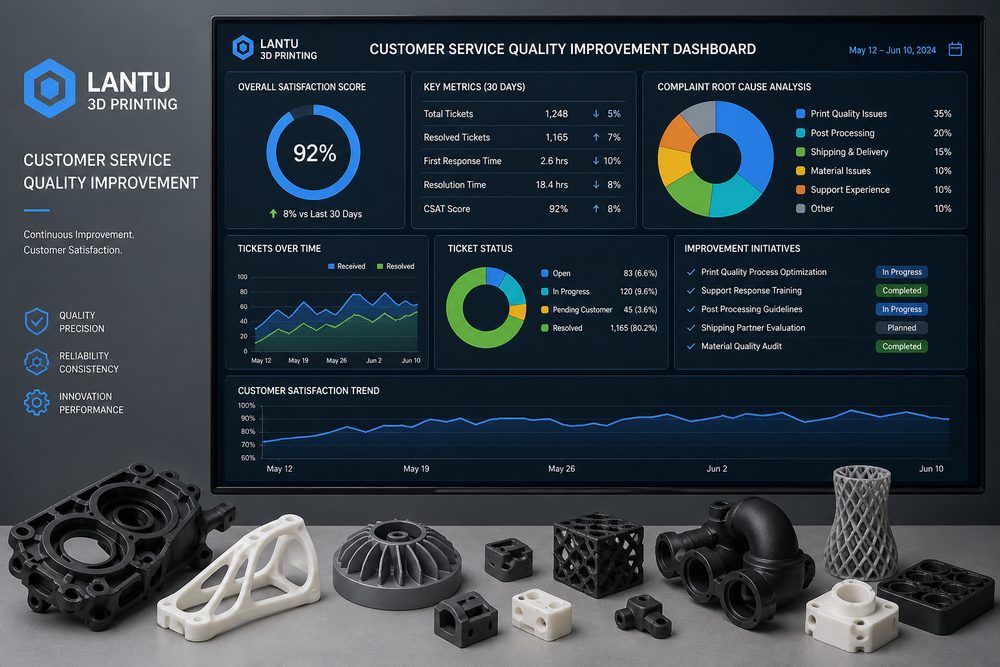
It is recommended to set an initial response within 2 hours, a preliminary determination within 24 hours, and a proposed resolution within 48 hours. The evidence checklist should include pre-delivery photos, inspection records, packaging photos, logistics information, and production parameters. Without an evidence chain, complaint handling easily becomes subjective judgment, which is not conducive to customer trust or internal improvement.
3. Remediation plans must balance cost and relationship
For issues clearly attributable to production or shipping, replacement parts or repairs should be provided quickly; for design boundary issues, modification suggestions and a revalidation plan should be offered; when the customer's use environment exceeds the material's capabilities, the material limitations should be explained and alternative solutions recommended. Professional complaint handling is not simply about compensation, but about helping the customer bring the project back onto the right track.
4. Turn complaints into process assets
Every closed complaint should be entered into a problem database, recording the cause, handling method, and preventive measures. If similar problems recur within a month, it indicates not an isolated case but a need for process rule adjustments. For example, if thin-walled parts break frequently, wall-thickness risk warnings should be added during the quotation and model-checking stages.
Conclusion: Turn experience into repeatable delivery capability
The core of From Complaint to Improvement: A Professionalized Design for Handling 3D Printing Customer Complaints is to condense fragmented experience into standard actions: a clear intake for requirements, evidence-based judgments, documented processes, closed-loop handling of exceptions, and reviewable outcomes. Enterprises are advised to start with one high-frequency product category or one typical customer project, establish the minimum viable process first, and then gradually expand to a material library, process library, quotation rules, and quality traceability system. This is exactly the continuous capability-building that lantu3D focuses on: from design blueprint to physical delivery, making 3D printing not just a prototyping tool, but a reliable node for rapid validation, small-batch production, and on-demand manufacturing.
Submit a model, drawing, image or written notes. Engineers will review material, process, finishing and delivery based on actual use.