Introduction: The Rise of Food-Grade 3D Printing and the Need for Standards
Food-grade 3D printing has emerged rapidly in recent years. From creative desserts in high-end restaurants to customized chocolate and candy, and even the personalized production of medical nutrition meals, 3D printing is bringing unprecedented room for innovation to the food industry. However, regulatory standards in the food industry are among the strictest of any sector because food safety is directly related to consumer health and even life. Food-grade 3D printing must not only meet the quality requirements of traditional 3D printing, but also comply with stringent food safety regulations: materials must be non-toxic and harmless, equipment must be easy to clean and disinfect, the production environment must meet hygiene standards, and the entire process must be traceable. Establishing a comprehensive food-grade quality control system is a necessary condition for entering this high-value market.
Certification and Selection of Food-Grade Materials
Food-grade 3D printing materials must pass food safety certification, which is the most basic requirement. In China, food-contact materials must comply with the GB 4806 series of national standards and obtain food-contact material safety certification. In the European Union, they must comply with Regulation EU 10/2011 and obtain a declaration of compliance for food-contact materials. In the United States, they must comply with FDA 21 CFR requirements and obtain FDA certification for food contact substances (FCS). Common food-grade 3D printing materials include: chocolate (printable directly), sugar powder (printed through binder jetting), edible gels (printed through extrusion), and food-grade PLA (used for packaging or decoration that does not directly contact food). When selecting materials, it is not enough to confirm food-grade certification; usage restrictions must also be understood, such as the maximum operating temperature, whether it can be used with acidic foods, and whether it can be used with alcoholic foods. Establishing a materials compliance file to record each material’s certification documents, usage restrictions, and storage requirements is fundamental work for ensuring compliance.
Hygienic Equipment Design and Cleaning/Disinfection Procedures
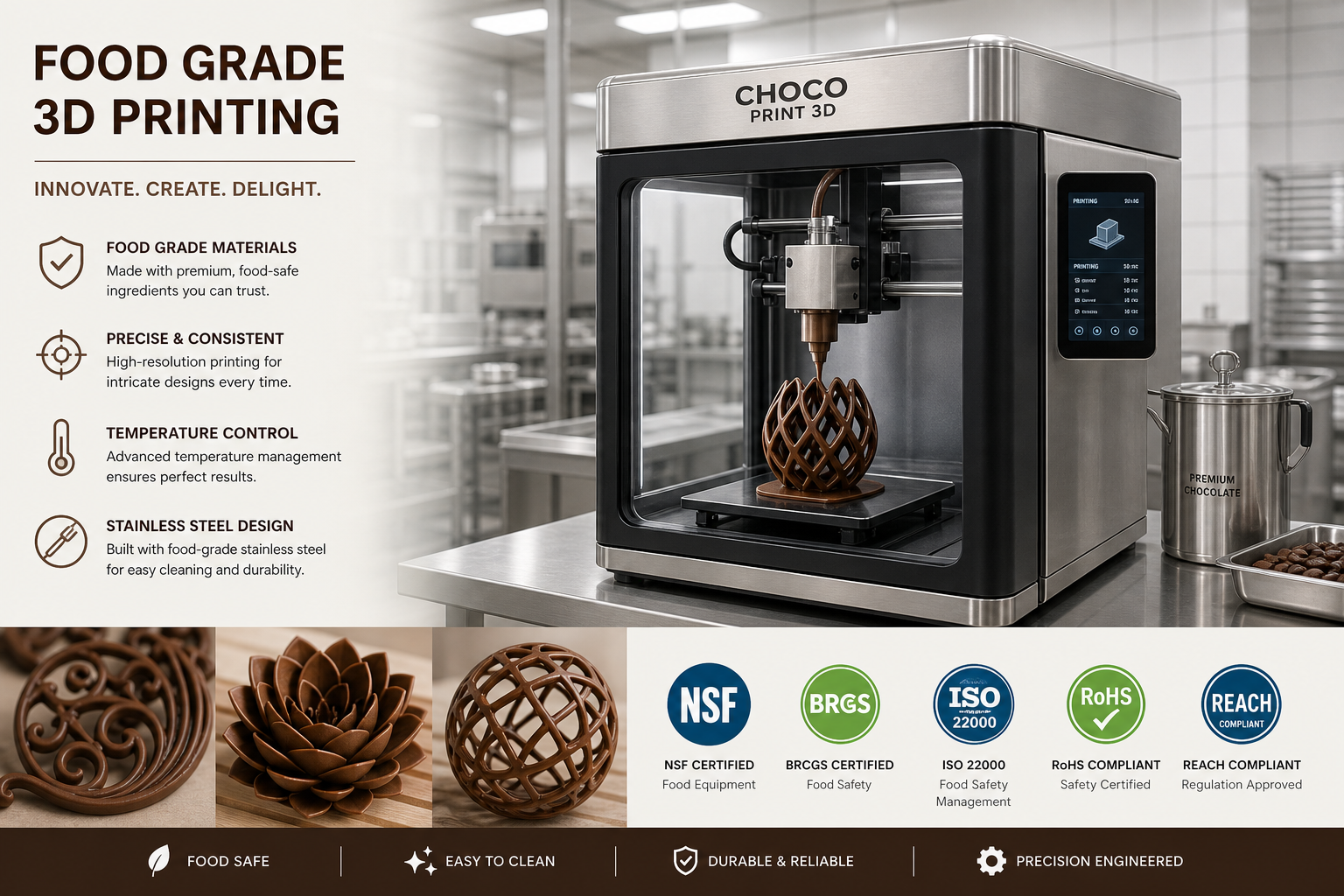
The hygienic design of food-grade 3D printing equipment is a core element of quality control. Surfaces that come into contact with food should be made of food-grade stainless steel (such as 304 or 316 stainless steel), and the surface roughness should be below 0.8 μm to prevent bacterial adhesion and residue. The equipment structure should avoid dead corners, gaps, grooves, and other hard-to-clean areas as much as possible, and all parts that contact food should be easy to disassemble and clean. Cleaning and disinfection procedures should include: initial cleaning after each production batch (to remove residue), deep cleaning at the end of each production day (using food-grade cleaning agents), and weekly disinfection (using food-grade disinfectants). The cleaning and disinfection process should follow standard operating procedures (SOPs) and record information such as cleaning time, type of cleaning agent, and disinfection method. Regular environmental microbiological testing (total colony count, E. coli, Salmonella, etc.) can verify cleaning effectiveness and ensure that the hygienic conditions of the production environment continue to meet standards.
Production Environment Control: Cleanroom Standards
The production environment for food-grade 3D printing should meet cleanroom standards. Depending on the product type, it is usually required to reach ISO Class 8 (Class 100,000) or higher cleanliness. The control elements of a cleanroom include: air cleanliness (controlling particle counts through high-efficiency filters), temperature and humidity control (preventing microbial growth), differential pressure control (maintaining positive pressure to prevent contaminated air from entering), and personnel purification (changing clothes, handwashing, disinfection). Personnel entering the cleanroom must wear cleanroom garments, caps, and shoes, and pass through an air shower to remove dust. Materials enter through transfer windows to avoid direct contact with outside air. Daily monitoring in the cleanroom includes dust particle counts, microbiological sampling, temperature and humidity records, and differential pressure records; all monitoring data should be retained for at least three years for inspection. Production environment control is not only a regulatory requirement but also an important means of ensuring stable product quality.
Allergen Management and Cross-Contamination Prevention
Food allergen management is a special requirement for food-grade 3D printing. Common food allergens include dairy products, eggs, nuts, soy, wheat, seafood, and more. If the printing material contains allergenic ingredients (such as milk chocolate or nut powder), strict cross-contamination prevention measures must be taken: first, allergen-containing materials should be produced on dedicated equipment or during dedicated time slots to avoid mixing with non-allergen materials; second, all equipment, tools, and containers that have come into contact with allergens must be dedicated to that use or thoroughly cleaned before use; third, allergen information must be clearly labeled on product packaging to remind consumers to be cautious; fourth, an allergen traceability system must be established so that once an allergen...
Submit a model, drawing, image or written notes. Engineers will review material, process, finishing and delivery based on actual use.